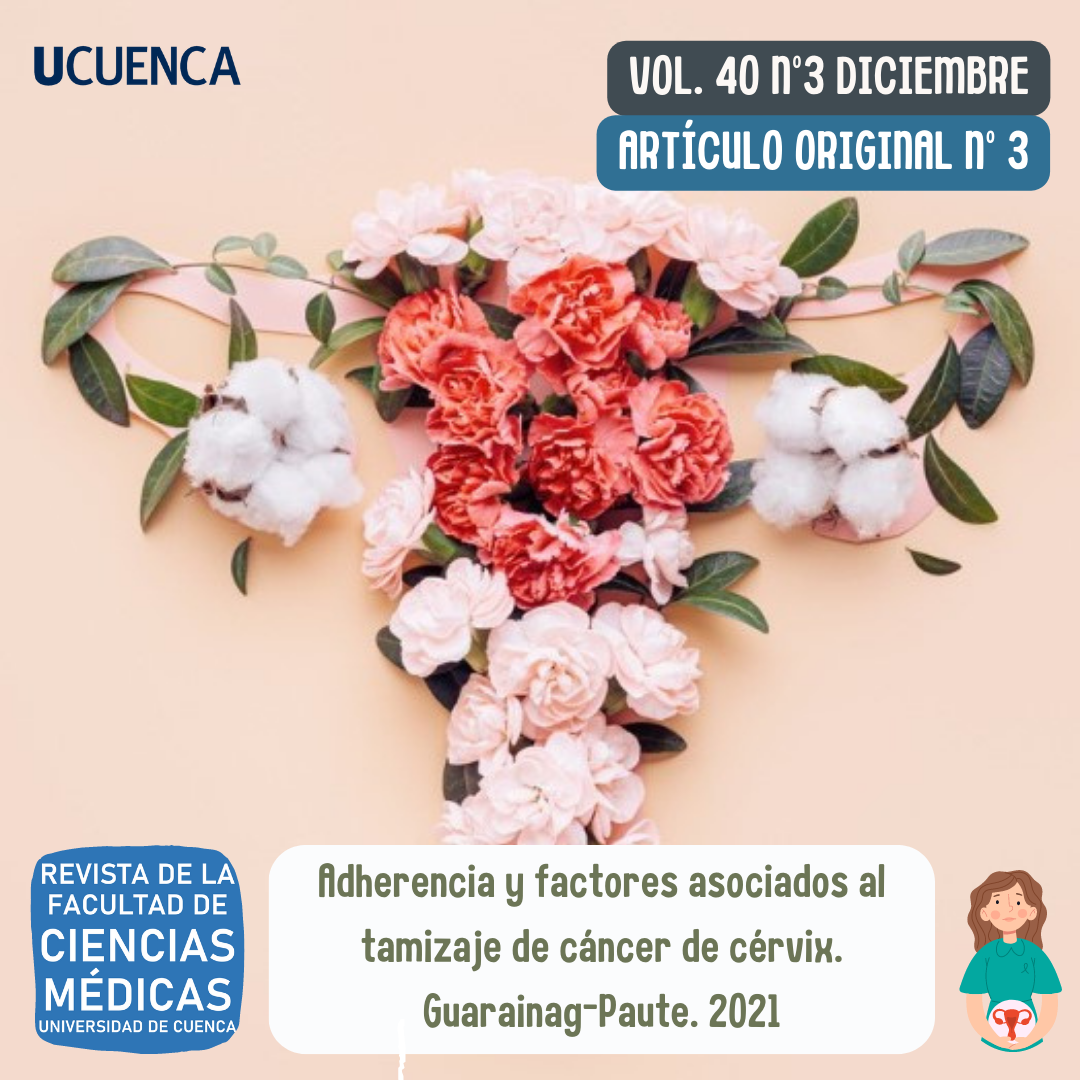
Adherence to cervical cancer screening and associated factors. Guarainag - Paute. 2021
DOI:
https://doi.org/10.18537/RFCM.40.03.04Keywords:
Cervical cancer, PAP smear, screening, adherenceAbstract
Objectives. The goal of this research was to identify adherence and factors associated with cervical cancer screening in women from the Guarainag parish in the canton of Paute. Methods: A descriptive cross-sectional study was carried out, the sample consisted of 208 women and for the selection of the participants, the houses of the parish were randomized by simple lottery. A univariate and bivariate analysis of the factors related to adherence to screening was performed. Results: Of the total of 208 women surveyed, where 15.7% had no schooling, 85.4% had a low level of income, the average age is 49.39 and most were married with a prevalence of 53, 5%; 24.5% had not had a PAP test at any time in their lives. The factors that showed limitations for adherence were: fear (17.3%) (RR 1.828, CI 1.094-3.054); lack of knowledge (35.7%) (RR 2.657, CI 1.613-4.376); lack of access (18.4%) (RR 2.082, CI 1.278-3.390); Factors favoring PAP performance included; adequate knowledge about cervical cancer (53%) (RR 1.262, CI 1.056-1.506) and performing other screenings (48.6%) (RR 21.316, CI 5.327-85.299). Conclusions: There is still a high percentage of women who do not access timely cancer detection. The health programs that improve knowledge, access to health services and those who work with the pacient feelings such as fear, can improve access to screening tests, and help to carry out an in-depth analysis of timely cancer detection measures based on social factors and demographics, to generate appropriate prevention strategies.
Downloads
Published
Issue
Section
License
Copyright (c) 2023 Maria Augusta Torres Ulloa, Daniel Santiago Peñafiel Saavedra, Bernardo José Vega Crespo

This work is licensed under a Creative Commons Attribution-NonCommercial-ShareAlike 4.0 International License.
Copyright © Autors.

You are free to:
 |
Share — copy and redistribute the material in any medium or format |
 |
Adapt — remix, transform, and build upon the material for any purpose, even commercially. |
Under the following conditions:
 |
Attribution — You must give appropriate credit, provide a link to the licence, and indicate if changes were made. You may do so in any reasonable manner, but not in any way that suggests the licenser endorses you or your use. |
| NonCommercial — You may not use the material for commercial purposes. | |
| ShareAlike — If you remix, transform, or build upon the material, you must distribute your contributions under the same license as the original. |
| No additional restrictions — You may not apply legal terms or technological measures that legally restrict others from doing anything the licence permits. |