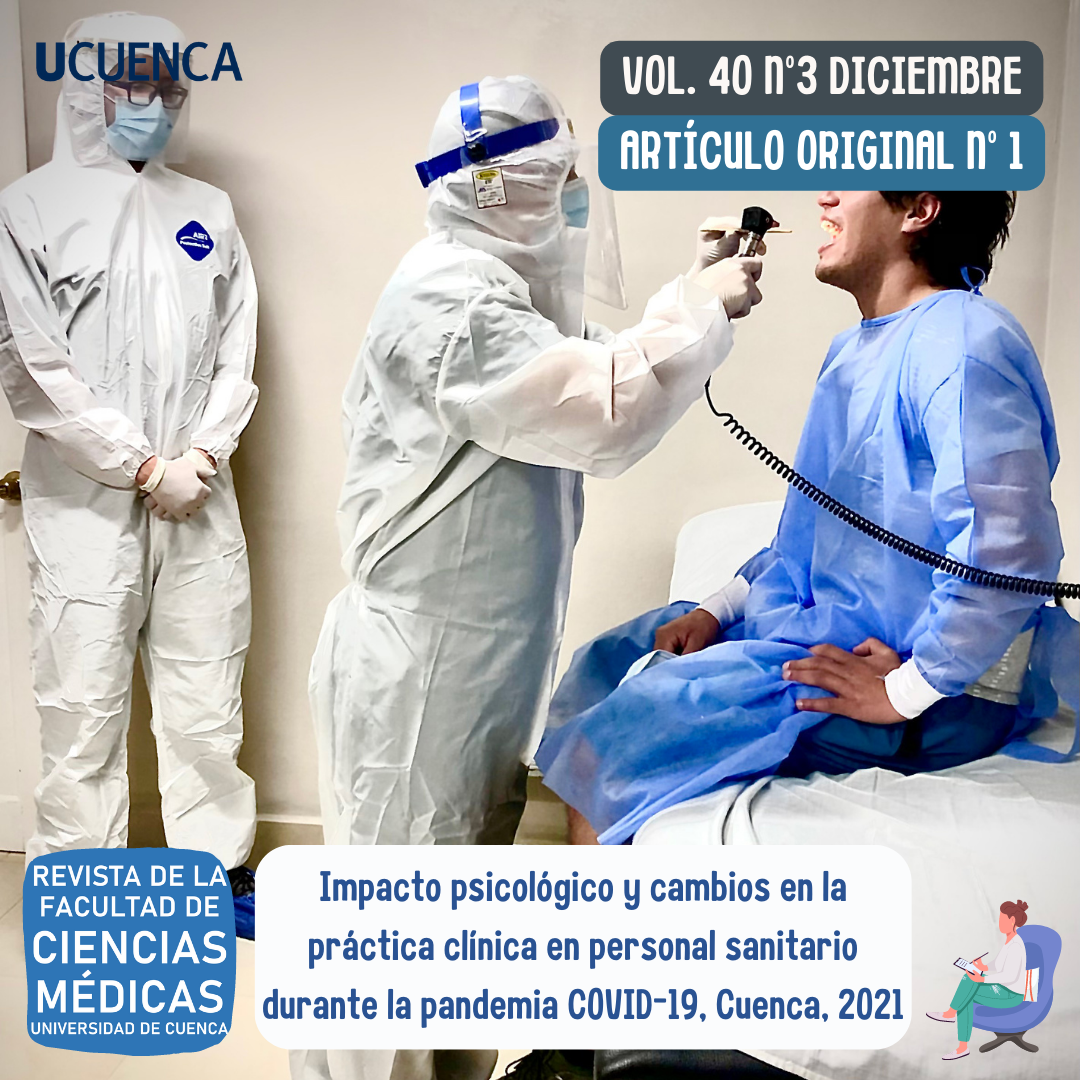
Impacto psicológico y cambios en la práctica clínica en personal sanitario durante la pandemia COVID-19, Cuenca, 2021
DOI:
https://doi.org/10.18537/RFCM.40.03.02Keywords:
COVID-19, psychological impact, healthcare workers, clinical practiceAbstract
Introduction: The COVID-19 pandemic had a great impact on people's health. A vulnerable group were health professionals, with a higher risk of psychological involvement during the care of patients with COVID-19.
Objective: to determine the psychological impact of health personnel at the José Carrasco and Municipal de Cuenca hospitals, and changes in clinical practice during the COVID-19 pandemic.
Methodology: a cross-sectional analytical study was conducted in 90 physicians and nurses. The PHQ-9 test were applied to determine depression, GAD-7 for anxiety, PSS-14 for stress and ISI for insomnia. A form was implemented to collect data on staff changes during clinical practice. Statistical analysis was performed in SPSS v15, applying descriptive statistics; to establish an association, OR was used with 95% CI and chi-squared.
Results: the prevalence of depression was 58.9%, anxiety 62.2%, stress 82.2% and insomnia 54.4%. Anxiety (p<0.01; OR 2.8 95% CI 1.1-6.7) and depression (p<0.001; OR 4.7 CI95% 1.9-11.9) were associated with the medical profession. Insomnia was associated with first-line (p=0.02; OR 8.2 CI95% 1.1-71.4). There were changes in clinical practice; 51.1% had physical distancing during care, 96.7% used PPE, and 85.6% required its use from patients.
Conclusion: the prevalence of psychological impact on health workers was high, associated with the medical profession and frontline work; changes in clinical practice were distancing during care and use of PPE by professionals and patients.
Downloads
Published
Issue
Section
License
Copyright (c) 2022 Md. Pablo Ordóñez, Dr. Marcos Molina, Dra. Lorena Encalada, Dr. Sergio Guevara

This work is licensed under a Creative Commons Attribution-NonCommercial-ShareAlike 4.0 International License.
Copyright © Autors.

You are free to:
 |
Share — copy and redistribute the material in any medium or format |
 |
Adapt — remix, transform, and build upon the material for any purpose, even commercially. |
Under the following conditions:
 |
Attribution — You must give appropriate credit, provide a link to the licence, and indicate if changes were made. You may do so in any reasonable manner, but not in any way that suggests the licenser endorses you or your use. |
| NonCommercial — You may not use the material for commercial purposes. | |
| ShareAlike — If you remix, transform, or build upon the material, you must distribute your contributions under the same license as the original. |
| No additional restrictions — You may not apply legal terms or technological measures that legally restrict others from doing anything the licence permits. |