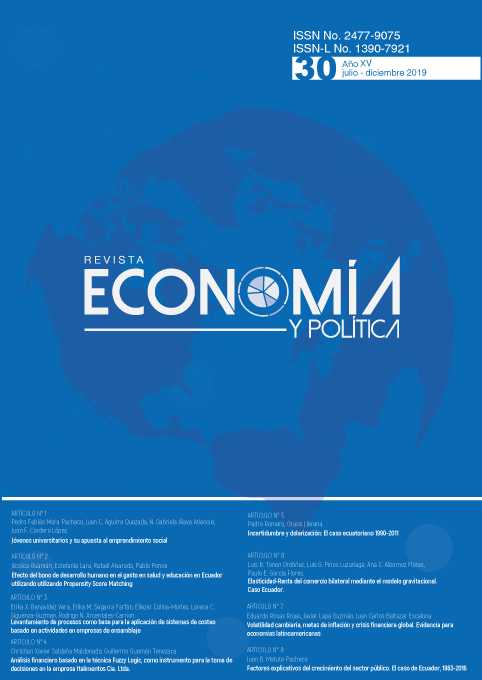
Financial analysis based on the Fuzzy Logic technique, as an instrument for decision making in Italimentos Cia. Ltda.
DOI:
https://doi.org/10.25097/rep.n30.2019.04Keywords:
Fuzzy Logic, Financial Analysis, Expertise, Contra expertiseAbstract
Traditional studies on solvency and profitability ratios use traditional mathematics and methods, based on historical statistics for short-term decision making. In this sense, the decisions of entrepreneurs have been based on possibly biased and closed data, without allowing them to trap the uncertainty that the data throw at the moment of the financial analysis of the companies. In this research, the Fuzzy Logic analysis technique is used, which allows us to consider the current data in order to make correct decisions, trapping uncertainty, through the principle of gradual simultaneity which states: "A proposition can be both true and false, provided that a degree is assigned to its truth and a degree to its falsehood". The investigation is important because it helps to make an analysis of the financial statements approaching the reality, since it will allow to consider two types of scenarios: the best of the cases and the worst of the cases; as well as, to provide provisional financial statements to take the best decisions, counting on more reliable and of quality information for the company. The accomplishment of this work, also allowed to find the difference between the traditional financial analysis and the application of the Fuzzy Logic technique, the same one that helped to establish more real results for the correct decision making in the future, providing an alternative for the decisional accounting.
Downloads
References
2. Díaz, J., Coba, E., Moreno, K., & Santamaría, E. (2017). La Lógica Difusa Aplicada a los Ratios Financieros en el Sector Cooperativo del Ecuador. INNOVA , 64-82.
3. Faga, H. A., & Ramos Mejía, M. E. (2006). Cómo conocer y manejar sus costos para tomar desiciones rentables. Buenos Aires: Ediciones Granica S.A.
4. García Parra, M., & Jordà Lloret, J. M. (2004). Dirección Financiera. Barcelona: Ediciones UPC.
5. Gil Alvarez, A. (2004). Introducción al Análisis Financiero. Imprenta Gamma, 10.
6. Lavalle Burguete, A. C. (2016). ANALISIS FINANCIERO. Editorial Digital UNID.
7. Luna, K., Tinto, J., Sarmiento, W., & Cisneros, D. (2018). Estudio de rentabilidad para el lanzamiento de un nuevo producto aplicando el enfoque difuso. Visión Gerencial, 42-53.
8. Medina Hurtado, S. (2006). Estado de la cuestión acerca del uso de la lógica difusa en problemas financieros. Cuadernos de Administración, Pontificia Universidad Javeriana, 195-223.
9. Reig Mullor, J., Sansalvador Selles, M. E., & Trigueros Pina, J. A. (2000). LÓGICA BORROSA Y SU APLICACIÓN EN LA CONTABILIDAD. REVISTA ESPAÑOLA DE FINANCIACIÓN Y CONTABILIDAD.
10. Rico F., M. A. (2010). Herramientas con base en subconjuntos borrosos. Propuesta procedimental para aplicar expertizaje y. Actualidad Contable Faces, 127-146.
11. Rico F., M. A. (2010). Herramientas con base en subconjuntos borrosos. Propuesta procedimental para aplicar expertizaje y recuperar efectos olvidados en la información contable. Actualidad Contable FACES, 127-146.
12. Scott, B., & Brigham, E. F. (2013). Fundamentos de Administración Financiera. Mexico.
13. Tinto Arandes, J. (2015). Implementación de Tecnología de avanzada (fuzzy-set) aplicadas a los sistemas de control y gestión en las cadenas agroalimentarias del Ecuador. Machala: Universidad Técnica de Machala UTMACH.
14. Tinto Arandes, J., Molina, M. E., Chavez A., H., & Mosquera Maldonado, S. (2016). AUTOMATIZACIÓN FUZZY APLICADO EN LA CONTABILIDAD. Revista ECA Sinergia, 7.
15. Tinto, J., Luna, K., & Cisneros, D. (2017). Teoría de los efectos olvidados en el rescate de la imagen comercial de los artesanos del calzado en el cantón Gualaceo provincia del Azuay, Ecuador. Visión Gerencial, 24-42.
16. Tinto, J., Molina, M., Chavez, H., & Mosquera, S. (2016). AUTOMATIZACIÓN FUZZY APLICADO EN LA CONTABILIDAD. Revista ECA Sinergia, 1-18.
17. Trillas, E., & Gutierrez, J. (1992). Aplicaciones de la Logica Borrosa. Madrid: Raycar S.A.
Downloads
Published
How to Cite
Issue
Section
License
The Journal declines any responsibility for possible conflicts derived from the authorship of the works that are published in it.
The University of Cuenca in Ecuador conserves the patrimonial rights (copyright) of the published works and will favor the reuse of the same ones, these can be: copy, use, diffuse, transmit and expose publicly.
Unless otherwise indicated, all contents of the electronic edition are distributed under a Creative Commons Attribution-NonCommercial-ShareAlike 4.0 International License.