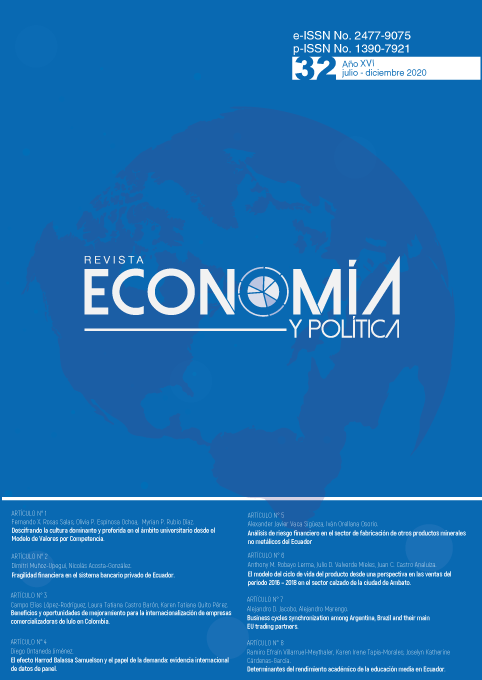
e Harrod Balassa Samuelson effect and the role of demand: international evidence from panel data
DOI:
https://doi.org/10.25097/rep.n32.2020.04Keywords:
Real exchange rate, Harrod-Balassa-Samuelson, demand, countries, panel dataAbstract
The study jointly analyzes the impact of labor productivity and demand factors in determining the real exchange rate. For this, the formalization of the Harrod-Balassa-Samuelson effect (HBS) is taken as a starting point, and the demand factors are analyzed from the point of view of government spending and per capita income. The empirical analysis is carried out for the period 1970-2010 using fixed-effect panel data regression models and the Generalized Moment Model (GMM) for a sample of 40 countries from different regions. The results provide evidence in favor of the HBS effect and the importance of demand factors in determining the real exchange rate. e results have important policy implications to help countries improve competitiveness.
Downloads
References
Alberola, E. y Tyrväinen, T. (1999): “¿Hay margen para los diferenciales de inflación en la Unión Económica y Monetaria?”, Moneda y Crédito, 208, pp. 65-120.
Apergis, N. (2013). The domestic Balassa–Samuelson effect of inflation for the Greek economy. Applied Economics, 45(23), 3288-3294.
Arellano, M. y Bover, O. (1995). Another look at the instrumental variable estimation of error components models, Journal of Econometrics, Elsevier, 68(1): 29-51.
Asea, P. K., & Mendoza, E. G. (1994). The Balassa‐Samuelson Model: A General‐Equilibrium Appraisal. Review of International Economics, 2(3), 244-267.
Blaszkiewicz, M., Kowalski, P. A., Rawdanowicz, L., & Wozniak, P. (2004). Harrod-Balassa-Samuelson effect in selected countries of central and eastern europe. CASE Network Reports, (57).
Balassa, B. (1964): “The Purchasing Power Parity Doctrine: a Reappraisal”, Journal of Political Economy, 72 (6), pp. 584-59.
Bahmani‐Oskooee, M., & Rhee, H. J. (1996). Time‐Series Support for Balassa's Productivity‐Bias Hypothesis: Evidence from Korea. Review of International Economics, 4(3), 364-370.
Balassa, Bela. (1973). "Just How Misleading are Official Exchange rate Conversions? A Comment" The Economic Journal, 83:332, pp. 1258-67.
Bello, O., Heresi, R., & Pineda Salazar, R. (2010). El tipo de cambio real de equilibrio: un estudio para 17 países de América Latina. CEPAL.
Blundell, R., & Bond, S. (1998). Initial conditions and moment restrictions in dynamic panel data models. Journal of econometrics, 87(1), 115-143.
Cañete, A. R. M. (2005). La relación entre los niveles de precios y los niveles de renta y productividad en los países de la zona del euro: implicaciones de la convergencia real sobre los diferenciales de inflación.
Clague, C., & Tanzi, V. (1972). Human capital, natural resources and the purchasing power parity doctrine: some empirical results. Economia Internazionale, 25(1), 3-18.
DeLoach, S. B. (2001). More evidence in favor of the Balassa–Samuelson hypothesis. Review of International Economics, 9(2), 336-342.
David, P. A. (1973). A reply to Professor Balassa. The Economic Journal, 83(332), 1267-1276.
De Gregorio, J., Giovannini, A., & Wolf, H. C. (1994). International evidence on tradables and nontradables inflation. European Economic Review, 38(6), 1225-1244.
DeLoach, S. B. (2001). More evidence in favor of the Balassa–Samuelson hypothesis. Review of International Economics, 9(2), 336-342.
Edison, H. J., & Klovland, J. T. (1987). A quantitative reassessment of the purchasing power parity hypothesis: Evidence from Norway and the United Kingdom. Journal of Applied Econometrics, 2(4), 309-333.
Égert, B., Drine, I., Lommatzsch, K., & Rault, C. (2003). The Balassa–Samuelson effect in Central and Eastern Europe: myth or reality?. Journal of comparative Economics, 31(3), 552-572.
Faria, J. R., & Leon-Ledesma, M. (2003). Testing the Balassa–Samuelson effect: Implications for growth and the PPP. Journal of Macroeconomics, 25(2), 241-253.
Feenstra, Robert C., Robert Inklaar and Marcel P. Timmer (2015), "The Next Generation of the Penn World Table", American Economic Review, 105(10), 3150-3182, available for download at www.ggdc.net/pwt.
FMI. (2018). La liberalización del comercio mundial y los países en desarrollo. https://www.imf.org/external/np/exr/ib/2001/esl/110801s.html
Frait, J., Komárek, L., & Melecký, M. (2008). The Real Exchange Rate Misalignment in the Five Central European Countries—Single Equation Approach. In Exchange rates and macroeconomic dynamics (pp. 61-93). Palgrave Macmillan, London.
Froot, K.A. y Rogoff, K. (1995): “Perspectives on PPP and Long-Run Real Exchange Rates”, en Grossman, G. y Rogoff, K. (eds.), Handbook of International Economics, Vol. III, Elsevier Science B.V., pp. 1647-1688.
Halpern, L., & Wyplosz, C. (2001). Economic transformation and real exchange rates in the 2000s: the Balassa-Samuelson connection. Economic Survey of Europe, 1, 227-239.
Harrod, R. (1933): International Economics, Cambridge University Press, Cambridge.
Imai, H. (2010). Japan's inflation under the Bretton Woods system: How large was the Balassa–Samuelson effect?. Journal of Asian Economics, 21(2), 174-185.
Katsimi, M. (2004): “Inflation Divergence in the Euro Area: The Balassa-Samuelson Effect“, Applied Economics Letters, 11 (5), pp. 329-32.
Lane, P. R., & Milesi-Ferretti, G. M. (2002). External wealth, the trade balance, and the real exchange rate. European Economic Review, 46(6), 1049-1071.
Lee, J., & Tang, M. K. (2007). Does productivity growth appreciate the real exchange rate?. Review of International Economics, 15(1), 164-187.
Mihaljek, D., & Klau, M. (2004). The Balassa–Samuelson effect in central Europe: a disaggregated analysis. Comparative Economic Studies, 46(1), 63-94.
Mihaljek, D., & Klau, M. (2008). Catching-up and inflation in transition economies: the Balassa-Samuelson effect revisited (No. 270). Bank for International Settlements.
Obstfeld, M., Rogoff, K. S., & Wren-lewis, S. (1996). Foundations of international macroeconomics (Vol. 30). Cambridge, MA: MIT press.
Officer, Lawrence H. (1976). "The Productivity Bias in Purchasing Power Parity: An Econometric Investigation", IMF Staff Paper 23, pp. 545-579.
Roodman, D. (2009). How to do xtabond2: An introduction to difference and system GMM in Stata, Stata Journal, 9(1): 86-136.
Samuelson, P. (1964): “Theoretical Notes on Trade Problems”, Review of Economics and Statistics, 46 (2), pp.145-154.
Timmer, M. P., de Vries, G. J., & de Vries, K. (2015). “Patterns of Structural Change in Developing Countries.” . In J. Weiss, & M. Tribe (Eds.), Routledge Handbook of Industry and Development. (pp. 65-83). Routledge
Published
How to Cite
Issue
Section
License
The Journal declines any responsibility for possible conflicts derived from the authorship of the works that are published in it.
The University of Cuenca in Ecuador conserves the patrimonial rights (copyright) of the published works and will favor the reuse of the same ones, these can be: copy, use, diffuse, transmit and expose publicly.
Unless otherwise indicated, all contents of the electronic edition are distributed under a Creative Commons Attribution-NonCommercial-ShareAlike 4.0 International License.