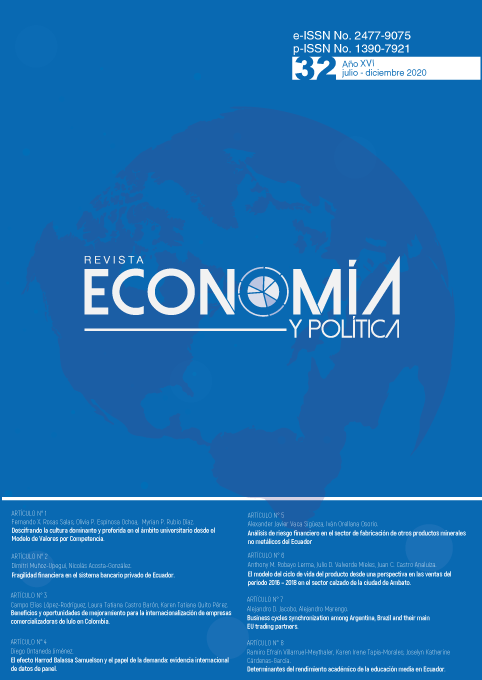
Business cycles synchronization among Argentina, Brazil and their main EU trading partners
DOI:
https://doi.org/10.25097/rep.n32.2020.07Keywords:
Argenina, Brazil, business cycleAbstract
In this paper, we apply the Hodrick and Prescott filter to explore whether the economic fluctuations of Argentina, Brazil and their main European Union (EU) trading partners followed a similar pattern for the period 1995.1–2018.4. When both South American economies are analyzed together, the highest coincidence is observed in Gross Domestic Product (GDP) fluctuations (almost 75% of the observations lie on the same side of the zero line). However, as to the rest of GDP components, a drop is observed in the coincidences (the observations are close to 50%). While Argentinian GDP, private consumption and imports have a significant correlation with their Brazilian counterparts, this association is rather modest. As to their main EU partners, trade integration is likely to lead to a higher business cycles synchronization for Argentina, but it is not for Brazil.
Downloads
References
Agénor, C., McDermott, J. & Prasad, S., 2000. Macroeconomic Fluctuations in Developing Countries: Some Stylized Facts. The World Bank Economic Review, 14(2), pp. 251-285.
Aguiar, M. & Gopinath, G., 2007. Emerging market Business Cycles: The cycle is the trend. Journal of Political Economy, Volume 115, pp. 69-102.
Ahumada, H. & Garegnani, M., 1999. Hodrick-Prescott Filter in Practice. V Jornadaas de Economía Monetaria e Internacional.
Aiolfi, M., Catão, L. & Timmermann , A., 2006. Common Factors in Latin America’s Business Cycles. IMF Working Paper, 49(6), pp. 1-22.
Arbatli, E. C., 2009. Business Cycle in Emerging Economies: Sudden Stop and the Cycle. In: Persistence of Income shock and the Intertemporal Model of Current Account. Baltimore: Johns Hopkins University, pp. 92-132.
Arnaudo, A. & Jacobo, A. D., 1997. Macroeconomic Homogeneity within MERCOSUR: An Overview. Estudios Económicos, 12(1), pp. 37-51.
Capello, M. & Grión, N., 2003. Ciclos Macroeconómicos y Fiscales en la Argentina de la Convertibilidad. Principales Hechos Estilizados. Departamento de Economia y Finanzas. Facultad de Ciencias Economicas. Universidad Nacional de Córdoba, Volume 16, pp. 1-24.
Catão, L., 2007. Latin America Retrospective. Finance and Development, 44(4), pp. 39-43.
Cerro, A., 1999. La Conducta Cíclica de la Economía Argentina y el Comportamiento del Dinero en el Ciclo Económico Argentina 1820-1998. Económica, 157(3), pp. 8-60.
Cerro, A. & Pineda, J., 2002. Latin Amrican Growth Cycles. Empirical Evidence 1960 - 2000. Estudios de Economía, 29(1), pp. 89-108.
Cleveland, R. B., Cleveland, W. S., McRae, J. E. & Terpenning, I., 1990. STL: A Seasonal-Trend Decomposition Procedure Based on Loess. Journal of Official Statistics, 6(1), pp. 3-33.
DeLong, J. & Summers, L., 1986. Are Business Cycles Symmetrical? In: The American Business Cycle: Continuity and Change. Chicago: University of Chicago Press for the National Bureau of Economic Research, pp. 166-178.
Díaz, C., 2007. Characterization of the Argentine Business Cycle, Madrid, Spain: Universidad Carlos III de Madrid, manuscript.
Ellery Jr., R., Gomes, V. & Sachsida, A., 2002. Business Cycle Fluctuations in Brazil. Revista Brasileira de Economia, 56(2), pp. 269-308.
Enders, W., 1995. Applied Econometric Time Series. New York: John Wiley & Sons.
Engle, R. F. & Issler, J., 1993. Common Trends and Common Cycles in Latin America. Revista Brasileira de Economia, 47(2), pp. 149-176.
Frankel, J. A., Vegh, C. A. & Vuletin, G., 2011. On graduation from fiscal procyclicality. Journal of Development Economics, 100(1), pp. 32-47.
Frankel, J. & Rose, A., 1998. The Endogeneity of the Optimum Currency Area Criteria. The Economic Journal, 108(449), pp. 1009-1025.
Garber, G., Mian, A., Ponticelli, J. & Sufi, A., 2019. Household debt and recession in Brazil. In: Handbook of US Consumer Economics. San Diego: Academic Press, pp. 97-119.
Gonzalez, G. H. R. A. & Patiño, A. M., 2012. Sincronización de Ciclos e Integración Latinoamericana: nuevas hipótesis tras otro ejercicio empírico. Trayectorias, 14(35), pp. 3-26.
Gutierrez, F. & Gomes, C., 2009. Evidence of Common Features and Business Cycle Synchronization in Mercosur. Brazilian Review of Econometrics, 29(1), pp. 37-58.
Hamilton, J. D., 1989. A new Approach to the Economic Analysis of Nonstationary Time Series and the Business Cycles. Econometrica, 57(2), pp. 357-384.
Jacobo, A. D., 2002. Taking the business cycle's pulse to some Latin American economies: Is there a rhythmical beat? Estudios Económicos, 17(2), pp. 219-245.
Jorrat, J., 2005. Construcción de índices compuestos mensuales coincidentes y líder de Argentina. Progresos en Econometría, Asociación Argentina de Economía Política, pp. 43-100.
Kanczuk, F., 2004. Real Interest Rates and Brazilian Business Cycles. Review of Economic Dynamics, 7(2), pp. 436-455.
Kydland, F. E. & Prescott, E. C., 1990. Business Cycles: Real Facts and a Monetary Myth. Federal Reserve Bank of Minneapolis. Quarterly Review, Volume 14, pp. 3-18.
Kydland, F. E. & Zarazaga, C. E. J. M., 1997. Is the Business Cycle of Argentina “Different”? Federal Reserve Bank of Dallas Economic Review, Volume fourth quarter, pp. 21-36.
Loayza, N., Fajnzylber, P. & Calderón, C., 2004. Economic Growth in Latin America and the Caribbean: stylized facts, explanations and forecasts. Banco Central de Chile Working Paper, Volume 265.
Lucas, R. E., 1977. Understanding Business Cycles. The Netherlands, Elsevier B.V., pp. 7-29.
Mejía-Reyes, P., 1999. Classical Business Cycles in Latin America: turning points, asymmetries and international synchronization. The Manchester School, 2(28), pp. 265-297.
Neumeyer, P. A. & Perri, F., 2005. Business Cycles in Emerging Economies: The Role of Interest Rates. Journal of Monetary Economics, 52(2), pp. 345-380.
Ravn, M. & Uhlig, H., 2001. On Adjusting the HP-Filter for the Frequency of Observations. CEPR Discussion Paper, Volume 2858.
Rojas, M., Zilio, M. & Zubimendi, S., 2009. Hechos Estilizados para la Economía Argentina. Ensayos Económicos, Volume 56, pp. 157-210.
Souza-Sobrinho, N. F., 2010. The Role of Interest Rates in the Brazilian Business Cycle. Revista Brasileira de Economia, 65(3), pp. 315-336.
Toledo, M., 2008. Understanding Business Cycles in Latin America. Manuscript.
Val, P. R. d. C. & Ferreira, P. C., 2002. Modelos de Ciclos Reais de Negócios Aplicados á Economia Brasileira. Ensaios Economicos, Volume 438, pp. 215-248.
Published
How to Cite
Issue
Section
License
The Journal declines any responsibility for possible conflicts derived from the authorship of the works that are published in it.
The University of Cuenca in Ecuador conserves the patrimonial rights (copyright) of the published works and will favor the reuse of the same ones, these can be: copy, use, diffuse, transmit and expose publicly.
Unless otherwise indicated, all contents of the electronic edition are distributed under a Creative Commons Attribution-NonCommercial-ShareAlike 4.0 International License.