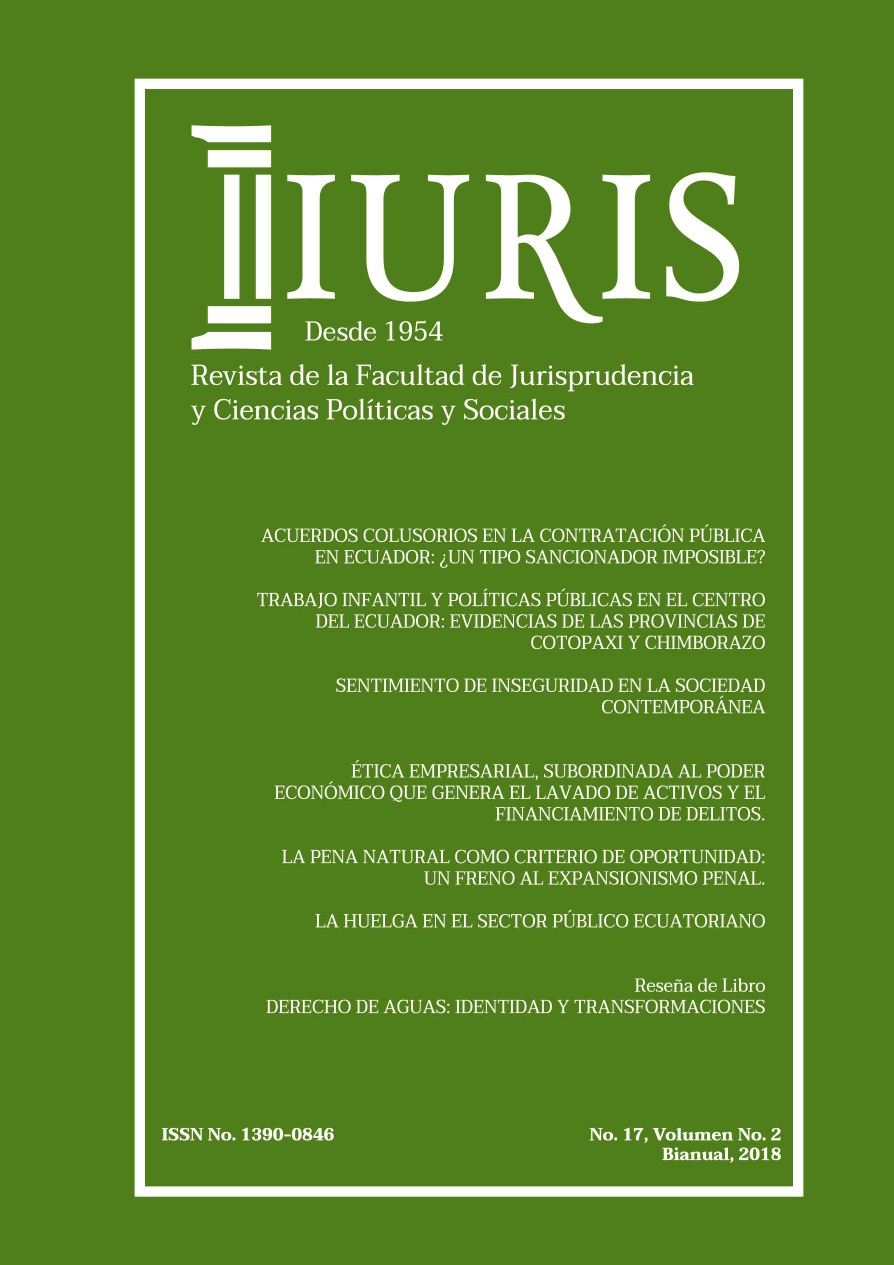
TRABAJO INFANTIL Y POLÍTICAS PÚBLICAS EN EL CENTRO DEL ECUADOR: EVIDENCIAS DE LAS PROVINCIAS DE COTOPAXI Y CHIMBORAZO
Palabras clave:
Trabajo Infantil, Políticas Públicas, Niñez y Adolescencia, EcuadorResumen
El trabajo infantil es toda actividad que priva a los niños, niñas y adolescentes de su proceso de crecimiento e impide el despliegue de su intelecto, capacidades, potencialidades y aspiraciones, afectándose así aspectos fundamentales para su desarrollo integral. No obstante haber sido el Ecuador el primer país en ratificar la Convención Internacional para los Derechos del Niño 1989, el trabajo infantil continúa siendo una asignatura pendiente. A pesar de haber logrado disminuir la tasa de trabajo infantil a un 6,27% hacia el año 2012, recientemente se ha venido registrando un retroceso significativo dado que para el año 2017, el cálculo oficial arrojaba un 8,41%. A este aumento comparativo de 2,14 puntos, se le suma que un 56% de los trabajos son considerados como peligrosos para el desarrollo efectivo de su salud, tanto física como mental. En el plano nacional, las provincias de Chimborazo y de Cotopaxi son dos de las más afectadas por el trabajo infantil, con un 31% y un 10% del total de casos a nivel nacional respectivamente. Debido a ello es que el presente trabajo se cuestiona la eficacia de las políticas públicas implementadas para la erradicación del Trabajo Infantil en el Ecuador, y en particular en las provincias de Cotopaxi y Chimborazo. A partir de una labor metodológica mixta se analizan datos tanto a nivel nacional como local a la vez de haberse efectuado entrevistas con los principales actores locales en la materia. De esta forma, el trabajo evidencia, por un lado, una tendencia al aumento del trabajo infantil en términos generales a nivel nacional y de las dos provincias estudiadas, registrándose por otro lado, una reducción considerable de la mendicidad como una tipología de trabajo infantil en particular.
Descargas
Citas
Aries, P. (2000). El niño y la vida familiar en el antiguo régimen. Recuperado de: http://www.redalyc.org/ html/1051/105115241009/
Arruabarrena, M. (2009). Trabajo infantil en un marco de pobreza. Recuperado de: https://www.academia.edu/ people/ utf8=%E2%9C%93&q+red=trabajo-infantil
Ayala, A. (2014). Análisis del rol de los actores sociales en la construcción de la política pública de erradicación del trabajo infantil en el caso de Ecuador. (Tesis de maestría). Recuperado de: http://repositorio. acsoandes.edu.ec/ bitstream/10469/7459/2/TFLACSO-2014APAV.pdf
Consejo Nacional para la Igualdad Intergeneracional (CNII) (2019). Informe de Observancia de Trabajo Infantil. Recuperado de: https://www.igualdad.gob.ec/informe-de-observancia-de- trabajo-infantil-se-socializara-en-ambato/
Delgado, B. (1998). Historia de la infancia. Recuperado de: http:// www.redalyc.org/ html/1051/105115241009/
Esteves, A. (2009). Magnitud y características del trabajo infantil en Ecuador. Recuperado de: http://repositorio. acsoandes.edu.ec/ bitstream/10469/194/1/BFLACSO-AMP4-05-Esteves.pdf
García E. & Areldsen, H. (1997). El debate actual sobre el trabajo infantil en América Latina y el Caribe. Recuperado por: http:// ww w.redalyc.org/html/773/77315614005/
Heredia, (13 de febrero de 2012). El maltrato a la menor crece.
El Telégrafo. Recuperado de: http://www.eltelegrafo.com. ec/noticias/sociedad/4/el-trabajo-infantil-en-ecuador-su- erradicacion-como-un-objetivo-comun
Instituto Nacional de Estadística y Censos (INEC) (2010). Número de Niños Niñas y Adolescentes en Cotopaxi y Chimborazo. Recuperador de: http://www.ecuadorencifras. gob.ec// documentos/web-inec/Estadisticas_Sociales/
Instituto Nacional de Estadística y Censos (INEC) (2012). Anuario de defunciones generales 2013. Recuperador de: http://www. ecuadorencifras.gob.ec//documentos/web-inec/Estadisticas_ Sociales/
Myers, W. E. (2001). Determinantes y consecuencias del Trabajo Infantil. Recuperado de: https://dialnet.unirioja.es/servlet/ articulo?codigo=4239648
Sandoval, A. (2007). Trabajo Infantil e Inasistencia Escolar. Recu- perado de: http://www.scielo.br/pdf/%0D/rbedu/v12n34/ a06v1234.pdf
Vilches, A. (2015). El Trabajo Infantil En Guayaquil Y Su Impacto Socioeconómico. (Tesis de grado). Recuperado de: http:// repositorio.ug.edu.ec/bitstream/redug/8764/1/ TESIS%20 TRABAJO%20INFANTIL%20EN%20GUAYAQUIL%20Y%20 SU%20IMPACTO%20SOCIO-ECON%C3%93MICO.pdf
Referencias Jurídicas:
Congreso Nacional (3 de enero de 2003). Código Orgánico de la Niñez y Adolescencia. Recuperado de: https://www.igualdad. gob.ec/wp-content/uploads/downloads/2017/11/codigo_ ninezyadolescencia.pdf?fbclid=IwAR3RMlP72fK2BF03tREM- dWaUFq9vy8Wcs4eSPraqr9d9r1T1tXKFTgIGh-4
Congreso Nacional (16 de diciembre de 2005). Código de Trabajo. (Ley 167 de 2005). Recuperado de:http://www.trabajo.gob. ec/wp-content/uploads/downloads/2012/11/C%C3%B3di- go-de-Tabajo-PDF.pdf
Organización Internacional de Trabajo (OIT) (1973). Convenio núme- ro 138 sobre la edad mínima de admisión al empleo. Recuper- ado de: https://www.ilo.org/dyn/normlex/es/f?p=NORMLEX- PUB:12100:0::NO::P12100_ILO_CODE:C138
Organización Internacional de Trabajo (OIT) (1999). Convenio sobre las peores formas de trabajo infantil. Recuperado de: https://www.ilo.org/dyn/normlex/es/f?p=NORMLEX- PUB:12100:0::NO::P12100_ILO_CODE:C182
Organización Internacional de Trabajo (OIT) (2015). Trabajo In- fantil en Ecuador: hacia un entendimiento integral de la temática. Recuperado de: https://www.unicef.org/ecuador/ LIBRO-UNICEF-FINAL-BAJA.pdf
Secretaría Nacional de Planificación y Desarrollo (SENPLADES) (2013). Plan Nacional para el Buen Vivir. Recuperado de: http://www.buenvivir.gob.ec/versiones-plan-nacional
Referencias de Entrevistas:
Garzón, S. (2017). (F. Vaca, investigador). Inspector de Trabajo del Cantón Latacunga.
Heredia, R. (2017). (F. Vaca, investigador). Coordinador de la Junta Cantonal de Latacunga.
Lagla, L. (2017). (F. Vaca, investigador). Coordinador distrital MIES Cotopaxi.
Medina, S. (2017). (F. Vaca, investigador). Director del departamento de trabajo social de Chimborazo.
Pavón, F. (2017). (F. Vaca, investigador). Jefe del departamento de Trabajo Social.
Sacator, P. (2017). (F. Vaca, investigador). Director del Centro de con- trol del MIES Latacunga.
Sánchez, A. (2017). (F. Vaca, investigador). Presidenta del Patronato Municipal de Latacunga.
Sánchez, P. (2017). (F. Vaca, investigador). Alcalde de Latacunga.
Vásquez, L. (2017). (F. Vaca, investigador). Director del Ministerio de Inclusión Económica y Social Chimborazo.