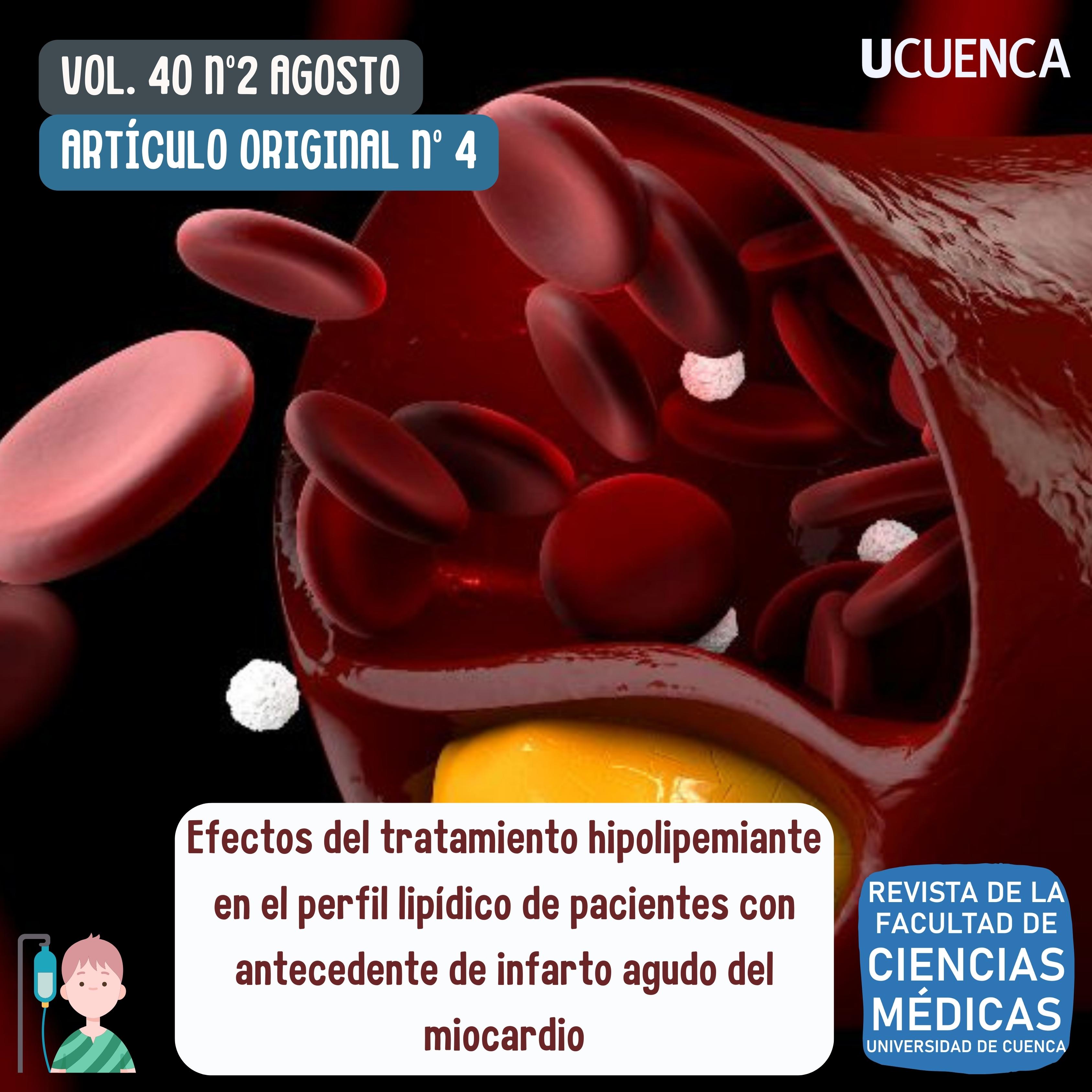
Achievements in the lipid profile of patients with lipid-lowering treatment, after Acute Myocardial Infarction at the José Carrasco Arteaga Hospital. 2017-2019.
DOI:
https://doi.org/10.18537/RFCM.40.02.05Keywords:
Heart attack. Lipid-lowering. Lipidic profile. Secondary prevention.Abstract
Introduction: The implementation of lipid-lowering agents has had a great impact worldwide considering the achievements proposed by the clinical guidelines: ATP III (Adult Treatment Panel), AHA (American Heart Assosiation) and SEC (European Society of Cardiology) in secondary prevention.
Objective: determine the lipid profile, type of lipid-lowering treatment, and its achievements against international guidelines in patients with a history of AMI at the José Carrasco Arteaga Hospital (HJCA), in the period 2017-2019.
Methodology: cross-sectional descriptive study, with a universe of 205 patients diagnosed with AMI and lipid-lowering therapy. The data was collected using a form with information from the medical records, which were processed in the SPSS version 25 program. The analysis was performed using a descriptive technique with tables based on the measurements of frequencies, percentages, arithmetic mean and standard deviation.
Results: The majority of patients affected by AMI are elderly (mean: 70, SD: 9.6) and male (88.8%). After the application of lipid-lowering therapy, 87.3% of the population maintained total cholesterol values within desirable parameters according to ATP III, but only 35.6% achieved optimal LDL-cholesterol values in relation to the risk group and secondary prevention (<70mg/dl). The most widely used lipid-lowering therapy was statin monotherapy in 92.7%, Simvastatin 40 mg being the most commonly applied drug (69.3%).
Conclusions: the values of the lipid profile in secondary prevention patients according to LDL-c proposed by the guidelines are not achieved.
Downloads
Published
Issue
Section
License
Copyright (c) 2023 Matamoros Román Ariana Brigit, Conza Pardo Karina Fernanda, López Rodríguez Javier Arturo, Romo Urgiles Juan Diego, Loaiza Romero Josselyne Elizabeth

This work is licensed under a Creative Commons Attribution-NonCommercial-ShareAlike 4.0 International License.
Copyright © Autors.

You are free to:
 |
Share — copy and redistribute the material in any medium or format |
 |
Adapt — remix, transform, and build upon the material for any purpose, even commercially. |
Under the following conditions:
 |
Attribution — You must give appropriate credit, provide a link to the licence, and indicate if changes were made. You may do so in any reasonable manner, but not in any way that suggests the licenser endorses you or your use. |
| NonCommercial — You may not use the material for commercial purposes. | |
| ShareAlike — If you remix, transform, or build upon the material, you must distribute your contributions under the same license as the original. |
| No additional restrictions — You may not apply legal terms or technological measures that legally restrict others from doing anything the licence permits. |