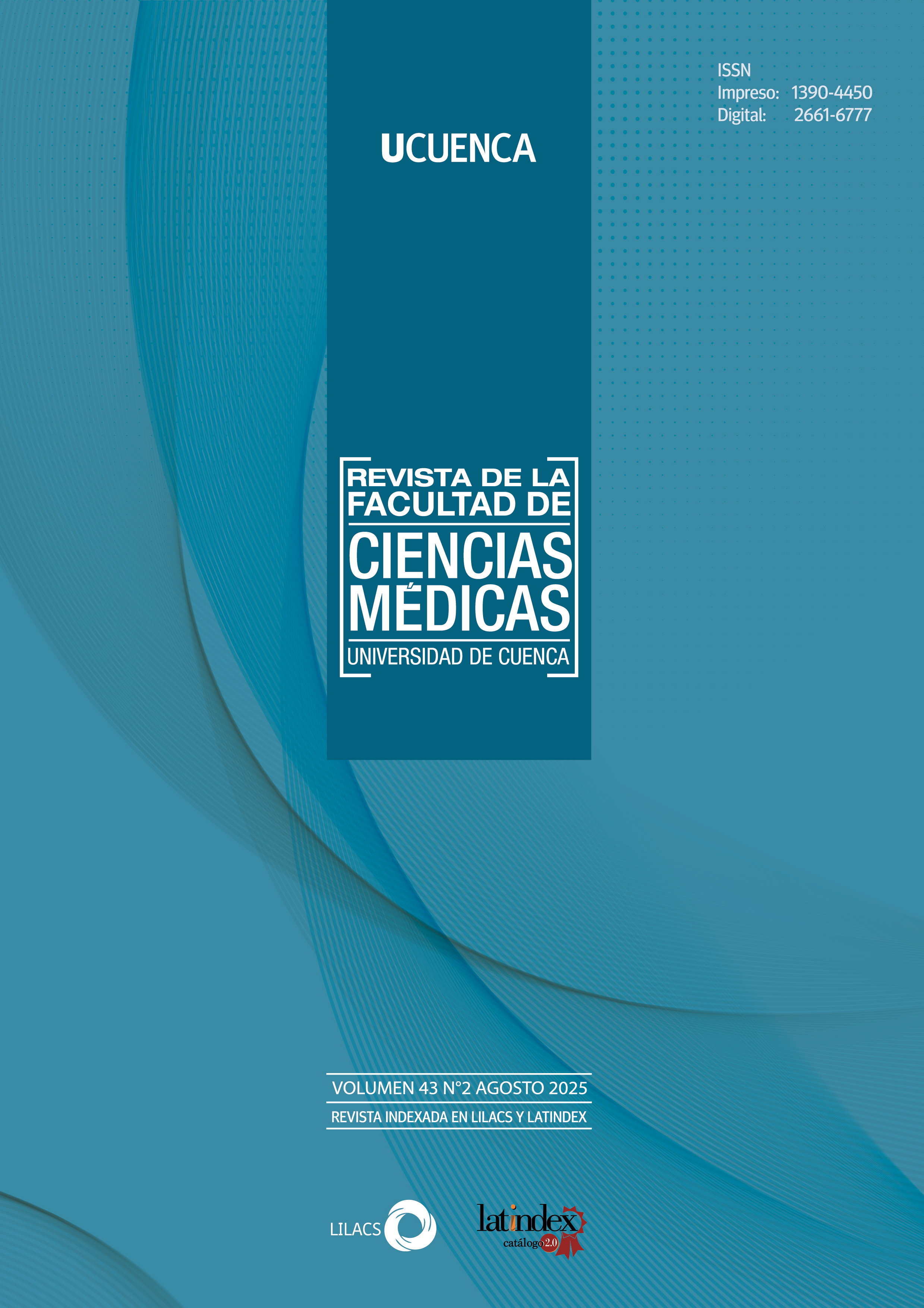
Academic performance in the subject of Morphology 2 in the Medical career at the University of Cuenca, before, during, and after the COVID-19 pandemic
DOI:
https://doi.org/10.18537/RFCM.43.02.03Keywords:
academic performance, COVID-19, education, medicalAbstract
Introduction: It is important to reflect on how to teach or learn morphology; there are various methods and resources available for learning, all of which are part of in-person learning. In 2020 (the COVID-19 pandemic), the way of learning changed abruptly, shifting from traditional (in-person) methods to virtual learning. This undoubtedly impacted both learning and teaching, as well as summative assessments and, in this area, student passing or failing grades.
Objective: to determine the differences in academic performance in the subject Morphology 2, pre-pandemic, during the pandemic and post-pandemic, in the March-August academic cycles of the Medicine degree at the University of Cuenca, during the period 2019-2022.
Methodology: the anonymized database provided by the Vice Dean's office of the Faculty of Medical Sciences was used. Final grade and passing data for students from the academic cycles, March - August of the years 2019, 2020, and 2022 were selected. The data are presented in tables of frequencies, means, and standard deviations. For data analysis and to determine differences, the one-factor ANOVA test and the Bonferroni post hoc test were used.
Results: In the March–August 2020 academic cycle (the first pandemic academic cycle), the passing rate (98.6%) increased compared to other academic cycles. In the post-pandemic year, the passing rate decreased (88.7%), reaching a similar level to the pre-pandemic period (87%). The final grades for the pre-pandemic, pandemic, and post-pandemic academic years were 64.80, 74.55, and 69.43, respectively; the differences were statistically significant.
Conclusion: the performance of morphology students during the COVID-19 pandemic period was higher than in the pre- and post-pandemic cycles analyzed.
Downloads
Published
Issue
Section
License
Copyright (c) 2025 Fernando Eugenio Castro Calle

This work is licensed under a Creative Commons Attribution-NonCommercial-ShareAlike 4.0 International License.
Copyright © Autors.

You are free to:
 |
Share — copy and redistribute the material in any medium or format |
 |
Adapt — remix, transform, and build upon the material for any purpose, even commercially. |
Under the following conditions:
 |
Attribution — You must give appropriate credit, provide a link to the licence, and indicate if changes were made. You may do so in any reasonable manner, but not in any way that suggests the licenser endorses you or your use. |
| NonCommercial — You may not use the material for commercial purposes. | |
| ShareAlike — If you remix, transform, or build upon the material, you must distribute your contributions under the same license as the original. |
| No additional restrictions — You may not apply legal terms or technological measures that legally restrict others from doing anything the licence permits. |