Digital transformation in the construction industry: Analysing the impact of technological changes on construction processes
DOI:
https://doi.org/10.18537/est.v014.n027.a16Keywords:
technical innovations, architectural dynamics, electronic modernization, repair procedures, use of devices for constructionAbstract
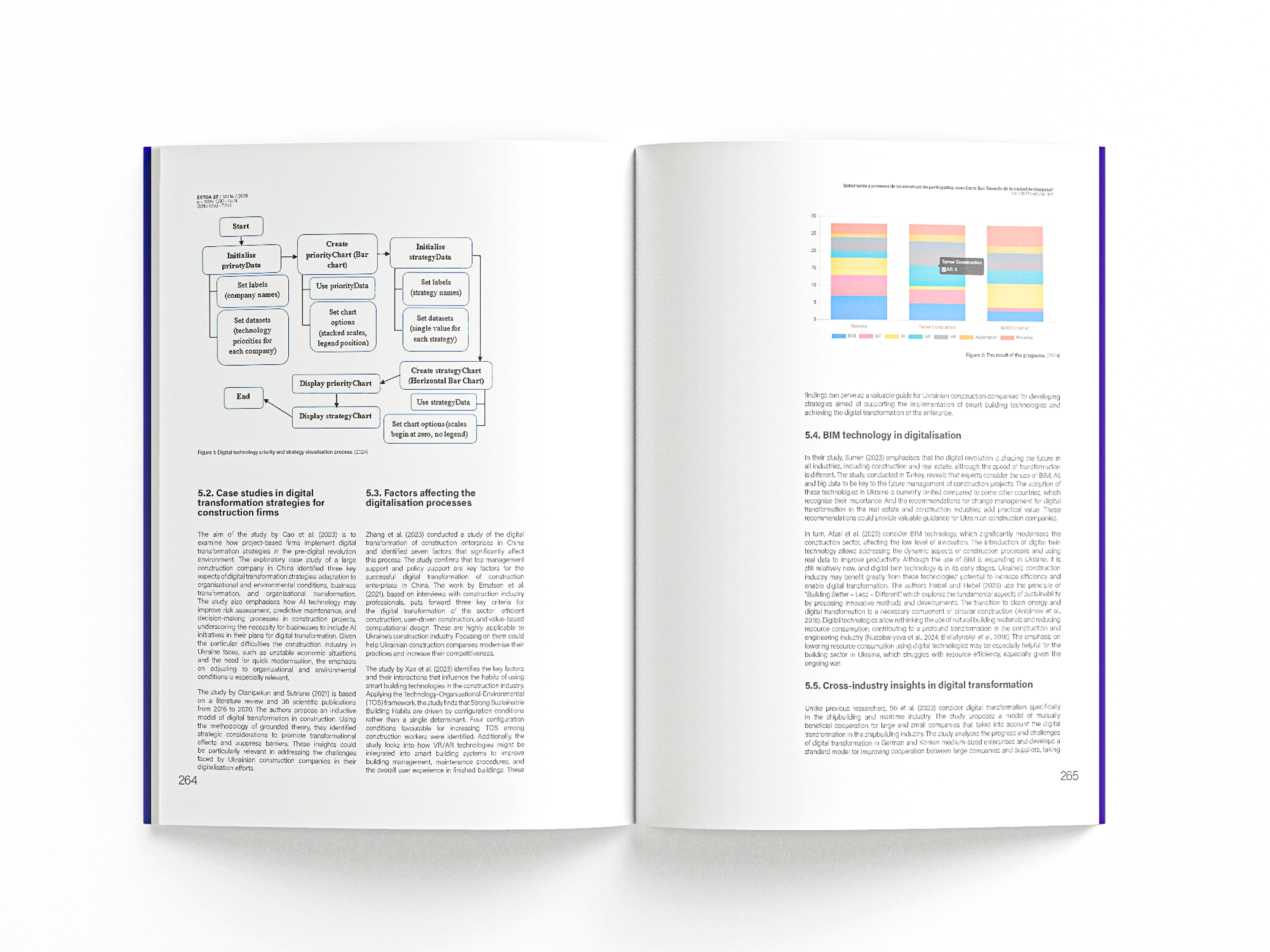
The relevance of the problem under study lies in the rapid development of digital technologies, which provide unique opportunities for optimising and improving the efficiency of construction production. The purpose of the study is to analyse the impact of digital changes on the technology and organisation of construction activities in Ukraine. The methods of literature review, experimentation, and abduction were used. The study determined which digital technologies, such as BIM, IoT, and AI, are most important to construction organisations. A framework of efficiency-boosting tactics, including personnel training, process optimisation, and technology integration, was created. To visualise data on digital priorities and initiatives, an application was developed. The study emphasised the significance of all-encompassing digital transformation plans and the demand for ongoing innovation in the building sector.
Downloads
References
Afzal, M., Khan, A. U., Bilal, M., Ayyub, M. F., & Shoaib, M. (2023). Digital twins: Facilitating digital transformation from and beyond BIM in construction. Research Square. https://doi.org/10.21203/rs.3.rs-3574344/v1
Akselrod, R., Trach, R., Chernyshev, D., Ryzhakov, D., Petrukha, S., & Homenko, O. (2021). Innovative directions of updating the operating systems of construction companies in an unstable business environment of the project. Management of Development of Complex Systems, 48, 102-113. https://doi.org/10.32347/2412-9933.2021.48.102-113
AlBalkhy, W., Karmaoui, D., Ducoulombier, L., Lafhaj, Z., & Linner, T. (2024). Digital twins in the built environment: Definition, applications, and challenges. Automation in Construction, 162, Article 105368. https://doi.org/10.1016/j.autcon.2024.105368
Al-Omari, R., Sweis, G., Abu-Khader, W., & Sweis, R. (2023). Barriers to the adoption of digitalization in the construction industry: Perspectives of owners, consultants, and contractors. Construction Economics and Buildings, 23(3/4), 87-106. https://doi.org/10.5130/AJCEB.v23i3/4.8636
Andrukhov, V., Bassist, V., Martyniuk, Yu., & Hladkyi, S. (2023). The use of BIM – technologies in the assessment of technical characteristics of residential buildings. Modern Technologies, Materials and Structures in Construction, 20(1), 146-151. https://doi.org/10.31649/2311-1429-2023-1-146-151
Anisimov, A, G., Mysak, I, S., Klub, M, V., Sargsyan K, B., Eritsyan, S, Kh., Petrosyan, G, S., Avtandilyan, A, V., & Gevorgyan, A, R. (2018). Development and Implementation of Automatic Conversion of Steam-Gas Power Unit from Compound Cycle Mode to Steam-Power Mode Without Shutdown of the Unit. Power Technology and Engineering, 51(5), 568-573. https://doi.org/10.1007/s10749-018-0875-7
Baduge, Sh.K., Thilakarathna, S., Perera, J.Sh., Arashpour, M., Sharafi, P., Teodosio, B., Shringi, A., & Mendis, P. (2022). Artificial intelligence and smart vision for building and construction 4.0: Machine and deep learning methods and applications. Automation in Construction, 141, 104440. https://doi.org/10.1016/j.autcon.2022.104440
Bannikov, D, O., Radkevich, A, V., & Nikiforova, N, A. (2019). Features of the design of steel frame structures in India for seismic areas. Materials Science Forum, 968, 348-354. https://doi.org/10.4028/www.scientific.net/MSF.968.348
Begić, H., & Galić, M. (2021). A systematic review of construction 4.0 in the context of the BIM 4.0 premise. Buildings, 11(8), 337. https://doi.org/10.3390/buildings11080337
Bieliatynskyi, A., Krayushkina, E., & Skrypchenko, A. (2016). Modern technologies and materials for cement concrete pavement’s repair. Proceedings of the 9th International Scientific Conference (Transbaltica 2015), 134, 344-347.
Bieliatynskyi, A., Yang, S, L., Pershakov, V., Shao, M, Y., & Ta, M, Y. (2022). Study of carbon nano-modifier of fly ash in cement concrete mixtures of civil engineering. Science And Engineering of Composite Materials, 29(1), 227-241. https://doi.org/10.1515/secm-2022-0018
Bollano, S. (2024). The study of “Cities of the Future” urban planning and development decision-making experience. Architectural Studies, 10(1), 47-57. https://doi.org/10.56318/as/1.2024.47
Cao, D., Teng, X., Chen, Y., Tan, D., & Wang, G. (2023). Digital transformation strategies of project-based firms: Case study of a large-scale construction company in China. Asia Pacific Journal of Innovation and Entrepreneurship, 17(2), 82-98. https://doi.org/10.1108/APJIE-02-2023-0027
Chathuranga, I. H. N., & Siriwardana, C. S. A. (2023). Assessing the readiness for digital technologies adoption for enhancing productivity in the Sri Lankan construction industry. In Proceedings of Civil Engineering Research Symposium (pp. 13-14). University of Moratuwa. http://dl.lib.uom.lk/handle/123/21533
Dergachova, G. M., & Koleshnya, Y. O. (2020). Digital business transformation: Essence, signs, requirements and technologies. Economic Bulletin of National Technical University of Ukraine “Kyiv Polytechnical Institute”, 17, 280-290. https://doi.org/10.20535/2307-5651.17.2020.216367
Ernstsen, S. N., Whyte, J., Thuesen, C., & Maier, A. (2021). How innovation champions frame the future: Three visions for digital transformation of construction. Journal of Construction Engineering and Management, 147(1), Article 05020022. https://doi.org/10.1061/(ASCE)CO.1943-7862.0001928
Heisel, F., & Hebel, D. E. (2023). Building better – Less – Different: Clean energy transition and digital transformation: Fundamentals, case studies, strategies. Birkhäuser. https://doi.org/10.1515/9783035627176
Kerimkhulle, S., Saliyeva, A., Makhazhanova, U., Kerimkulov, Z., Adalbek, A., & Taberkhan, R. (2023). The estimate of innovative development of construction industry in the Kazakhstan. E3S Web of Conferences, 389, Article 06004. https://doi.org/10.1051/e3sconf/202338906004
Kor, M., Yitmen, I., & Alizadehsalehi, S. (2023). An investigation for integration of deep learning and digital twins towards Construction 4.0. Smart and Sustainable Built Environment, 12(3), 461-487. https://doi.org/10.1108/SASBE-08-2021-0148
Leshchenko, M, V., & Semko, V. (2015). Thermal characteristics of the external walling made of cold-formed steel studs and polystyrene concrete. Magazine of Civil Engineering, 60(8), 44-55. https://doi.org/10.5862/MCE.60.6
Lim, S. J., Lam, W. H., & Lam, W. S. (2024). A performance study on the potential improvement of construction sector companies in Malaysia. Journal of Advanced Research in Applied Sciences and Engineering Technology, 43(2), 65-74. https://doi.org/10.37934/araset.43.2.6574
Lipych, L. (2023). Digital business strategy of the enterprise and its components. Economic Forum, 1(2), 98-108.
Marchenko, О., & Koliadenko, R. (2023). Digital transformation of the construction business: Trends and perspectives. Digital Economy and Economic Security, 4(04), 20-26. https://doi.org/10.32782/dees.4-4
Moshood, T. D., Rotimi, J. O. B., Shahzad, W., & Bamgbade, J. A. (2024). Infrastructure digital twin technology: A new paradigm for future construction industry. Technology in Society, 77, Article 102519. https://doi.org/10.1016/j.techsoc.2024.102519
Naji, K. K., Gunduz, M., Alhenzab, F. H., Al-Hababi, H., & Al-Qahtani, A. H. (2024). A systematic review of the digital transformation of the building construction industry. IEEE Access, 12, 31461-31487. https://doi.org/10.1109/ACCESS.2024.3365934
Niiniluoto, I. (2024). Peirce’s abduction and its interpretations. In C. de Waal (Ed.), The Oxford Handbook of Charles S. Peirce (pp. 208-225). Oxford University Press. https://doi.org/10.1093/oxfordhb/9780197548561.013.19
Nussibaliyeva, A., Sergazin, G., Tursunbayeva, G., Uzbekbayev, A., Zhetenbayev, N., Nurgizat, Y., Bakhtiyar, B., Orazaliyeva, S., & Yussupova, S. (2024). Development of an Artificial Vision for a Parallel Manipulator Using Machine-to-Machine Technologies. Sensors, 24(12), 3792. https://doi.org/10.3390/s24123792
Olanipekun, A. O., & Sutrisna, M. (2021). Facilitating digital transformation in construction – A systematic review of the current state of the art. Frontiers in Built Environment, 7, Article 660758. https://doi.org/10.3389/fbuil.2021.660758
Prieto, S. A., Giakoumidis, N., & Garcia de Soto, B. (2024). Multiagent robotic systems and exploration algorithms: Applications for data collection in construction sites. Journal of Field Robotics, 41(4), 1187-1203. https://doi.org/10.1002/rob.22316
Sawhney, A., Riley, M., & Irizarry, J. (Eds). (2020). Construction 4.0: An innovation platform for the built environment. Abingdon: Routledge. https://www.arataumodular.com/app/wp-content/uploads/2022/07/Construction-4.0-An-Innovation-Platform-For-The-Built-Environment.pdf
Serdyuk, V. (2023). Circular economy: Ukrainian realities and prospects of implementation in the construction industry. Modern Technologies, Materials and Structures in Construction, 20(1), 156-164. https://doi.org/10.31649/2311-1429-2023-1-156-164
Seyman Guray, T., & Kısmet, B. (2023). Digital transformation model for building construction curriculum in architecture. Journal of Architecture and Life, 8(2), 493-501. https://doi.org/10.26835/my.1181516
Siriwardhana, S., & Moehler, R. (2024). Mastering the skills of Construction 4.0: A review of the literature using science mapping. Smart and Sustainable Built Environment, 13(4), 989-1014. https://doi.org/10.1108/SASBE-03-2023-0045
So, S. U., Han, M. K., Kim, Y. H., & Park, J. S. (2023). A study for digital transformation based on collaboration master plan for shipbuilding & marine engineering industry. Journal of Ocean Engineering and Technology, 37(5), 190-197. http://dx.doi.org/10.26748/KSOE.2023.011
Sonkor, M. S., & García de Soto, B. (2024). Using ChatGPT in construction projects: Unveiling its cybersecurity risks through a bibliometric analysis. International Journal of Construction Management. https://doi.org/10.1080/15623599.2024.2355782
Statsenko, L., Samaraweera, A., Bakhshi, J., & Chileshe, N. (2023). Construction 4.0 technologies and applications: A systematic literature review of trends and potential areas for development. Construction Innovation, 23(5), 961-993. https://doi.org/10.1108/CI-07-2021-0135
Sumer, L. (2023). The digital future of the construction project management. In F. Calisir (Ed.), Industrial Engineering in the Age of Business Intelligence (pp. 255-267). Springer. https://doi.org/10.1007/978-3-031-08782-0_20
Tanne, Y. A., & Indrayani, N. L. A. (2024). The advance integration and visualization of construction 4.0: Automation, robotics, and BIM. Asian Journal of Civil Engineering. https://doi.org/10.1007/s42107-024-01101-0
Tytok, V., & Rasputnyi, D. (2023). Imperatives for managing the development of enterprises in the context of digitalization of the economy. Digital Economy and Economic Security, 7(07), 75-79. https://doi.org/10.32782/dees.7-12
Tytok, V., Emelianova, O., Galinsky, O., Lysytsia, N., & Malykhin, M. (2022). Organisational and economic tools for managing investment programmes involving construction enterprises through digitalisation. Review of Economics and Finance, 20, 1060-1066.
Voitovych, V., Emelianova, O., Tytok, V., Pokolenko, V., & Pylypchuk, O. (2023). Optimization of the load of production units of the construction company. WSEAS Transactions on Information Science and Applications, 20, 228-237. http://dx.doi.org/10.37394/23209.2023.20.26
Webster, J., & Watson, R. T. (2002). Analyzing the past to prepare for the future: Writing a literature review. MIS Quarterly, 26(2), 13-23. https://web.njit.edu/~egan/Writing_A_Literature_Review.pdf
Xiao, J., Han, L., & Zhang, H. (2022). Exploring driving factors of digital transformation among local governments: Foundations for smart city construction in China. Sustainability, 14(22), Article 14980. http://dx.doi.org/10.3390/su142214980
Xue, H., Zhang, S., Wu, Z., & Zhang, L. (2023). How to improve the smart construction technology usage behavior of construction enterprise employees? – TOE framework based on configuration study. Engineering Construction and Architectural Management. https://doi.org/10.1108/ECAM-07-2022-0631
Zhang, G., Wang, T., Wang, Y., Zhang, S., Lin, W., Dou, Z., & Du, H. (2023). Study on the influencing factors of digital transformation of construction enterprises from the perspective of dual effects – A hybrid approach based on PLS-SEM and fsQCA. Sustainability, 15(7), Article 6317. https://doi.org/10.3390/su15076317
Zhu, H., Wang, L., Li, C., Philbin, S. P., Li, H., Li, H., & Skitmore, M. (2023). Building a digital transformation maturity evaluation model for construction enterprises based on the Analytic Hierarchy Process and Decision-Making Trial and Evaluation Laboratory method. Buildings, 14, Article 91. https://doi.org/10.20944/preprints202309.0737.v1
Published
How to Cite
Issue
Section
License
Copyright (c) 2024 Estoa. Journal of the Faculty of Architecture and Urbanism

This work is licensed under a Creative Commons Attribution-NonCommercial-ShareAlike 4.0 International License.
The Journal declines any responsibility for possible conflicts derived from the authorship of the works that are published in it.
The University of Cuenca in Ecuador conserves the patrimonial rights (copyright) of the published works and will favor the reuse of the same ones, these can be: copy, use, diffuse, transmit and expose publicly.
Unless otherwise indicated, all contents of the electronic edition are distributed under a Creative Commons Attribution-NonCommercial-ShareAlike 4.0 International License.