The colonial and the porfiriato urbanization: inheritance of urban (un)sustainability in Mexico City
DOI:
https://doi.org/10.18537/est.v014.n027.a05Keywords:
forest biomass, historic urban landscape, New Spain, sustainability, TenochtitlanAbstract
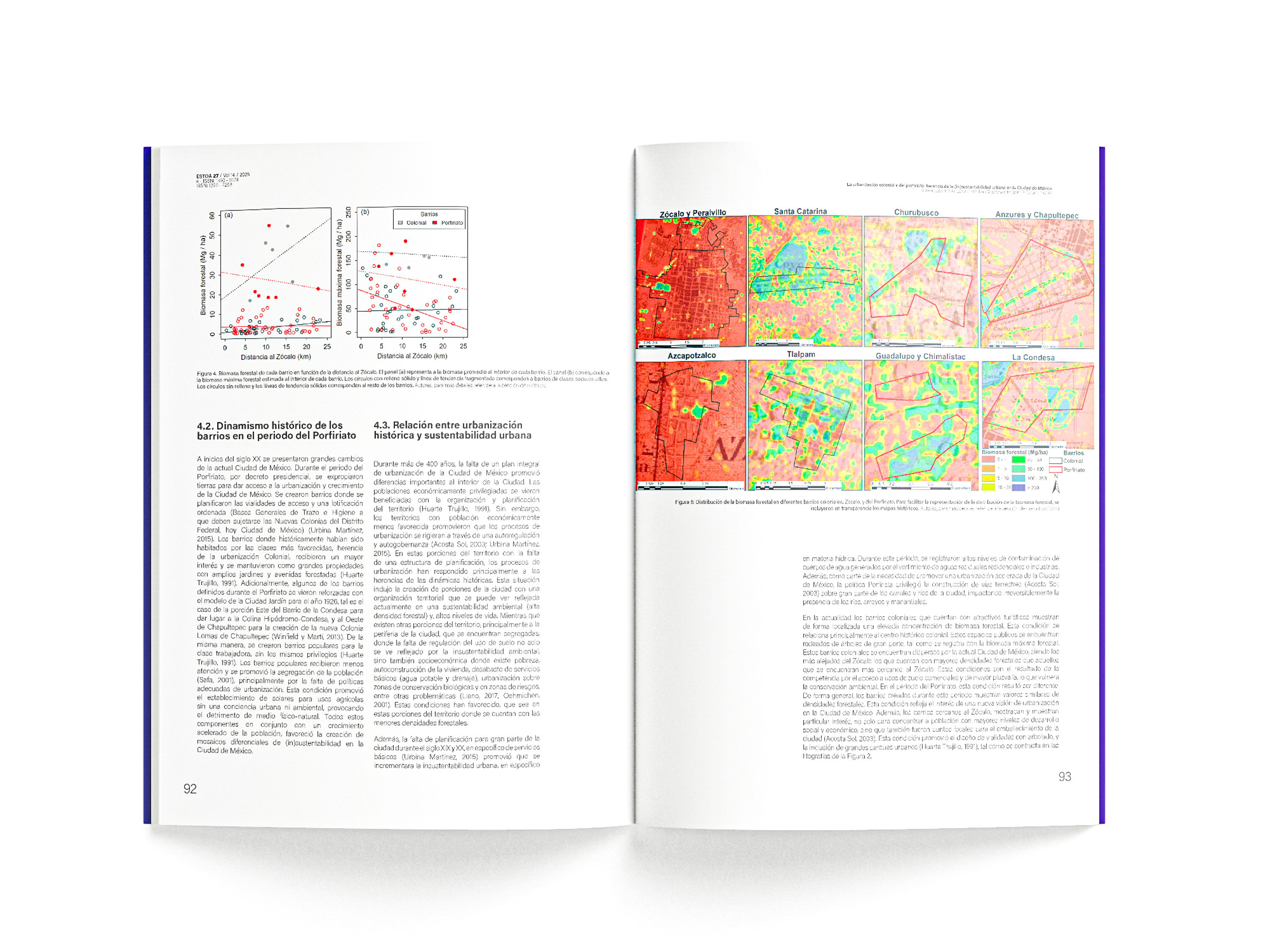
Mexico City has experienced different periods of urban transformation, especially during the Colonial era and the Porfiriato. These periods have left a mark on urban (un)sustainability not only in Mexico City but also in other colonial cities. Using cartographic time series and the functional concept of neighborhoods, this study analyzes their influence on urban sustainability in the 21st century. We evaluate this sustainability through the environmental indicator of forest biomass. Our results suggest that colonial neighborhoods show a central concentration of forest biomass, decreasing as they move away from the colonial square (Zócalo). In contrast, during the Porfiriato, biomass is concentrated in the urbanization near the Zócalo, distributed in median strips and gardens. This study lays the groundwork for understanding the legacy of urban (un)sustainability throughout the periods of urbanization in Mexico.
Downloads
References
Acosta Sol, E. (2003). Parte I. Crecimiento urbano durante el Porfiriato. Esencia Espacio, 43-46.
Ascher, F. (2007). Los Nuevos principios del urbanismo. El fin de las ciudades no está a la orden del día. Alianza Editorial.
Bandarin, F., y Van Oers, R. (2014). El paisaje urbano histórico. La gestión del patrimonio en un siglo urbano. Abada editores.
Caballero Deloya, M. (1986). Urban forestry activities in Mexico. Journal of Arboriculture, 12(10), 251-256.
Cárdenas-Mamani, Ú., y Perrotti, D. (2022). Understanding the contribution of ecosystem services to urban metabolism assessments: An integrated framework. Ecological Indicators, 136, 108593. doi:10.1016/j.ecolind.2022.108593
Castro Gutiérrez, F. (2010). El origen y conformación de los barrios de indios. Los indios y las ciudades en Nueva España, 105-122.
CONAFOR. (2012). National Forest inventory and soils 2004-2009. Protocolo de muestreo de campo. Comisión Nacional Forestal, Guadalajara, México.
Corona-Núñez, R.O, Mendoza-Ponce, A.V., y López-Martínez, R. (2017). Model selection changes the spatial heterogeneity and total potential carbon in a tropical dry forest. Forest Ecology and Management, 405, 69-80.
Corona-Núñez, R.O., Mendoza-Ponce, A.V., y Campo, J. (2021). Assessment of above-ground biomass and carbon loss from a tropical dry forest in Mexico. Journal of Environmental Management, 282, 111973. 10.1016/j.jenvman.2021.111973
Corona, R.O, Galicia, L., Palacio-Prieto, J.L., Bürgi, M., y Hersperger, A. (2016). Local deforestation patterns and driving forces in a tropical dry forest in two municipalities of southern Oaxaca, Mexico (1985-2006). Investigaciones geográficas, 91, 86-104. 10.14350/rig.50918
Cruz-Bello, G., Galeana-Pizaña, J., y González-Arellano, S. (2023). Urban growth in peri-urban, rural and urban areas: Mexico City. Buildings and cities, 4(1), 1-16. 10.5334/bc.230
Christlieb, F.F., y Urquijo-Torres, P.S. (2005). The spaces of the pueblo de indios after the process of Congregación, 1550-1625. Investigaciones geográficas, 60, 145-158.
Dekolo, S., Oduwaye, L., y Nwokoro, I.I.C. (2014). Urban Sprawl and Loss of Agricultural Land in Peri-urban Areas of Lagos. Regional Statistics, 5(2), 20-33.
Denevan, W.M. (1992). The Native population of the Americas in 1492. University of Wisconsin Press.
EEA. (2022). Urban Sustainability in Europe — Glossary of key terms and concepts. https://www.eea.europa.eu/themes/sustainability-transitions/urban-environment/urban-sustainability-in-europe.
Escamilla Trejo, A. (2020). La política industrial del Porfiriato a la Revolución. Aproximación historiográfica y análisis. Economía UNAM, 17(49), 165-203. 10.22201/fe.24488143e.2020.49.513
Escobar-Chanona, L. (2016). La evolución histórica del paisaje rural al paisaje urbano de los barrios tradicionales de la Ciudad de México. Estudio comparativo del Barrio de Santa Catarina, Coyoacán y el Barrio de la Asunción, Iztacalco. (Maestría en Diseño. Diseño, planeación y conservación de paisajes y jardínes.), Universidad Autónoma de Metropolitana.
Florescano Mayet, E. (2009). México durante el Porfiriato, 1876-1911. Herencia, 22(1), 89-120.
Gaitán Ortíz, J. (1993). La ciudad de México durante el Porfiriato: “El País de América”. En Centro de estudios Mexicanos y Centroamericanos (Ed.), México Francia (179-196). México, 10.4000/books.cemca.823.
Hatab, A.A., Cavinato, M. E. R., Lindemer, A., y Lagerkvist, C.J. (2019). Urban sprawl, food security and agricultural systems in developing countries: A systematic review of the literature. Cities, 94, 129-142.
Henderson, V. (2003). The urbanization process and economic growth: The so-what question. Journal of Economic growth, 8(1), 47-71.
Huarte Trujillo, M.C. (1991). La política de urbanización de nuevas áreas habitacionales en el Porfiriato (1900-1910). Revista Fuentes Humanísticas, 2(3), 38-45.
James, P. (2014). Urban Sustainability in Theory and Practice: Circles of sustainability. London: Routledge, 10.4324/9781315765747.
Liano, A.J.G. (2017). Segregación social en la periferia urbana de la Ciudad de México. Estudio de caso de Xochimilco. Revista Latinoamericana de Estudiantes de Geografía, 5(1), 57-64.
Maxwell, S., y Slater, R. (2003). Food Policy Old and New. Development Policy Review, 21(5-6), 531-553. 10.1111/j.1467-8659.2003.00222.x
Mendoza-Ponce, A.V., Corona-Núnez, R.O., Galicia, L., y Kraxner, F. (2019). Identifying hotspots of land use cover change under socioeconomic and climate change scenarios in Mexico. Ambio, 48(4), 336-349.
Mendoza-Ponce, A.V., Corona-Núñez, R.O., Galicia, L., y García-Guerrero, V. M. (2019). Population and economic projections under different scenarios for Mexico. Papeles de población, 25(99), 9-43.
Mendoza-Ponce, A.V., Corona-Núñez, R.O., Kraxner, F., y Estrada, F. (2020). Spatial prioritization for biodiversity conservation in a megadiverse country. Anthropocene, 32, 100267. 10.1016/j.ancene.2020.100267.
Meza Aguilar, M.C. y Moncada Maya, J. (2009). La protección y conservación de las áreas verdes de la ciudad de México: un reto actual. Revista Legado de Arquitectura y Diseño, 4(5), 79-100.
Miranda Pacheco, S. (2019). Desagüe, ambiente y urbanización de la Ciudad de México en el siglo XIX. Relaciones Estudios de Historia y Sociedad, 31-72.
Musset, A. (1996). De Tláloc a Hipócrates. El agua y la organización del espacio en la Cuenca de México. Siglos XVI a XVIII. En Tierra, agua y bosques: historia y medio ambiente en el México Central, coord. A. Tortolero. CEMCA, Instituto Mora.
Oehmichen, C. (2001). Espacio urbano y segregación étnica en la ciudad de México. Papeles de población, 7(28), 181-197.
Pearson, R.G., Martínez-Meyer, E., Andrade Velázquez, M. Caron, M., Corona-Núñez, R.O., Davis, K., Paz Durán, K., García Morales, R., Hackett, T.D., Ingram, D.J., Loyola Díaz, R.,Lescano, J., Lira-Noriega, A., López-Maldonado, Y., Manuschevich, D., Mendoza, A., Milligan, B., Mills, S.C., Moreira-Arce, D., Nava, L.F., Oostra, V., Owen, N., Prieto-Torres, D., Rodríguez-Soto, C., Smith, T., Suggitt, A.J., Tejo Haristoy, C., Velásquez-Tibatá, J., Díaz, S., y Marquet, P.A. (2019). Research priorities for maintaining biodiversity’s contributions to people in Latin America. UCL Open: Environment, 26320886. 10.14324/111.444/000014.v1
Perrotti, D. (2020). Chapter 2. Urban metabolism: old challenges, new frontiers, and the research agenda ahead. En P. Verma, P. Singh, R. Singh, y A. S. Raghubanshi (Eds.), Urban Ecology (17-32): Elsevier, 10.1016/B978-0-12-820730-7.00002-1.
Ramírez, P. (2009). Espacio público y ciudadanía en la ciudad de México. Percepciones, apropiaciones y prácticas sociales en Coyoacán y su Centro Histórico. UNAM-Posgrado en Urbanismo y Porrúa.
Safa, P. (2001). Vecinos y vecindarios en la ciudad de México. Un estudio sobre la construcción de las identidades vecinales en Coyoacán. Editorial Porrúa.
Sánchez Ruiz, G. (2020). Ciudades latinoamericanas entre mediados del siglo XIX y principios del XX: del Higienismo al Urbanismo. Arquitectura y Urbanismo, XLI(2).
Schirpke, U., Tscholl, S., y Tasser, E. (2020). Spatio-temporal changes in ecosystem service values: Effects of land-use changes from past to future (1860–2100). Journal of Environmental Management, 272, 111068, 10.1016/j.jenvman.2020.111068.
Spiliotopoulou, M., y Roseland, M. (2020). Urban Sustainability: From Theory Influences to Practical Agendas. Sustainability, 12(18), 7245.
Terrones, M. (2009). La Ciudad de México y su Hinterland: El círculo virtuoso. In M. Barbosa y S. González (Eds.), En: Problemas de la urbanización en el Valle de México, 1810-1910. (91-125). Los Centenarios-UAM.
Toussaint, M. (1956). “Introducción” en Información de méritos y servicios de Alonso García Bravo, alarife que trazó la Ciudad de México. Ciudad de México, México. Instituto de Investigaciones Estéticas, UNAM.
UNESCO (2005). Memorándum de Viena sobre el Patrimonio Mundial y la Arquitectura Contemporánea. Gestión del Paisaje Histórico Urbano. Organización de las Naciones Unidas para la Educación, la Ciencia y la Cultura. Viena, Austria. Recuperado de https://unesdoc.unesco.org/ark:/48223/pf0000141303_spa
Urbina Martínez, G. (2015). Algunas formas de negociación de los sectores populares ante los juzgados civiles de la ciudad de México en las primeras décadas del siglo XX. Trashumante, 6, 83-103. 10.17533/udea.trahs.n6a05
Vieira, L.C., Serrao-Neumann, S., Howes, M., y Mackey, B. (2018). Unpacking components of sustainable and resilient urban food systems. Journal of Cleaner Production, 200, 318-330. 10.1016/j.jclepro.2018.07.283
Whitehead, M. (2009). Sustainability, Urban. In R. Kitchin y N. Thrift (Eds.), International Encyclopedia of Human Geography (109-116). Elsevier.
Winfield, F. y Martí, D. (2013). Urbanismo y modernidad: La influencia de las ciudades jardín en México: 1921-1930. Arquitectura Moderna en Latinoamérica, 31(44), 34-47.
Downloads
Published
How to Cite
Issue
Section
License
Copyright (c) 2024 Estoa. Journal of the Faculty of Architecture and Urbanism

This work is licensed under a Creative Commons Attribution-NonCommercial-ShareAlike 4.0 International License.
The Journal declines any responsibility for possible conflicts derived from the authorship of the works that are published in it.
The University of Cuenca in Ecuador conserves the patrimonial rights (copyright) of the published works and will favor the reuse of the same ones, these can be: copy, use, diffuse, transmit and expose publicly.
Unless otherwise indicated, all contents of the electronic edition are distributed under a Creative Commons Attribution-NonCommercial-ShareAlike 4.0 International License.
Funding data
-
Secretaría de Ciencia, Humanidades, Tecnología e Innovación,Consejo Mexiquense de Ciencia y Tecnología
Grant numbers ESYCA2023-1721 -
Sistema Nacional de Investigadores
Grant numbers 15004