Traslatio: study and dissemination of maritime heritage
DOI:
https://doi.org/10.18537/est.v014.n027.a01Keywords:
maritime architecture, maritime heritage, restoration, identity, participationAbstract
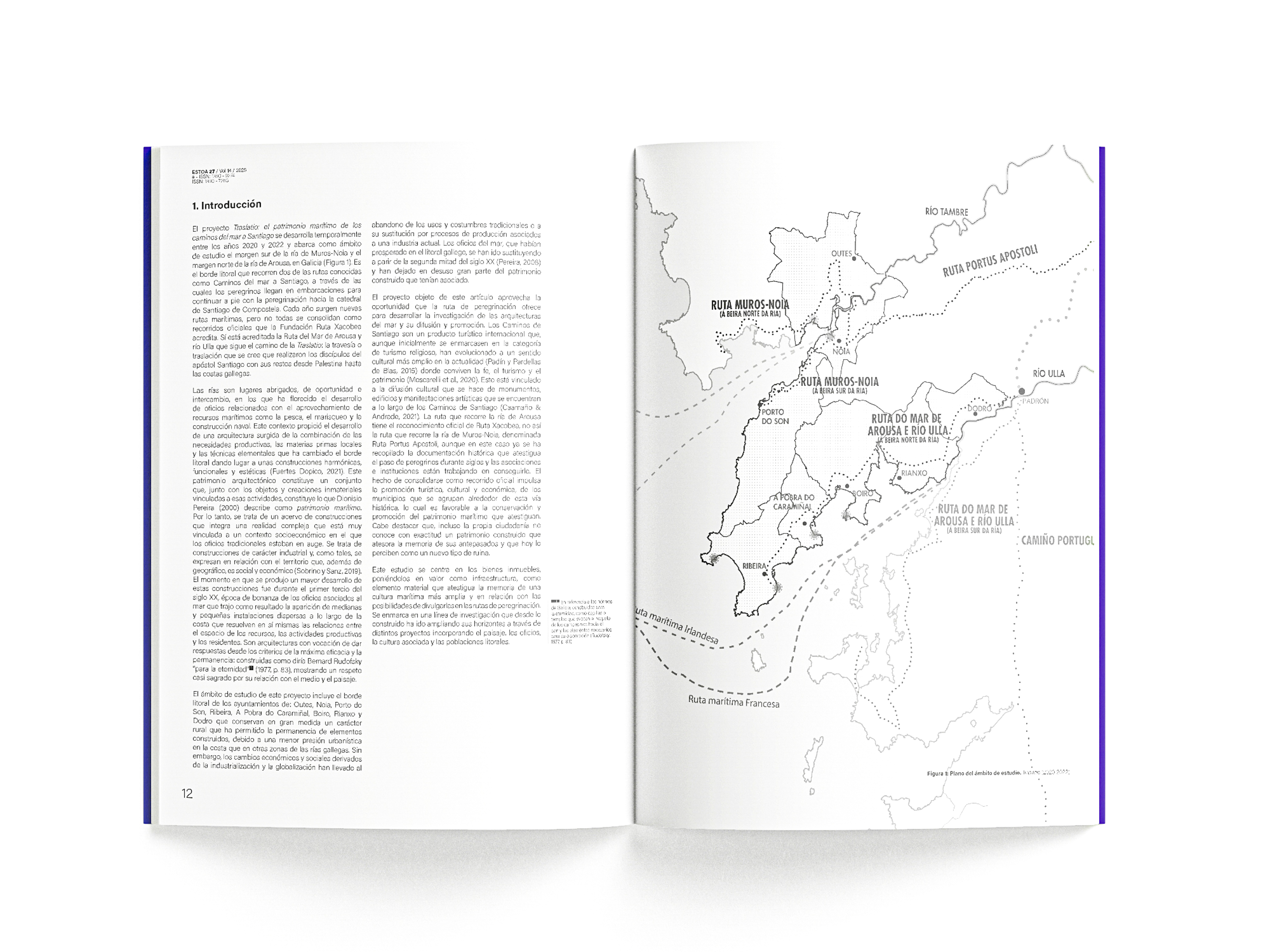
The Traslatio project develops research on the southern estuary of Muros-Noia and the northern estuary of Arousa in Galicia, Spain. The aim is to enhance the maritime architectural heritage of both estuaries through the systematic study of buildings associated with small-scale traditional maritime industries, such as salting factories, canneries, traditional shipyards, shellfish farms, whaling factories and ancillary buildings. Following the inventory of the constructions, participatory and dissemination activities are developed with the objective of disseminating knowledge to visitors and pilgrims who travel the sea routes to Santiago de Compostela, engaging with local population and fostering intergenerational dialogue and the transmission of this heritage that represents the identity of the Galician coast.
Downloads
References
Abelleira Doldán, M. A. (2021). Tres naves varadas. Fábrica de salazón en A Pobra do Caramiñal. En I. Fernández Penedo y Ó. Fuentes Dopico (Eds.), Patrimonio marítimo: el patrimonio marítimo de los caminos del mar a Santiago, 13-17.
AFIPRODEL (2021). Guía de Buenas Prácticas “O teu Xacobeo 21-22, Asociación “ Finisterrae” de profesionales de desarrollo local https://afiprodel.org/afiprodel/wp-content/uploads/2021/10/BOAS-PRACTICAS-CIENCIA-NO-CAMINO.pdf
Amaro, A. & Oliveira, L. (2019). IoT for Playful Intergenerational Learning about Cultural Heritage: The LOCUS Approach. Proceedings of the 5th International Conference on Information and Communication Technologies for Ageing Well and e-Health - ICT4AWE; ISBN 978-989-758-368-1; ISSN 2184-4992, SciTePress, 282-288. https://doi.org/10.5220/0007747202820288
Azurmendi, L. (2005). La arquitectura y el paisaje. En S. Marchán (Coord.), Molinos de mar y estuarios, 17-38.
Caamaño-Franco, I., & Andrade-Suárez, M. (2021). The Way of Saint James and the Xacobeo as polysemic phenomena: Reflections through the study of their media image. Revista Galega De Economía, 30(3), 1-20. https://doi.org/10.15304/rge.30.3.7485
Caamaño-Franco, I. y Lezcano González, M. E. (2021). El patrimonio marítimo industrial. Pasado, presente y futuro en el ámbito cultural-turístico de Galicia. En I. Fernández Penedo y Ó. Fuentes Dopico (Eds.), Patrimonio marítimo: el patrimonio marítimo de los caminos del mar a Santiago, 13-17
Calvo, M., Cruickshank, L., & Sclater, M. (2022). Exploring mutual learning in co-design. Discern: International Journal of Design for Social Change, Sustainable Innovation and Entrepreneurship, 3(2), 79-96.
Carmona Badía, X. (2010) Lo material y lo inmaterial en el Patrimonio Industrial de Galicia: notas sobre su situación y características. En M. G. Álvarez Areces (Coord.), Patrimonio Industrial y Paisaje: V congreso sobre patrimonio industrial y la obra pública en España. Gijón, Editorial CICEES, 533-540.
Castillo, A., Yáñez, A., Domínguez, M. & Salto, I. (2015) Citizenship and heritage commitment: looking for participatory methodologies adapted to the urban cultural heritage context. In M. Di Stefan (Ed.), 18 ICOMOS General Assembly: Symposium, Firenze, Italia 9-14 November 2014: heritage and landscape as human values Conference Proceedings. Napoli, Giannini, 416-422.
Consellería de Cultura y Turismo (2019), DECRETO 52/2019, de 9 de mayo, por el que se declaran bien de interés cultural las técnicas constructivas de la carpintería de ribera. Xunta de Galicia, DOG nº99 de 27/05/2019, 25703-25722. https://www.xunta.gal/dog/Publicados/2019/20190527/AnuncioG0535-200519-0001_es.pdf
Cuenca López, J. M. (2023). La educación patrimonial como eje articulador para la formación de los agentes patrimoniales y turísticos orientada a la sostenibilidad de los paisajes culturales. En J. Morillas Alcázar (Ed.), El Observatorio en Turismo Patrimonial Sostenible en Andalucía: análisis, diagnóstico, adecuación, innovación y transferencia, 213-227.
Fabregat-Nodar, C. (2021). Rehabilitar el patrimonio de los oficios del mar para coser la brecha entre pasado y futuro. En I. Fernández Penedo y O. Fuertes Dopico (Ed.), Patrimonio marítimo: el patrimonio marítimo de los caminos del mar a Santiago, 24-31
Fernández Penedo, I. (2021). El patrimonio olvidado de la ría de Vigo. 3 casos singulares. En I. Fernández Penedo y O. Fuertes Dopico (Ed.), Patrimonio marítimo: el patrimonio marítimo de los caminos del mar a Santiago, 13-17
Fuertes Dopico, O. (2021). La arquitectura del borde litoral un patrimonio construido como seña de identidad de la cultura del mar de Galicia. En I. Fernández Penedo y O. Fuertes Dopico (Ed.), Patrimonio marítimo: el patrimonio marítimo de los caminos del mar a Santiago,13-17
Fuertes Dopico, O. (2019). Valorización y estudio del patrimonio marítimo preindustrial vinculado a los oficios del mar del borde litoral de la provincia de A Coruña. Proyecto de investigación. Deputación da Coruña.
Fuertes Dopico, O. y Varela Lojo, F. (2014). Las arquitecturas del mar. Fundación Universidad de A Coruña.
Llorca, J. (2021). Aporías de la investigación en arquitectura: adaptación del modelo científico en la producción y divulgación del conocimiento explícito. ACE: Architecture, City and Environment, 16(46), 9531. http://dx.doi.org/10.5821/ace.16.46.9531
Lucca, E. (2017). Estrategias y metodologías de formación de equipos interdisciplinarios para trabajar en hábitat. Hábitat y Sociedad, 10, 15-34. http://dx.doi.org/10.12795/HabitatySociedad.2017.i10.02
Manzini Marchesi, L. (2011). El significado cultural del patrimonio. Estudios del Patrimonio Cultural, 6, 27-42.
Moscarelli, R., López, L., & Lois González, R. C. (2020). Who is interested in developing the way of Saint James? The pilgrimage from faith to tourism. Religions, 11(1), 24. https://doi.org/10.3390/rel11010024
OSE [Compilador], (2009). Patrimonio natural, cultural y paisajístico: claves para la sostenibilidad territorial. Madrid. Observatorio de la Sostenibilidad en España. Ministerio de Medio Ambiente y Medio Rural y Marino. Fundación Biodiversidad. Fundación General de la Universidad de Alcalá.
Padín, C., y Pardellas de Blas, X. (2015). Patrimonio y turismo sostenible en el Camino de Santiago: la gestión de las administraciones locales del itinerario francés en Galicia. PASOS: Revista de turismo y patrimonio cultural, 13(6), 1413-1423. https://doi.org/10.25145/j.pasos.2015.13.098
Pereira, D. (2000). O patrimonio marítimo de Galicia. Cambados: Federación Galega pola Cultura Marítima.
Pereira, D. (2008). Patrimonio marítimo galego: un diagnóstico actual. Adra: revista dos socios e socias do Museo do Pobo Galego, 3, 25-44
Pérez Porto, A., Torres García, C. y García Vázquez, J. (2021). Galicia enxebre. En P. Sabín Díaz, P. (Coord)., I. Fernández Penedo y O. Fuertes Dopico (Eds.), Patrimonio marítimo: el patrimonio marítimo de los caminos del mar a Santiago, 13-17
Río Vázquez, A. S. (2021). El borde marino como paisaje de la modernidad. I. Fernández Penedo y O. Fuertes Dopico (Ed.), Patrimonio marítimo: el patrimonio marítimo de los caminos del mar a Santiago, 13-17
Rossi, A. (2018). Tipología, Manualística y Arquitectura. En M. Puente (Ed.) y F. Serra i Cantarell (trad.), Posicionamientos. Barcelona: Editorial GG, 29–45.
Rudofsky, B. (1977). Architecture without architects, an introduction to nonpedigreed architecture. New York: The Museum of Modern Art, Distributed by Doubleday Garden City.
Sabín Díaz, P. y Blanco Rodríguez, E. (2021). Arquitecturas del límite. I. Fernández Penedo y O. Fuertes Dopico (Ed.), Patrimonio marítimo: el patrimonio marítimo de los caminos del mar a Santiago, 13-17
Sobrino Simal, J. y Sanz Carlos, M. (2019) Pensando el patrimonio industrial. Los retos del siglo XXI. Periférica. Revista para el análisis de la cultura y el territorio, 20, 88-99.
Tambaum, T. (2022). Intergenerational Learning in Action. Third International Handbook of Lifelong Learning. Springer, Cham. 1-24 https://doi.org/10.1007/978-3-030-67930-9_35-1
Downloads
Published
How to Cite
Issue
Section
License
Copyright (c) 2024 Estoa. Journal of the Faculty of Architecture and Urbanism

This work is licensed under a Creative Commons Attribution-NonCommercial-ShareAlike 4.0 International License.
The Journal declines any responsibility for possible conflicts derived from the authorship of the works that are published in it.
The University of Cuenca in Ecuador conserves the patrimonial rights (copyright) of the published works and will favor the reuse of the same ones, these can be: copy, use, diffuse, transmit and expose publicly.
Unless otherwise indicated, all contents of the electronic edition are distributed under a Creative Commons Attribution-NonCommercial-ShareAlike 4.0 International License.
Funding data
-
Xunta de Galicia
Grant numbers Xacobeo 21-22