The Assessment of Low Intensity Complex Heritage Landscapes. The Case Study of Sancti Petri (Cádiz)
DOI:
https://doi.org/10.18537/est.v015.n029.a07Keywords:
value, methodology, invisible heritage, attributes, territoryAbstract
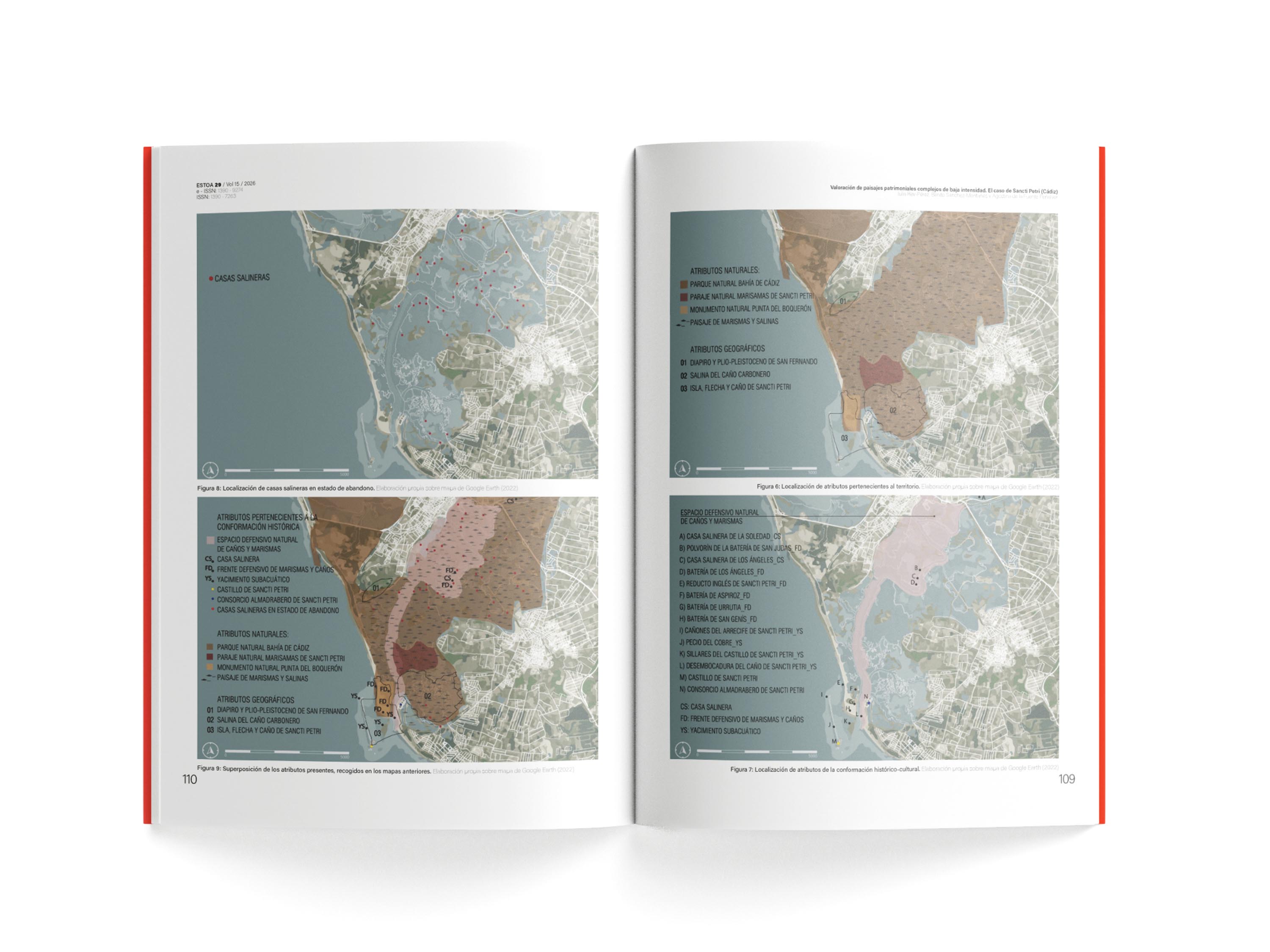
There are areas where heritage elements are not associated with the common idea of heritage, which increases their invisibility and lack of protection. The aim of this research is to recognise the existence of these heritage environments known as Low Intensity Complex Heritage Landscapes (LICHL), through the case study of Sancti Petri. The proposed methodology firstly identifies the attributes that make up the heritage reality of this place, in order to subsequently address its valuation and the definition of its heritage intensity in terms of the relationship between all its factors. Secondly, it identifies the structure and density of the heritage reality, with the elaboration of maps, being able to justify whether it is a LICHL. The results reveal the number of heritage attributes that characterise the environment and its relationships, which reveals the difficulty of its management and the absence of regulatory figures for its protection.
Downloads
References
Alba, J. M. (2016). Taller Cabo de Trafalgar y Sancti Petri. https://juanmiguelalba.blogspot.com/2016/02/?m=1
Aragón Panés, J. (2011). Breve historia de Chiclana. Navarro.
Consejería de Transformación Económica, Industria y Universidades - Junta de Andalucía. (2009). Atlas de la Historia del Territorio de Andalucía. https://www.juntadeandalucia.es/institutodeestadisticaycartografia/atlasterritorio/at/index.html
Consejería de Cultura y Patrimonio Histórico - Junta de Andalucía. (s.f.). Catálogo General del Patrimonio Histórico Andaluz. https://www.juntadeandalucia.es/organismos/culturaydeporte/areas/cultura/bienes-culturales/catalogo-pha/consulta.html
Consejo de Europa. (2000). Convenio Europeo del Paisaje. Florencia. https://www.mapa.gob.es/es/desarrollo-rural/planes-y-estrategias/desarrollo-territorial/090471228005d489_tcm30-421583.pdf
Consejo de Europa. (2005). Convenio Marco del Consejo de Europa sobre el valor del patrimonio cultural para la sociedad. Faro. https://rm.coe.int/16806a18d3
de la Torre, M. & Mason, R. (2002). Introduction. En M. de la Torre (Ed.), Assessing the values of Cultural Heritage. Research report (pp. 3–4). The Getty Conservation Institute. https://www.getty.edu/conservation/publications_resources/pdf_publications/pdf/assessing.pdf
Fernández-Baca Casares, R., Castellano Bravo, B., Fernández Cacho, S., García de Casasola Gómez, M., Rey-Pérez, J. y Villalobos Gómez, A. (2007). Acciones en el paisaje cultural de la Ensenada de Bolonia, Cádiz. PH Boletín Del Instituto Andaluz Del Patrimonio Histórico, 63, 92–115. http://hdl.handle.net/11532/244836
Fernández-Cacho, S. (Ed.). (2022). How to Create a Cultural Landscape Guide. Instituto Andaluz de Patrimonio Histórico - IAPH. https://hdl.handle.net/11532/362884
Fernández-Salinas, V. (2013). Los paisajes de interés cultural de Asturias. Ería: Revista Cuatrimestral de Geografía, 91, 129-149. https://reunido.uniovi.es/index.php/RCG/article/view/9994
García, M. y Mestre, S. (2019). Documento Ambiental Estratégico del Plan de Usos del Puerto de Sancti-Petri. https://www.juntadeandalucia.es/medioambiente/portal/documents/20151/506586/DAE_2019_09_PU_Sancti_Petri_DAE.pdf
Google Earth. (2022). Caño de Sancti Petri, Chiclana, 36.430570, -6.195263. https://www.google.es/intl/es/earth/index.html
Higueras-Milena, A. (2021). Aproximación al patrimonio arqueológico subacuático de San Fernando (Cádiz). Un extraordinario legado en torno al islote de Sancti-Petri. Revista Atlántica-Mediterránea, 22, 309-335. https://doi.org/10.25267/rev_atl-mediterr_prehist_arqueol_soc.2020.v22.19
Hong, Z., Wentao C., Ying C., Sijia Z. & Wenjun Z. (2024). Identifying Rural Landscape Heritage Character Types and Areas: A Case Study of the Li River Basin in Guilin, China. Sustainability 16(4), 2-23, https://doi.org/10.3390/su16041626
IAPH. (2010). Paisajes y patrimonio cultural en Andalucía. Tiempo, usos e imágenes. Junta de Andalucía. Consejería de Cultura. https://www.juntadeandalucia.es/organismos/iaph/servicios/publicaciones/detalle/78651.html
Instituto Andaluz del Patrimonio Histórico. (2013). Guía Digital del Patrimonio Cultural de Andalucía, Consejería de Cultura y Patrimonio Histórico: Salinas en la Bahía de Cádiz. https://guiadigital.iaph.es/bien/inmaterial/237967/cadiz/san-fernando-chiclana-de-la-frontera-puerto-real-puerto-de-santa-maria-el/salinas-en-la-bahia-de-cadiz
ICOMOS. (1982). Historic Gardens (The Florence Charter 1981). http://www.icomos.org/en/charters-and-texts
ICOMOS. (1999). Charter on the built vernacular heritage (1999). https://www.icomos.org/images/DOCUMENTS/Charters/vernacular_e.pdf
ICOMOS. Australia. (1999). The Australia ICOMOS Charter for the Conservation of Places of Cultural Significance. https://openarchive.icomos.org/id/eprint/2145/
ICOMOS. (2011). The Valletta Principles for the Safeguarding and Management of Historic Cities, Towns and Urban Areas. París. https://www.icomos.org/images/DOCUMENTS/Dubrovnik-Valletta_Principles_EN_20091017.pdf
ICOMOS. (2014). The Florence Declaration on Heritage and Landscape as Human Values. https://www.icomos.org/images/DOCUMENTS/Secretariat/2015/GA_2014_results/GA2014_Symposium_FlorenceDeclaration_EN_final_20150318.pdf
ICOMOS. (2017). Principios sobre los Paisajes Rurales como Patrimonio. https://culturapedia.com/wp-content/uploads/2020/09/2017-principios-paisaje-rural-patrimonio.pdf
Ikt y Paisaia. (2005). Catálogo abierto de paisajes singulares y sobresalientes de la CAPV. Vitoria, Departamento de Medio Ambiente y Ordenación del Territorio del Gobierno Vasco, Dirección de Biodiversidad y Participación Ambiental.
Juca Freire, N. A. (2021). Gobernanza del patrimonio. Desafíos de una comunidad impulsada por su patrimonio. Estoa. Revista de la Facultad de Arquitectura y Urbanismo de la Universidad de Cuenca, 10(19), 45–53. https://doi.org/10.18537/est.v010.n019.a04
Junta de Andalucía. (2007). Ley 14 de 26 de noviembre, del Patrimonio Histórico de Andalucía, Boletín Oficial del Estado, 38, de 13 de febrero de 2008. https://www.boe.es/buscar/pdf/2008/BOE-A-2008-2494-consolidado.pdf
Martín, E. (2007). Salinas y explotaciones salineras en la Bahía de Cádiz a finales de la edad media. En N. Morère Molinero (Ed.), Las salinas y la sal de interior en la historia: economía, medio ambiente y sociedad. DYKINSON.
Martínez, D. (12 de julio de 2018). El histórico poblado de Sancti Petri afronta sus últimos días de existencia. Diario de Cádiz. https://www.diariodecadiz.es/noticias-provincia-cadiz/historico-Sancti-Petri-ultimos-existencia_0_167383651.html
Naeyer, A. De, Arroyo, S. & Blanco, J. (2000). Krakow charter 2000: Principles for conservation and restoration of built heritage. Bureau Krakow 2000. http://hdl.handle.net/1854/LU-128776
Pereira Roders, A. (2007). RE-ARCHITECTURE: lifespan rehabilitation of built heritage. Eindhoven University of Technology.
Pilquiman, M., Merino, A. y Cabrera, G. (2020). Paisaje patrimonial y turismo en la zona precordillerana de Panguipulli, sur de Chile. Investigaciones Turísticas, (20), 262–283. https://doi.org/10.14198/INTURI2020.20.12
Pozo, A. D. (2008). Santi Petri. Espacio disciplinado. (Tesis Doctoral). Universidad de Sevilla. https://idus.us.es/handle/11441/15460
Recurso contra Costas al negar que el poblado pase a disposición municipal. (1 de septiembre 2016). El periódico de Chiclana. http://elperiodicodechiclana.com/8971-2/
Reina, J. A. (27 de julio de 2022). Sancti Petri: dos décadas de espera para su recuperación turística. La Razón. https://www.larazon.es/andalucia/20220727/ncqkmj3735hrzngc5e5iwgu544.html
Riegl, A. (1987). El culto moderno a los monumentos. Caracteres y origen. Visor.
Rössler, M. (2006). Los paisajes culturales y la Convención del Patrimonio Mundial Cultural y Natural: resultados de reuniones previas. En E. Mújica Barreda (Ed.), Paisajes culturales en los Andes: memoria narrativa, casos de estudio, recomendaciones de la Reunión de expertos, Arequipa y Chiva, Perú, mayo de 1998, Lima (pp. 47–55). Unesco. http://www.condesan.org/unesco/ZAnexo04Roessler.pdf
Sánchez-Montañés, B. y Castilla, M. (2020). Fábricas de resiliencia. Una oportunidad para el patrimonio industrial: el caso de La Trinidad. ACE: Architecture, City and Environment, 15(43), 1-18. http://dx.doi.org/10.5821/ace.15.43.9192
Silva, R. y Fernández, V. (2017). El nuevo paradigma del patrimonio y su consideración con los paisajes: Conceptos, métodos y prospectivas. Documents d’Anàlisi Geogràfica, 63(1), 129–151. https://doi.org/10.5565/rev/dag.344
Spoormans, L. y Pereira, A. (2020). Methods in assessing the values of architecture in residential neighbourhoods. International Journal of Building Pathology and Adaptation, 39(3), 490-506. https://doi.org/10.1108/IJBPA-10-2019-0095
Tarrafa, A. y Pereira, A. (2021). Taxonomias do significado cultural do património: valores e atributos. En C. Almeida Marado, T. Valente y J. Pedro Bernardes (Eds.), Gestão do Património Cultural: experiências e desafios (pp. 10-31). University of Algarve. https://doi.org/10.34623/vt4s-7r64
Tévar Sanz, G. (1996). La cuenca visual en el análisis del paisaje. Serie Geográfica 6: 99-113. https://ebuah.uah.es/dspace/bitstream/handle/10017/1052/La%20Cuenca%20Visual%20en%20el%20An%c3%a1lisis%20del%20Paisaje.pdf?sequence=1&isAllowed=y
Troitiño, L. (2017). El paisaje como recurso patrimonial y turismo. II Seminario Turismo y Patrimonio en áreas metropolitanas, Madrid. https://www.ucm.es/data/cont/media/www/pag103563/El%20paisaje%20como%20patrimonial%20y%20tur%C3%ADstico_LibertadTroiti%C3%B1o.pdf
UNESCO. (1972). Convention Concerning the protection of the World Cultural and Natural Heritage. http://whc.unesco.org/en/conventiontext
UNESCO. (1976). Recommendation concerning the Safeguarding and Contemporary Role of Historic Areas. http://portal.unesco.org/en/ev.php-RL_ID=13133&URL_DO=DO_TOPIC&URL_SECTIO=201.html
UNESCO. (1992). Convention concerning the protection of the world cultural and natural heritage. World Heritage Committee. Sixteenth Session. Santa Fe, United States of America (7-14 December, 1992). https://whc.unesco.org/archive/1992/whc-92-conf002-12e.pdf
UNESCO. (2003). Convención para la salvaguardia del patrimonio cultural inmaterial 2003. https://unesdoc.unesco.org/ark:/48223/pf0000132540_spa
UNESCO. (2011). Recommendation on the historic urban landscape. https://whc.unesco.org/document/160163
UNESCO. (2012). Records of the General Conference. 36th Session. Paris, 25 October–10 November 2011. Volume 1. Resolutions. Paris. https://unesdoc.unesco.org/ark:/48223/pf0000215084
Veldpaus, L. y Pereira Roders, A. (2014). Learning from a Legacy: Venice to Valletta. Change over Time, 4(2), 244–263. https://muse.jhu.edu/article/557037/summary
Verdini, G., Frassoldati, F. & Nolf, C. (2017). Reframing China’s heritage conservation discourse. Learning by testing civic engagement tools in a historic rural village. International Journal of Heritage Studies, 23(4), 317–334. https://doi.org/10.1080/13527258.2016.1269358
Vioque, R. (1997). Arquitecturas asociadas a la pesca de almadraba en el Golfo de Cádiz (Memoria Docente curso 96-97). Universidad de Sevilla.
Downloads
Published
How to Cite
Issue
Section
License
Copyright (c) 2025 Estoa. Journal of the Faculty of Architecture and Urbanism

This work is licensed under a Creative Commons Attribution-NonCommercial-ShareAlike 4.0 International License.
The Journal declines any responsibility for possible conflicts derived from the authorship of the works that are published in it.
The University of Cuenca in Ecuador conserves the patrimonial rights (copyright) of the published works and will favor the reuse of the same ones, these can be: copy, use, diffuse, transmit and expose publicly.
Unless otherwise indicated, all contents of the electronic edition are distributed under a Creative Commons Attribution-NonCommercial-ShareAlike 4.0 International License.