Impact of heat on the deterioration of facades of the industrial heritage of the Peruvian Sierra
DOI:
https://doi.org/10.18537/est.v015.n029.a05Keywords:
architectural heritage, thermal sensation, heat impact, facades, climate variabilityAbstract
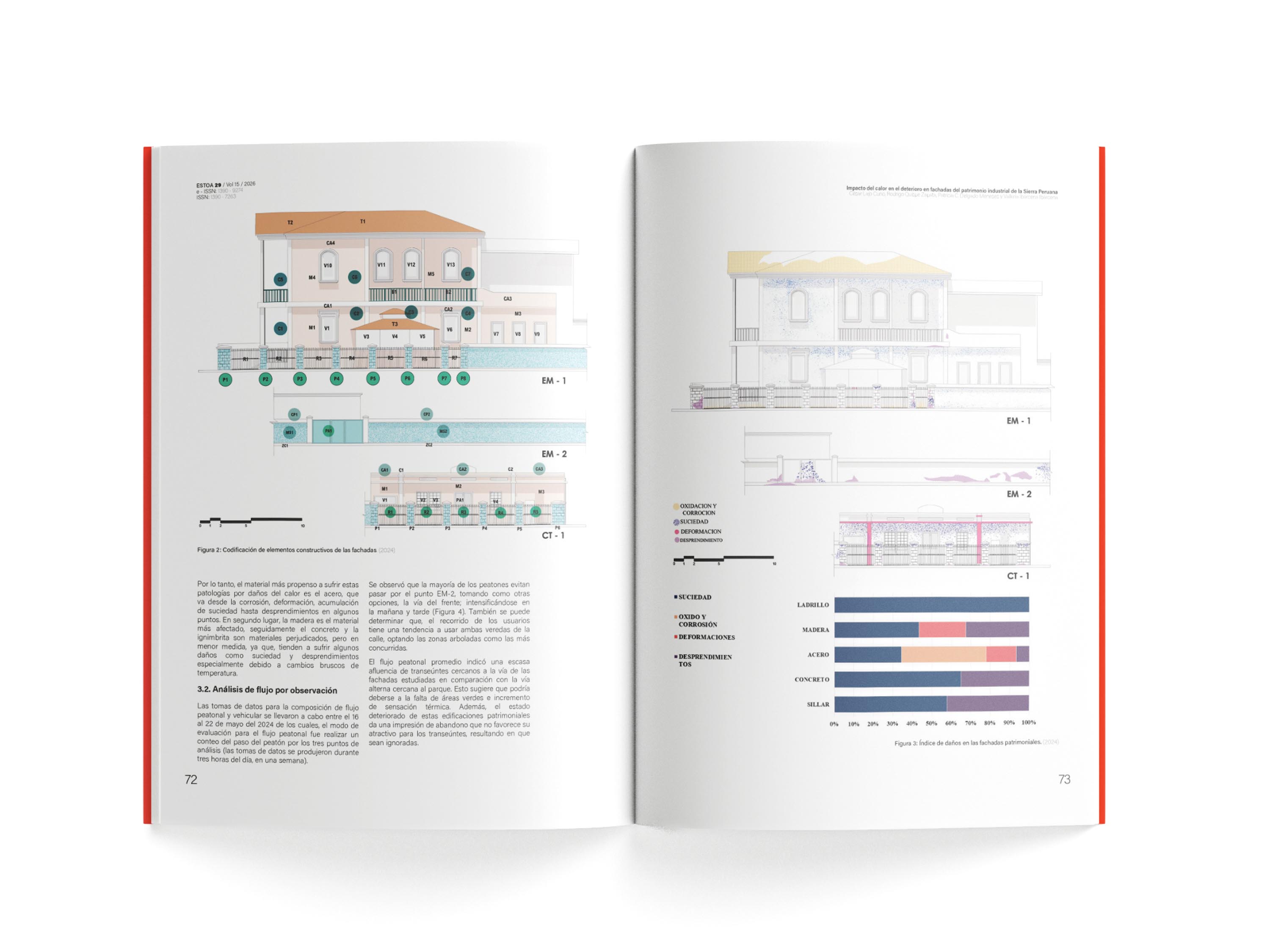
Urban heat and environmental pollution contribute to the deterioration of architectural heritage. Therefore, this research aims to analyze the impact of climatic, social, and environmental urban variables on heritage façade materials in three phases: identification of damage indexes based on materiality, observational flow analysis, and analysis of climate variability and wind chill using a thermographic camera and hygrometer. The results show that wood and ignimbrite are the materials most affected by heat and pedestrian behavior influences pedestrian traffic, choosing alternative routes to avoid discomfort caused by wind chill. This study aims to contribute to material analysis and develop conservation strategies for these types of heritage façades, addressing current environmental challenges and ensuring their durability over time.
Downloads
References
Administración Nacional Oceánica y Atmosférica. (s.f.). Herramientas de seguridad térmica. https://www.weather.gov/safety/heat-tools
Aguilar, E. (2021). Análisis de la distribución e intensidad de las Islas de Calor Urbanas superficiales diurnas (icus) en el Cantón Manta, Manabí y su relación con la vegetación local y otras vaherrriables geográficas. https://diposit.ub.edu/dspace/handle/2445/180526
Alarcón, A. (2020). Mejora de la eficiencia energética de los edificios y reducción de la “isla de calor” en las ciudades del futuro. https://riunet.upv.es/handle/10251/160366
Barrelas, J., Silva, A., de Brito, J. y Tadeu, A. (2024). Influence of temperature increase and precipitation decrease on the degradation evolution of rendered façades in service conditions. Journal of Building Engineering, 94. https://doi.org/10.1016/j.jobe.2024.109843
Candanedo, M. y Villarreal, D. (2020). Efecto de las islas de calor urbano en las principales vías de la Ciudad de Panamá. https://revistas.utp.ac.pa/index.php/id-tecnologico/article/view/2829
Falcão Socoloski, R., Bersch, J. D., Guerra, M. & Borges Masuero, A. (2023). The influence of temperature and rain moisture in mortar facades obtained through hygrothermal simulation. Construction and Building Materials, 370. https://doi.org/10.1016/j.conbuildmat.2023.130587
Gunawardena, K., Kershaw, T. & Steemers, K. (2019). Simulation pathway for estimating heat island influence on urban/suburban building space-conditioning loads and response to facade material changes. Building and Environment, 150, 195–205. https://doi.org/10.1016/j.buildenv.2019.01.006
Herrera-Sosa, L. C., Villena-Montalvo, E. E. y Rodriguez-Neira, K. R. (2020). Evaluación del desempeño térmico del sillar (ignimbrita) de Arequipa, Perú. Revista de Arquitectura, 22(1), 152–163. https://doi.org/10.14718/revarq.2020.2261
Instituto Nacional de la Infraestructura Física Educativa. (2022). Normas y especificaciones para estudios, proyectos, construcción e instalaciones (1st ed., Vol. 3). https://www.academia.edu/125775965/VOLUMEN_3_TOMO_I_Diseno_arquitectonico
Jang, S., Bae, J. & Kim, Y. J. (2024). Street-level urban heat island mitigation: Assessing the cooling effect of green infrastructure using urban IoT sensor big data. Sustainable Cities and Society, 100. https://doi.org/10.1016/j.scs.2023.105007
Mendoza, M. y Aguillón, J. (2021). Influencia del color en la percepción térmica del diseño arquitectónico. https://www.redalyc.org/articulo.oa?id=477966601014
Ornam, K., Wonorahardjo, S. & Triyadi, S. (2023). Several facade types for mitigating urban heat island intensity. Building and Environment, 111031. https://doi.org/10.1016/j.buildenv.2023.111031
Palme, M., Clemente, C., Cellurale, M., Carrasco, C. & Salvati, A. (2019). Mitigation strategies of the urban heat island intensity in Mediterranean climates: Simulation studies in Rome (Italy) and Valparaiso (Chile). IOP Conference Series: Earth and Environmental Science, 323(1). https://doi.org/10.1088/1755-1315/323/1/012025
Rajagopal, P., Priya, R. S. & Senthil, R. (2023). A review of recent developments in the impact of environmental measures on urban heat island. In Sustainable Cities and Society, 88. https://doi.org/10.1016/j.scs.2022.104279
Ravelo, G. (2011). Influencia de los elementos climáticos en el deterioro de las fachadas de edificaciones del barrio Colón. https://www.redalyc.org/articulo.oa?id=376839863003
Resende, M. M., Gambare, E. B., Silva, L. A., Cordeiro, Y. de S., Almeida, E. & Salvador, R. P. (2022). Infrared thermal imaging to inspect pathologies on façades of historical buildings: A case study on the Municipal Market of São Paulo, Brazil. Case Studies in Construction Materials, 16. https://doi.org/10.1016/j.cscm.2022.e01122
Servicio Nacional de Meteorología e Hidrología del Perú. (2024). Pronóstico del clima - Arequipa. https://www.senamhi.gob.pe/main.php?dp=arequipa&p=pronostico-detalle
Sullón, M. (2017). Determinación y evaluación de las patologías del cerco perimétrico de la Institución Educativa 14013, Señor de la Divina Misericordia, distrito 26 de octubre, provincia de Piura, departamento de Piura, febrero 2017. https://repositorio.uladech.edu.pe/handle/20.500.13032/2078
Tabatabaei, S. S. & Fayaz, R. (2023). The effect of facade materials and coatings on urban heat island mitigation and outdoor thermal comfort in hot semi-arid climate. Building and Environment, 243. https://doi.org/10.1016/j.buildenv.2023.110701
Wonorahardjo, S., Sutjahja, I. M., Mardiyati, Y., Andoni, H., Achsani, R. A., Steven, S., Thomas, D., Tunçbilek, E., Arıcı, M., Rahmah, N. & Tedja, S. (2022). Effect of different building façade systems on thermal comfort and urban heat island phenomenon: An experimental analysis. Building and Environment, 217. https://doi.org/10.1016/j.buildenv.2022.109063
Xi, C., Ren, C., Zhang, R., Wang, J., Feng, Z., Haghighat, F. & Cao, S. J. (2023). Nature-based solution for urban traffic heat mitigation facing carbon neutrality: sustainable design of roadside green belts. Applied Energy, 343. https://doi.org/10.1016/j.apenergy.2023.121197
Xiang, Y., Cen, Q., Peng, C., Huang, C., Wu, C., Teng, M. & Zhou, Z. (2023). Surface urban heat island mitigation network construction utilizing source-sink theory and local climate zones. Building and Environment, 243. https://doi.org/10.1016/j.buildenv.2023.110717
Zeballos, C. (2021). Atlas Ambiental de Arequipa (Vol. 1). Universidad Católica de Santa María. https://isbn.bnp.gob.pe/catalogo.php?mode=detalle&nt=150340
Zhuo, S., Zhou, W., Fang, P. Ye, J., Luo, H., Li, H., Wu, C., Chen, W. & Liu, Y. (2024). Cost-effective pearlescent pigments with high near-infrared reflectance and outstanding energy-saving ability for mitigating urban heat island effect. Applied Energy, 353. https://doi.org/10.1016/j.apenergy.2023.122051
Downloads
Published
How to Cite
Issue
Section
License
Copyright (c) 2026 Estoa. Journal of the Faculty of Architecture and Urbanism

This work is licensed under a Creative Commons Attribution-NonCommercial-ShareAlike 4.0 International License.
The Journal declines any responsibility for possible conflicts derived from the authorship of the works that are published in it.
The University of Cuenca in Ecuador conserves the patrimonial rights (copyright) of the published works and will favor the reuse of the same ones, these can be: copy, use, diffuse, transmit and expose publicly.
Unless otherwise indicated, all contents of the electronic edition are distributed under a Creative Commons Attribution-NonCommercial-ShareAlike 4.0 International License.