Analysing the transformation of Commercial Centres with respect to the process of urban development in a city: identification of relevant parameters and sub-parameters
DOI:
https://doi.org/10.18537/est.v015.n029.a15Keywords:
commercial centres, transformation of commercial centres, urban development, process of urban development, parametersAbstract
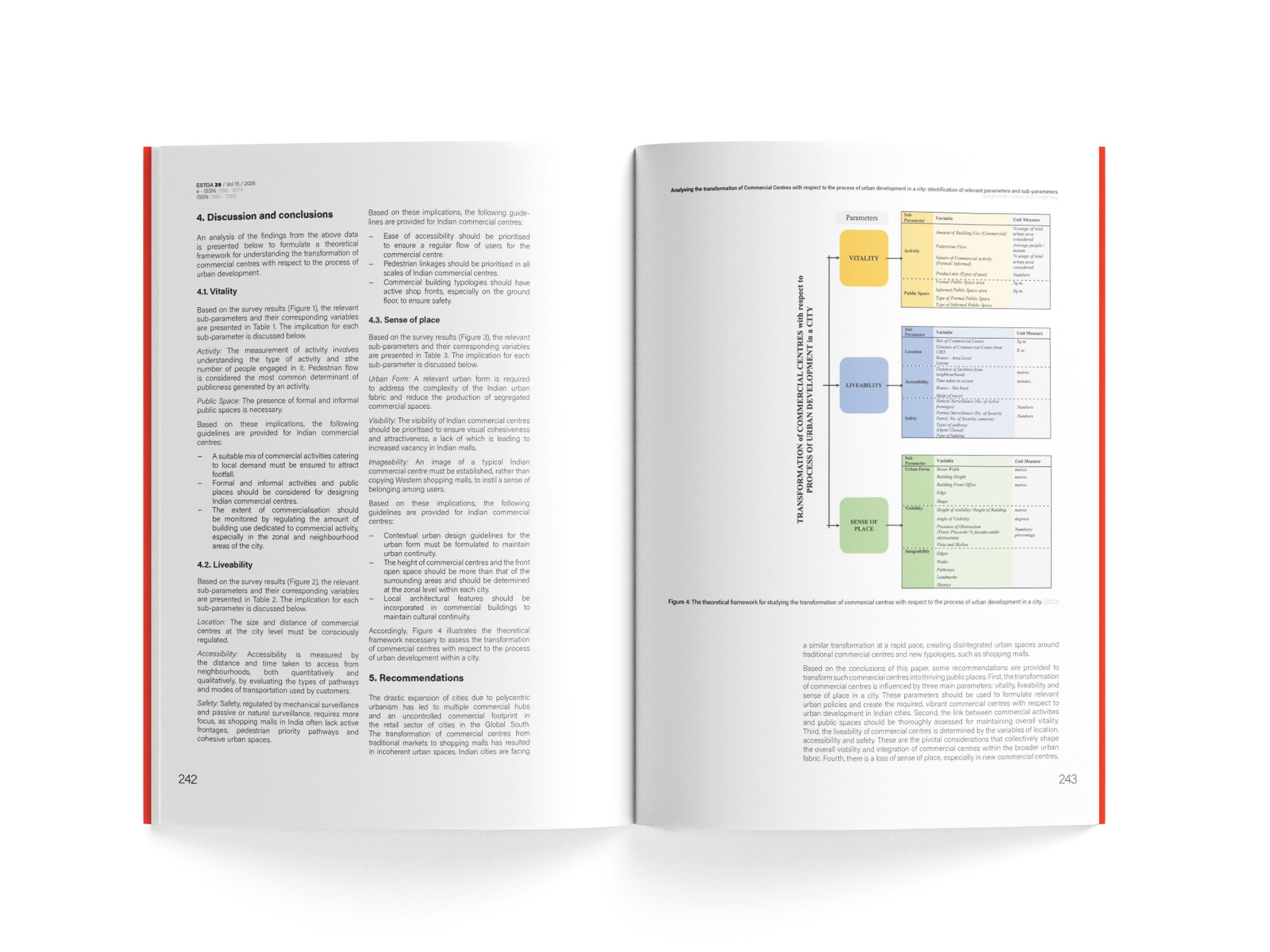
The transformation of commercial centres is a common feature of current urban development processes, where modern typologies of commercial centres are generated alongside traditional markets, disrupting the urban fabric of Indian cities. This disruption has led to lifestyle changes and altered the character of public places. The existing literature has not adequately explored this issue from an urban design perspective for Indian cities. To predict the future direction of transformation, a holistic study of this phenomenon is imperative. This paper aims to theoretically identify the relevant parameters, sub-parameters and variables that influence this phenomenon in the Indian context. Furthermore, it seeks to establish a theoretical framework based on their inter-relationship for examining similar transformations in contemporary urban development processes.
Downloads
References
Abdulameer, H. N., Al-Jaberi, A. A., Al-Khafaji, A. S., Alrobaee, T. R. & Al-Ansari, H. A. (2024). Evaluating of Urban space vitality: The role of safety, security, and Urban Planning in the Religion Center of Kufa City, Iraq. International Journal of Design & Nature and Ecodynamics, 19(1), 155–167. https://doi.org/10.18280/ijdne.190118
Ahmad, A. E. M. K. (2012). Attractiveness factors Influencing Shoppers satisfaction, loyalty, and word of Mouth: An Empirical Investigation of Saudi Arabia shopping malls. International Journal of Business Administration, 3(6), 101-112.
Alexander, C. (1977). A Pattern Language: Towns, Buildings, Construction. Oxford University Press.
Alfonzo, M. A. (2005). To walk or not to walk? The hierarchy of walking needs. Environment and behavior, 37(6), 808-836. https://doi.org/10.1177/0013916504274016
Balsas, C. J. (2004). Measuring the livability of an urban centre: an exploratory study of key performance indicators. Planning, Practice & Research, 19(1), 101-110. https://doi.org/10.1080/0269745042000246603
Beyhan, S. G. & Gürkan, Ü. Ç. (2015). Analyzing the relationship between urban identity and urban transformation implementations in historical process: The case of Isparta. ArchNet-IJAR: International Journal of Architectural Research, 9(1), 158.
Bosselmann, P. (2012). Urban transformation: Understanding city form and design. Island Press.
Carmona, M. (2019). Principles for public space design, planning to do better. Urban design international, 24(1), 47-59. https://doi.org/10.1057/s41289-018-0070-3
Chattopadhyay, S. (2017). Neoliberal urban transformations in Indian cities: Paradoxes and predicaments. Progress in Development Studies, 17(4), 307-321. https://doi.org/10.1177/1464993417716355
Chen, Y., Zacharias, J. & Zeng, M. (2020). Searching for the center: A new civic role for the Central Business District in China. Sustainability, 12(3), 866. https://doi.org/10.3390/su12030866
Choon-Piew, P. (2016). Creating a liveable city for whom? A critical examination of singapore’s recent urban transformation. Managing Diversity In Singapore: Policies And Prospects (pp. 173-187). https://doi.org/10.1142/p1083
Christaller, W. (1933). Die zentralen Orte in Süddeutschland. Fischer.
El-Khouly, T., Eldiasty, A. & Kamel, B. (2023). Monitoring the transformation in New Cairo’s urban vitality and the accompanying social and economic phenomena. Frontiers of Architectural Research, 12(5), 867-891. https://doi.org/10.1016/j.foar.2023.05.005
Ellis, P. & Roberts, M. (2015). Leveraging urbanization in South Asia: Managing spatial transformation for prosperity and livability. World Bank Publications.
Gehl, J. (2011). Life between buildings. Island Press.
Ghahremani, H., Afsari Bajestani, S., McCarthy, L. & Jalalianhosseini, M. (2021). Transformation of urban spaces within cities in the context of globalization and urban competitiveness. Journal of Urban Planning and Development, 147(3), 05021026. https://doi.org/10.1061/(ASCE)UP.1943-5444.0000703
Ghazi, N. M. & Abaas, Z. R. (2019). Toward liveable commercial streets: A case study of Al-Karada inner street in Baghdad. Heliyon, 5(5), e01652. https://doi.org/10.1016/j.heliyon.2019.e01652
Guimarães, P. P. C. (2018). The resilience of shopping centres: An analysis of retail resilience strategies in Lisbon, Portugal. Moravian Geographical Reports, 26(3), 160-172. https://doi.org/10.2478/mgr-2018-0013
Heffernan, E., Heffernan, T. & Pan, W. (2014). The relationship between the quality of active frontages and public perceptions of public spaces. Urban Design International, 19(1), 92-102. https://doi.org/10.1057/udi.2013.16
Hölscher, K. & Frantzeskaki, N. (2021). Perspectives on urban transformation research: transformations in, of, and by cities. Urban Transformations, 3(1), 2. https://doi.org/10.1186/s42854-021-00019-z
Ilgin, C. & Hacihasanoğlu, O. (2010). Göç-aidiyet ilişkisinin belirlenmesi için model. İtüdergisi/a, 5(2).
Istrate, A. L. & Chen, F. (2022). Liveable streets in Shanghai: Definition, characteristics and design. Progress in planning, 158, 100544. https://doi.org/10.1016/j.progress.2021.100544
Jacobs, J. (1961). The Death and Life of Great American Cities. Random House.
Jawaharlal Nehru Urban Renewal Mission. (2015). Ministry of Urban Development, Government of India https://mohua.gov.in/upload/uploadfiles/files/1Mission%20Overview%20English(1).pdf
Jin, A., Ge, Y. & Zhang, S. (2024). Spatial characteristics of multidimensional urban vitality and its impact mechanisms by the built environment. Land, 13(7), 991. https://doi.org/10.3390/land13070991
Karami, S., Fakhrayee, A. & Karami, S. (2015). Studying the Effect of Accessibility and Vitality on Urban Space Efficiency in Iran (Case Study: Hamadan City). International Journal of Architecture and Urban Development (IJAUD) https://dorl.net/dor/20.1001.1.22287396.2015.5.1.4.4
Kim, S. (2020). Urban Vitality, urban form, and land use: Their relations within a geographical boundary for walkers. Sustainability, 12(24), 10633. https://doi.org/10.3390/su122410633
Kotby, M. M., Khalifa, M. & Elshater, A. (2021). Lightening other faces of the livability parameters in the Egyptian urban communities. Contemporary Approaches in Urbanism and Heritage Studies, 33-43. http://dx.doi.org/10.38027/N4ICCAUA2021174
Kumar, M. (2024). India’s small shopping centres turning into ghost malls, says Knight Frank, Reuters Report https://www.reuters.com/business/retail-consumer/indias-small-shopping-centres-turning-into-ghost-malls-says-knight-frank-2024-05-07/
Lan, F., Gong, X., Da, H. & Wen, H. (2020). How do population inflow and social infrastructure affect urban vitality? Evidence from 35 large-and medium-sized cities in China. Cities, 100, 102454. https://doi.org/10.1016/j.cities.2019.102454
Latham, A. & Layton, J. (2019). Social infrastructure and the public life of cities: Studying urban sociality and public spaces. Geography compass, 13(7), e12444. https://doi.org/10.1111/gec3.12444
Lee, S. (2018). Market Modernization and the Sense of Place Lost in Transformation. In Urban Renewal, Community and Participation: Theory, Policy and Practice (pp. 111-123). Springer International Publishing. https://doi.org/10.1007/978-3-319-72311-2_6
Liang, Y., D’Uva, D., Scandiffio, A. & Rolando, A. (2022). The more walkable, the more livable? -- can urban attractiveness improve urban vitality?. Transportation research procedia, 60, 322-329. https://doi.org/10.1016/j.trpro.2021.12.042
Lynch, K. (1987). Good City Form. MIT.
Mandeli, K. (2019). Public space and the challenge of urban transformation in cities of emerging economies: Jeddah case study. Cities, 95, 102409. https://doi.org/10.1016/j.cities.2019.102409
Maununaho, K., Puumala, E. & Luoma-Halkola, H. (2023). Conviviality in the city: experience-based spatial design against the segregation of places. Journal of Urbanism: International Research on Placemaking and Urban Sustainability, 16(4), 407-429. https://doi.org/10.1080/17549175.2021.2005115
Mehta, V. (2008). Walkable streets: pedestrian behavior, perceptions and attitudes. Journal of urbanism, 1(3), 217-245. https://doi.org/10.1080/17549170802529480
Montgomery, J. (1998). Making a city: Urbanity, vitality and urban design. Journal of urban design, 3(1), 93-116. https://doi.org/10.1080/13574809808724418
Mehrbani, E. M., Mansouri, S. A. & Javadi, S. (2018). Landscape Approach in Creating Vitality in Valiasr Avenue An Emphasis on Creating the Sense of Place. A Case Study of Valiasr Avenue (The Distance between Vanak Square and Parkway Intersection). Bagh-e Nazar, 14(55).
Nambuge, G. S., Peiris, M. T. O. V. & Kalugalla, K. G. P. (2020). Assessment of urban public spaces within shopping malls: Youth perspective in the city of Colombo. International Journal of Real Estate Studies, 14(2), 28-38. https://doi.org/10.11113/intrest.v14n2.49
Nuissl, H. & Siedentop, S. (2021). Urbanisation and land use change. Sustainable land management in a European context, 8, 75-99. https://doi.org/10.1007/978-3-030-50841-8_5
Niyogi, S. (2024). ‘1-in-4 shopping centres in Kolkata a ghost mall’, Times of India. https://timesofindia.indiatimes.com/city/kolkata/1-in-4-shopping-centres-in-kolkata-a-ghost-mall/articleshow/109931336.cms
Pettersen, G. R., Nordbø, E. C., Ese, J. & Ihlebæk, C. (2023). Can shopping centres foster wellbeing? A scoping review of motivations and positive experiences associated with non-shopping visits. Wellbeing, Space and Society, 4, 100133. https://doi.org/10.1016/j.wss.2023.100133
Poldma, T., Labbé, D., Bertin, S., De Grosbois, È., Barile, M., Mazurik, K. & Artis, G. (2014). Understanding people’s needs in a commercial public space: About accessibility and lived experience in social settings. Alter, 8(3), 206-216. https://doi.org/10.1016/j.alter.2014.02.007
Ramachandra, T. V., Aithal, B. H. & Sanna, D. D. (2012). Insights to urban dynamics through landscape spatial pattern analysis. International journal of applied earth observation and geoinformation, 18, 329-343. https://doi.org/10.1016/j.jag.2012.03.005
Rahman, N. A., Shamsuddin, S. & Ghani, I. (2015). What makes people use the street?: Towards a liveable urban environment in Kuala Lumpur city centre. Procedia-Social and Behavioral Sciences, 170, 624-632. https://doi.org/10.1016/j.sbspro.2015.01.064
Ravenscroft, N., Reeves, J. & Rowley, M. (2000). Leisure, property, and the viability of town centres. Environment and Planning A, 32(8), 1359-1374. https://doi.org/10.1068/a32221
Roy, D. & Ray, N. (2017). Consumer Buying Behavior and Perception toward Shopping Malls with Special Reference to the City of Kolkata, West Bengal, India. In International Symposium on Chaos, Complexity and Leadership (pp. 343-355). Springer International Publishing. https://doi.org/10.1007/978-3-319-89875-9_29
Sahu, S. R. (2016). An case study approach for identifying factors responsible for failed shopping malls in India. International Journal of Research in Finance and Marketing, 6(10), 13-32.
Sepe, M. (2014). Urban transformation, socio-economic regeneration and participation: Two cases of creative urban regeneration. International Journal of Urban Sustainable Development, 6(1), 20-41. https://doi.org/10.1080/19463138.2013.866560
Shamsuddin, S., Hassan, N. R. A. & Bilyamin, S. F. I. (2012). Walkable environment in increasing the liveability of a city. Procedia-Social and Behavioral Sciences, 50, 167-178. https://doi.org/10.1016/j.sbspro.2012.08.025
Shamur, T. (2023). Place melancholy as a lost sense of belonging during urban transformation among older women long-term residents of HaTikva neighborhood in Tel Aviv-Jaffa. Gender, Place & Culture, 30(1), 111-131. https://doi.org/10.1080/0966369X.2021.2016654
Sustainable Development Goals. (2015). Goal. https://sdgs.un.org/goal
Taneja, N. ( 2022). ‘A new era of growth for commercial real estate’, Voices, Economy, Times of India, https://timesofindia.indiatimes.com/blogs/voices/a-new-era-of-growth-for-commercial-real-estate/
Teller, C. & Reutterer, T. (2008). The evolving concept of retail attractiveness: what makes retail agglomerations attractive when customers shop at them? Journal of Retailing and consumer services, 15(3), 127-143. https://doi.org/10.1016/j.jretconser.2007.03.003
Thwaites, K., Simpson, J. & Simkins, I. (2020). Transitional edges: A conceptual framework for socio-spatial understanding of urban street edges. Urban Design International, 25(4), 295-309. https://doi.org/10.1057/s41289-020-00115-9
Tiwari, R. (2015). Designing a safe walkable city. Urban Design International, 20(1), 12-27. https://doi.org/10.1057/udi.2013.33
Turhan, T. Z. & Ayataç, H. (2020). A characterization of public space: the conceptual transformation in Sarajevo. Journal of city and civilization.
Xia, C., Zhang, A. & Yeh, A. G. (2022). The varying relationships between multidimensional urban form and urban vitality in Chinese megacities: Insights from a comparative analysis. Annals of the American Association of Geographers, 112(1), 141-166. https://doi.org/10.1080/24694452.2021.1919502
Zaidin, N., Hussain, M. R. M., Tukiman, I. & Shahli, F. M. (2015). Place attachment in relation to urban street vitality. American Transactions on Engineering & Applied Sciences, 4(4), 219-230. http://tuengr.com/ATEAS/V04/219.pdf
Zhang, A., Li, W., Wu, J., Lin, J., Chu, J. & Xia, C. (2021). How can the urban landscape affect urban vitality at the street block level? A case study of 15 metropolises in China. Environment and Planning B: Urban Analytics and City Science, 48(5), 1245-1262. https://doi.org/10.1177/2399808320924425
Zeng, C., Song, Y., He, Q. & Shen, F. (2018). Spatially explicit assessment on urban vitality: Case studies in Chicago and Wuhan. Sustainable cities and society, 40, 296-306. https://doi.org/10.1016/j.scs.2018.04.021
Published
How to Cite
Issue
Section
License
Copyright (c) 2025 Estoa. Journal of the Faculty of Architecture and Urbanism

This work is licensed under a Creative Commons Attribution-NonCommercial-ShareAlike 4.0 International License.
The Journal declines any responsibility for possible conflicts derived from the authorship of the works that are published in it.
The University of Cuenca in Ecuador conserves the patrimonial rights (copyright) of the published works and will favor the reuse of the same ones, these can be: copy, use, diffuse, transmit and expose publicly.
Unless otherwise indicated, all contents of the electronic edition are distributed under a Creative Commons Attribution-NonCommercial-ShareAlike 4.0 International License.