Practice and scientificity in contemporary production applied to Art, Architecture and Design
DOI:
https://doi.org/10.18537/est.v015.n029.a20Keywords:
practice-led, research, architecture, art, designAbstract
A reflection is proposed around the most representative aspects of the debate on scientific production in arts, architecture and design, towards the discussion for its legitimacy and demystification of the barriers about what is or is not valid in the production of scientific knowledge. Based on a bibliographic review, the favorable scenarios that allow the validation of all forms of knowledge are described as a contribution to the understanding and reflection of contemporary problems. The overview of research directed by project practice and aspects related to subjectivity and scientificity in creative disciplines is presented. The dynamic context of the contemporary world demands from different disciplines a greater concern for analyzing their methodologies and forms of knowledge production. The design disciplines, due to their great creative load, require a greater commitment to new ways of approaching knowledge towards innovation.
Downloads
References
Aguilar, M. (2000). Camino al diseño, proceso del Diseño arquitectónico. Universidad Nacional de Colombia.
Almusaed, A., Yitmen, I, Almssad, A. & Myhren, J. A. (2024). Construction 5.0 and Sustainable Neuro-Responsive Habitats: Integrating the Brain–Computer Interface and Building Information Modeling in Smart Residential Spaces. Sustainability, 16(21), 9393. https://doi.org/10.3390/su16219393
Altamirano, O., Ramírez, B. (2016). Aspectos transdisciplinares de diseño y arquitectura: un enfoque metodológico basado en la innovación. Procesos Urbanos, 3(3), 143 - 148. https://doi.org/10.21892/2422085X.274
Altamirano, O. y Moura, M. (2017). La ciudad como red y sistema de navegación. Colombia. Procesos Urbanos, 4(4) 39- 46. https://doi.org/10.21892/2422085X.349
Altamirano, O., Montes, W. y Sumano, E. (2020a). O hibridismo na construção narrativa contemporánea. Narrativas complejas. Ria. http://www.riaeditorial.com/index.php/narrativas-complexas/?fbclid=IwAR0QT5z5jNCPx-GbqLBqNyH2y0ZO09aD35EhJNle7KHvTcmq5SW1OH2Y45w
Altamirano, O., Montes, W. y Sumano, E. (2020b). Mediatización Urbana: nuevas dinámicas de comportamiento entre individuo, medios y territorio. Procesos Urbanos, 7(2), e494. https://doi.org/10.21892/2422085X.494
Bissoonauth, C., Fischer, T. & Herr, C. M. (2020). An ethnographic enquiry into digital design tool making. In 25th International Conference on Computer-Aided Architectural Design Research in Asia, CAADRIA 2020 (pp. 213-222). The Association for Computer-Aided Architectural Design Research in Asia (CAADRIA).
Borgdorff, H. (2006). The debate on research in the arts. Kunsthøgskolen i Bergen.
Borgdorff, H. (2012). The conflict of the faculties: Perspectives on artistic research and academia. Leiden University Press.
Burkholder, C., Aladejebi, F. & Schwab-Cartas, J. (Eds.). (2022). Facilitating community research for social change: Case studies in qualitative, arts-based and visual research. Routledge.
Burke, M., Ockwell, D. & Whitmarsh, L. (2018). Participatory arts and affective engagement with climate change: ¿The missing link in achieving climate compatible behaviour change? Global Environmental Change, 49, 95–105.
Candlin, F. (2000). Practice‐based doctorates and questions of academic legitimacy. Journal of Art & Design Education, 19(1), 96-101.
Cardoso, R. (2012). Design para um mundo complexo. Ed. Cosac Naify.
Carneiro de Sousa, C. (2025). CapCat. https://www.deviantArt.com/capcat
Castellanos Tuirán A. I. y Martínez-Osorio P. A. (2020). Educación en Arquitectura: Transiciones hacia el Desarrollo Sostenible. Procesos Urbanos, 7(1). https://doi.org/10.21892/2422085X.493
De Sousa, C. (2015). Meta_Body: Uma Investigação Baseada na Prática Artística. MATLIT: Revista do Programa de Doutoramento em Materialidades da Literatura, 3(1), 195-208. https://doi.org/10.4018/978-1-4666-8384-6.ch009
Feast, L. (2010, June). Epistemological positions informing theories of design research: implications for the design discipline and design practice. In Proceedings of’ Design and complexity’, the 2010 Design Research Society International Conference. Montreal, Canada.
Frayling, C. (1993). Research in art and design. Royal College of Art Research Papers, 1(1), 1993/4.
Friberg, C. (2011). Theory based or Practice based Research–Whatʹs the Difference?. http://www.re-ad.dk/ws/files/32911445/Carsten_Friberg_Theory_Based_or_Practice_Based_Research_What_s_the_Difference.pdf
Groat, L. N. & Wang, D. (2013). Architectural research methods. John Wiley & Sons.
Hauberg, J. (2014). Research by Design—situating practice-based research as part of a tradition of knowledge production, exemplified through the works of le Corbusier. Lusofona Journal of Architecture and Education, (11), 57- 76.
Iriarte, I. & Justel, D. (2013). Considerations in design research. 17th International Congress on Project Management and Engineering Logroño, 17-19th July 2013.
Jullander, S. (2013). Creating Dialogues on Artistic Research. Svensk Tidskrift för Musikforskning, 11-24.
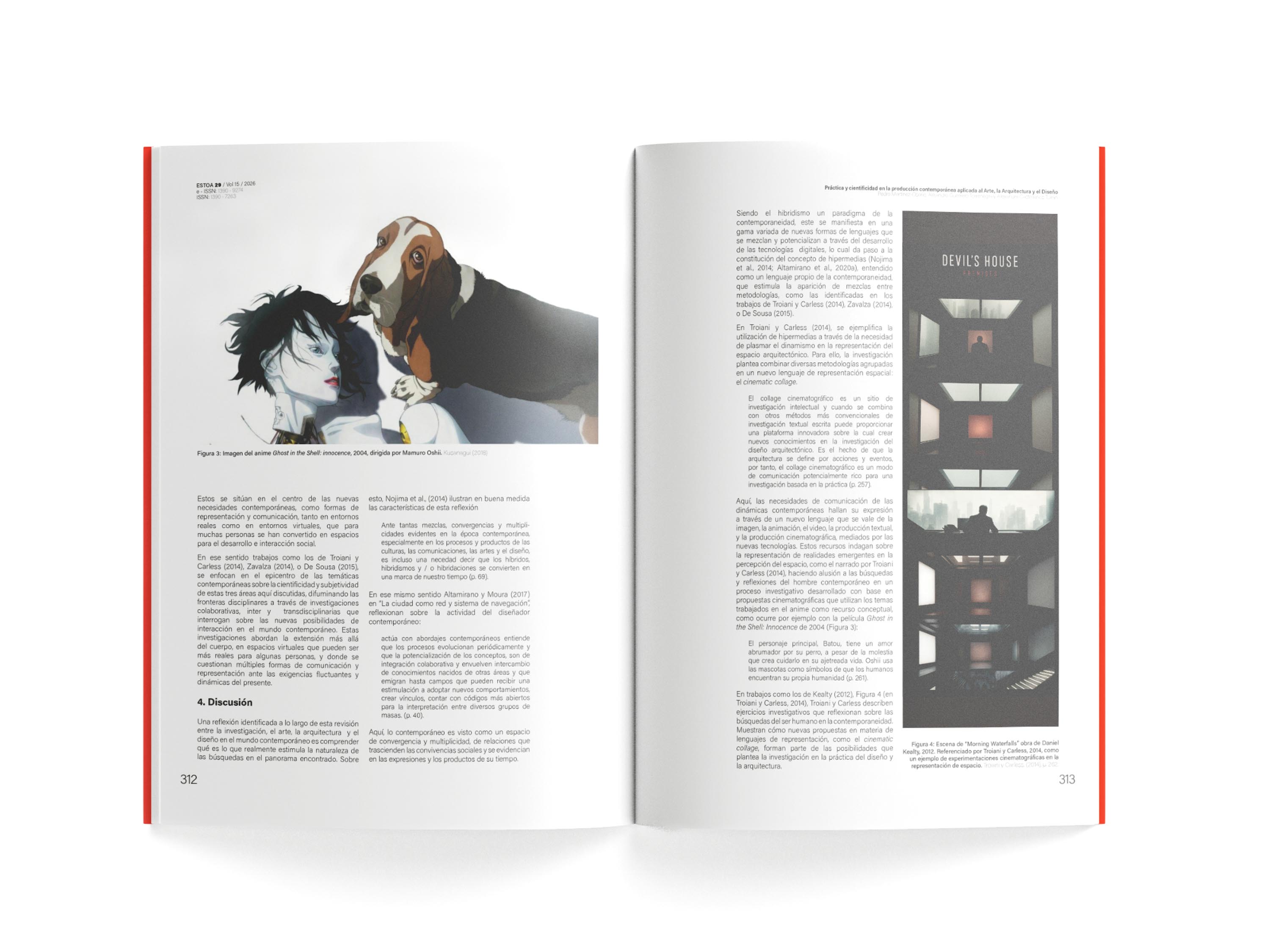
Kealty, D. (2012). Merging Realities: filmmaking as architectural design. https://issuu.com/r_l_d/docs/kealty_daniel/1
Knuts, E., Markussen, T. & Christensen, P. R. (2014). The Role of Fiction in Experiments within Design, Art & Architecture. Artifact, 3(2), 8-1.
Kusanagui, K. (2018). Cómic vs manga: Bullet Time. Ghost in the Shell 2: Innocence. https://elrincondelcomicymanga.blogspot.com/2018/02/ghost-in-shell-2-innocence.html
Martínez, P. (2009). La arquitectura como problema. Corporación Universitaria del Caribe, CECAR.
Martínez, P. (2015). El proyecto arquitectónico como un problema de investigación. Revista de Arquitectura, 15(1), 54-61. https://doi.org/10.14718/RevArq.2013.15.1.6
Martínez, P. (2016). La subjetividad de la metodología en la proyectación de la arquitectura. Procesos Urbanos, 3(3), 149 - 157. https://doi.org/10.21892/2422085X.275
Moura, M. (2014). Design Brasileiro contemporâneo: reflexões. Estação das Letras e Cores.
Niedderer, K. & Reilly, L. (2011). Research practice in art and design: Experiential knowledge and organised inquiry. Journal of Research Practice, 6(2), 2.
Niedderer, K. & Roworth-Stokes, S. (2007, November). The role and use of creative practice in research and its contribution to knowledge. In IASDR International Conference. http://niedderer.org/IASDR07SRS.pdf
Nimkulrat, N. (2013). Situating creative artifacts in art and design research. FORMakademisk, 6(2), 1-16.
Norberg-Schulz, C. (1979). Intenciones en arquitectura. Gustavo Gili.
Nojima, V., Braida, F. & Moura, M. (2014). A contemporaneidade híbrida nas artes e no design. En M. Moura. Design Brasileiro contemporâneo: reflexões. Estação das Letras e Cores, pp. 69 - 92.
Oshii, M. (Dir.). (2004). Ghost in the Shell: innocence. Studio Ghibli.
Rodríguez Morales, L. (1989). Para una teoría del diseño. Trillas.
Rust, C., Mottram, J. & Till, J. (2007). AHRC Research Review Practice-Led Research in Art. Design and Architecture: Arts and Humanities Research Council. https://shura.shu.ac.uk/7596/1/Pactice-ledReviewNov07.pdf
Santamaría-Delgado, C. (2013). ¿Es posible una política diferencial de investigación e innovación? Una mirada desde las artes [Ponencia]. La Investigación en la Pontificia Universidad Javeriana. Tercera sesión del simposio sobre políticas de investigación y de innovación. http://hdl.handle.net/10554/15150.
Schippers, H. (2007). The marriage of art and academia: Challenges and opportunities for music research in practice-based environments. Dutch journal of music theory, 12(1), 34 -40.
Stappers, P. & Giaccardi, E. (2014). Research through Design. Interaction Design Foundation - IxDF. https://www.interaction-design.org/literature/book/the-encyclopedia-of-human-computer-interaction-2nd-ed/research-through-design.
Till, J. (2009). Architecture depends (55). MIT press.
Troiani, I. & Carless, T. (2014). Architectural design research through cinematic collage. Revista Lusófona de Arquitectura e Educação, 11, 255 – 278.
Wang, Y., Wang, L. & Siau, K. L. (2024). Human-Centered Interaction in Virtual Worlds: A New Era of Generative Artificial Intelligence and Metaverse. International Journal of Human–Computer Interaction, 1-43. https://doi.org/10.1080/10447318.2024.2316376
Yang, Q., Cruz-Garza, J.G. & Kalantari, S. (2023). Brain–computer interfaces as an architectural design tool: Feasibility and usability study. Autom. Constr. 154, 105011.
Zátonyi, M. (1993). Arquitectura y diseño, análisis y teoría. Kliczkowski.
Zavalza, M. P. E. (2014). Aproximación a un proyecto de investigación en arte: “Navegar en el tiempo”. Tercio creciente, 3(1), 61 - 66.
Zimmerman, J., Forlizzi, J. & Evenson, S. (2007). Research through design as a method for interaction design research in HCI. Human-Computer Interaction Institute, 41. Carneige Mellon University. Research Showcase. http://repository.cmu.edu/hcii/41
Published
How to Cite
Issue
Section
License
Copyright (c) 2025 Estoa. Journal of the Faculty of Architecture and Urbanism

This work is licensed under a Creative Commons Attribution-NonCommercial-ShareAlike 4.0 International License.
The Journal declines any responsibility for possible conflicts derived from the authorship of the works that are published in it.
The University of Cuenca in Ecuador conserves the patrimonial rights (copyright) of the published works and will favor the reuse of the same ones, these can be: copy, use, diffuse, transmit and expose publicly.
Unless otherwise indicated, all contents of the electronic edition are distributed under a Creative Commons Attribution-NonCommercial-ShareAlike 4.0 International License.