Green in urban in-between spaces. The Garden Courtyard of the Turó de la Peira Sports Center and the Sants Green Corridor in Barcelona
DOI:
https://doi.org/10.18537/est.v015.n029.a11Keywords:
urban green, intermediate space, green courtyard, green corridor, renaturalizationAbstract
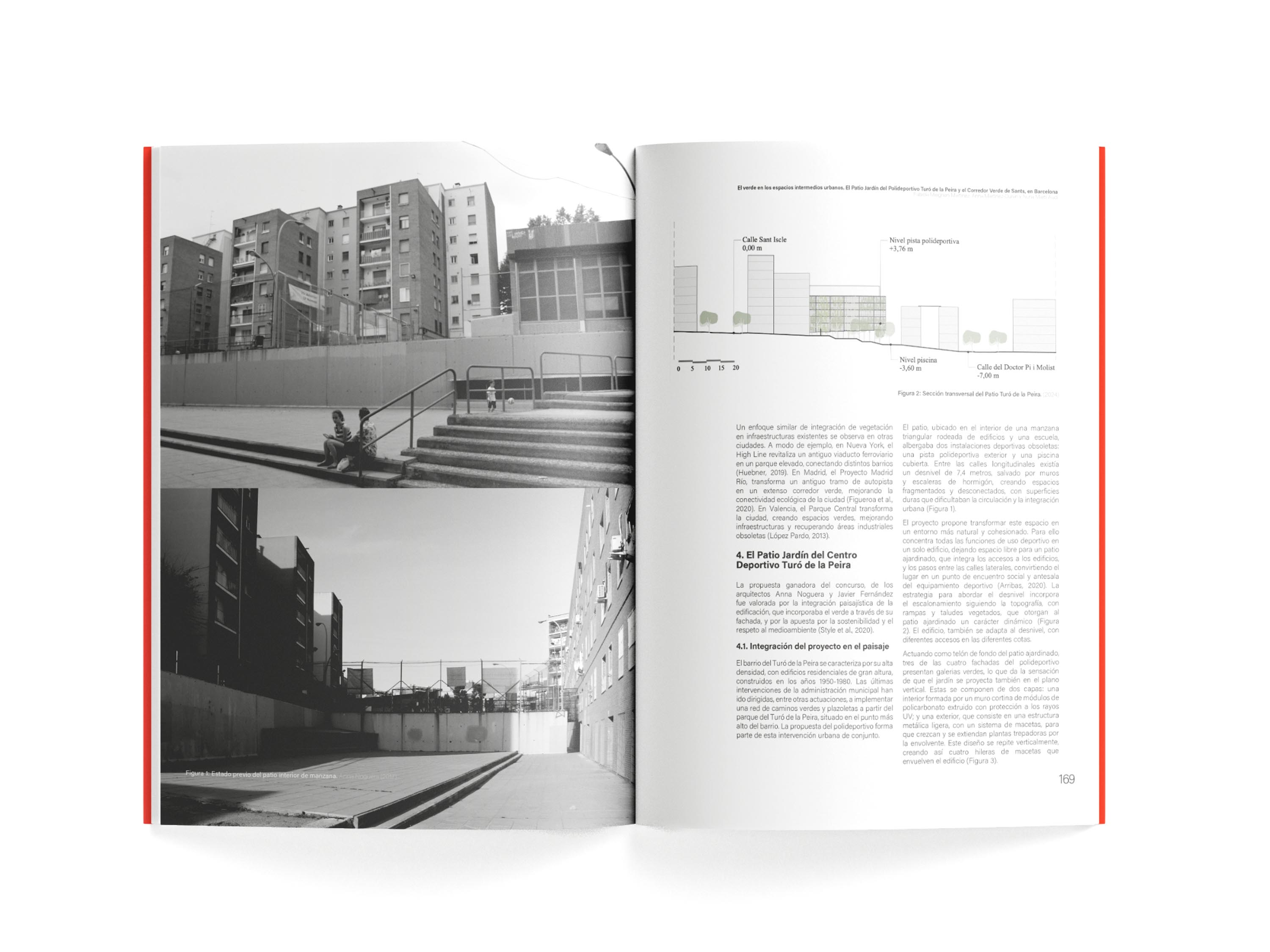
The integration of green areas in urban intermediate spaces improves spatial configuration, optimizes the environmental performance of cities, and enriches the sensory experience of users. Vegetation promotes cohesion between built structures and plays a key role in mitigating heat islands, thereby enhancing environmental comfort. This article analyzes two urban projects in Barcelona focused on green space implementation: the Patio of the Turó de la Peira Sports Center (2019) and the Sants Gardens (2017). Through graphical documentation and a comparative analysis of the paths in both projects, the applied design strategies are identified. These solutions offer a replicable model for other urban contexts, demonstrating how implementing greenery in intermediate urban spaces can contribute to the creation of more sustainable environments.
Downloads
References
Ajuntament de Barcelona. (2013). Plan del Verde y de la Biodiversidad de Barcelona 2020. http://hdl.handle.net/11703/85102
Ajuntament de Barcelona. (2015). Guía de azoteas vivas y cubiertas verdes. http://hdl.handle.net/11703/98793
Ajuntament de Barcelona. (2015). Pla de millora de la qualitat de l’aire de Barcelona 2015-2018. http://hdl.handle.net/11703/83944
Ajuntament de Barcelona. (2017a). Programa de impulso de la infraestructura verde urbana: Medida de gobierno. http://hdl.handle.net/11703/104927
Ajuntament de Barcelona. (2017b). Árboles para vivir: Plan director del arbolado de Barcelona 2017-2037. http://hdl.handle.net/11703/115135
Ajuntament de Barcelona. (2019). Estratègia d’agricultura urbana a la ciutat de Barcelona 2019-2030. http://hdl.handle.net/11703/116590
Ajuntament de Barcelona. (2021). Plan Natura Barcelona 2021-2030. http://hdl.handle.net/11703/123407
Ajuntament de Barcelona, Ventayol, I., Castells, C., Font, T., Franquesa, T., Gabàs, A. y Soldevilla, I. (2018). Plan Clima 2018-2030. http://hdl.handle.net/11703/109461
Ajuntament de Barcelona. (2023). Avaluació de la qualitat de l’aire a la ciutat de Barcelona. Informe 2022. http://hdl.handle.net/11703/132525
Arribas, C. (2020). Tècnica anàlisi d’obra. Paisatgisme urbà. L’arquitectura viva del nou poliesportiu municipal del Turó de la Peira.
Ba, M., Li, Z. & Kang, J. (2023). The multisensory environmental evaluations of sound and odour in urban public open spaces. Environment and Planning B: Urban Analytics and City Science, 50(7), 1759-1774. https://doi.org/10.1177/23998083221141438
Fariello, F. (2004). La arquitectura de los jardines: De la antigüedad al siglo XX. Mairea/Celeste.
Figueroa, D., Martínez, D. y García, R. (2020). Revitalización urbana y la integración de la infraestructura verde: El caso del Proyecto Madrid Río. Urban Ecology Review, 35(2), 110-123. https://doi.org/10.1016/j.uer.2020.02.004
Godia, S. (2012). Un edificio para el tren, un paseo para la ciudad. Intermedio libros.
Hartig, T., Mitchell, R., de Vries, S. & Frumkin, H. (2014). Nature and health. Annual Review of Public Health, 35, 207–228. https://doi.org/10.1146/annurev-publhealth-032013-182443
Huebner, J. (2019). IOP Conf. Ser.: Mater. Sci. Eng. 471, 092085. https://doi.org/10.1088/1757-899X/471/9/092085
Irfeey, A. M. M., Chau, H. -W., Sumaiya, M. M. F., Wai, C. Y., Muttil, N. & Jamei, E. (2023). Sustainable mitigation strategies for urban heat island effects in urban areas. Sustainability, 15(14), 10767. https://doi.org/10.3390/su151410767
López Pardo, J. M. (2013). Parque Central: Desarrollo en Valencia. https://riunet.upv.es/handle/10251/35630
Meignen, F., Martínez, A. y Martí, N. (2020). Greenery in intermediate spaces of the dwellings in the city of Barcelona. International Journal of Sustainable Development and Planning, 15, 801–811. https://doi.org/10.18280/ijsdp.150602
Montenys, X. (2021). La Casa como jardín. Editorial Gustavo Gili
Sarría, A., Fernández, E. & Gil, A. (2017). Cooling effects of urban green spaces in the city of Barcelona. Environmental Research Letters, 12(7), 074019.
Style, O., Noguera, A., Saltó, X., Clavero, B. y Wassouf, M. (2020). Turo de la Peira: simulación termodinámica y datos de monitorización de un polideportivo y piscina interior EECN. CONTART 2020, 063. http://hdl.handle.net/20.500.12251/2163
Vidal Yañez, D., Barboza, E. P., Cirach, M., Daher, C., Nieuwenhuijsen, M. & Mueller, N. (2023). An urban green space intervention with benefits for mental health: A health impact assessment of the Barcelona “Eixos Verds” Plan. Environment International, 174, 107880. https://doi.org/10.1016/j.envint.2023.107880
Zheng, H., Luo, M., Wang, Y. & Wei, Y. (2024). Multi-Sensory Interaction and Spatial Perception in Urban Microgreen Spaces: A Focus on Vision, Auditory, and Olfaction. Sustainability, 16(20), 8809. https://doi.org/10.3390/su16208809
Zheng, T., Yan, Y., Lu, H., Pan, Q., Zhu, J., Wang, C., & Zhan, Y. (2020). Visitors’ perception based on five physical senses on ecosystem services of urban parks from the perspective of landsenses ecology. International Journal of Sustainable Development & World Ecology, 27(3), 214–223. https://doi.org/10.1080/13504509.2020.1729272
Downloads
Published
How to Cite
Issue
Section
License
Copyright (c) 2026 Estoa. Journal of the Faculty of Architecture and Urbanism

This work is licensed under a Creative Commons Attribution-NonCommercial-ShareAlike 4.0 International License.
The Journal declines any responsibility for possible conflicts derived from the authorship of the works that are published in it.
The University of Cuenca in Ecuador conserves the patrimonial rights (copyright) of the published works and will favor the reuse of the same ones, these can be: copy, use, diffuse, transmit and expose publicly.
Unless otherwise indicated, all contents of the electronic edition are distributed under a Creative Commons Attribution-NonCommercial-ShareAlike 4.0 International License.