Brewing property in one-dimensional city? Exploring Starbucks’ locational strategies-impacts in the case of Izmir, Türkiye
DOI:
https://doi.org/10.18537/est.v015.n029.a14Keywords:
one-dimensional city, starbucksization, global brands, property-led development, Izmir-TürkiyeAbstract
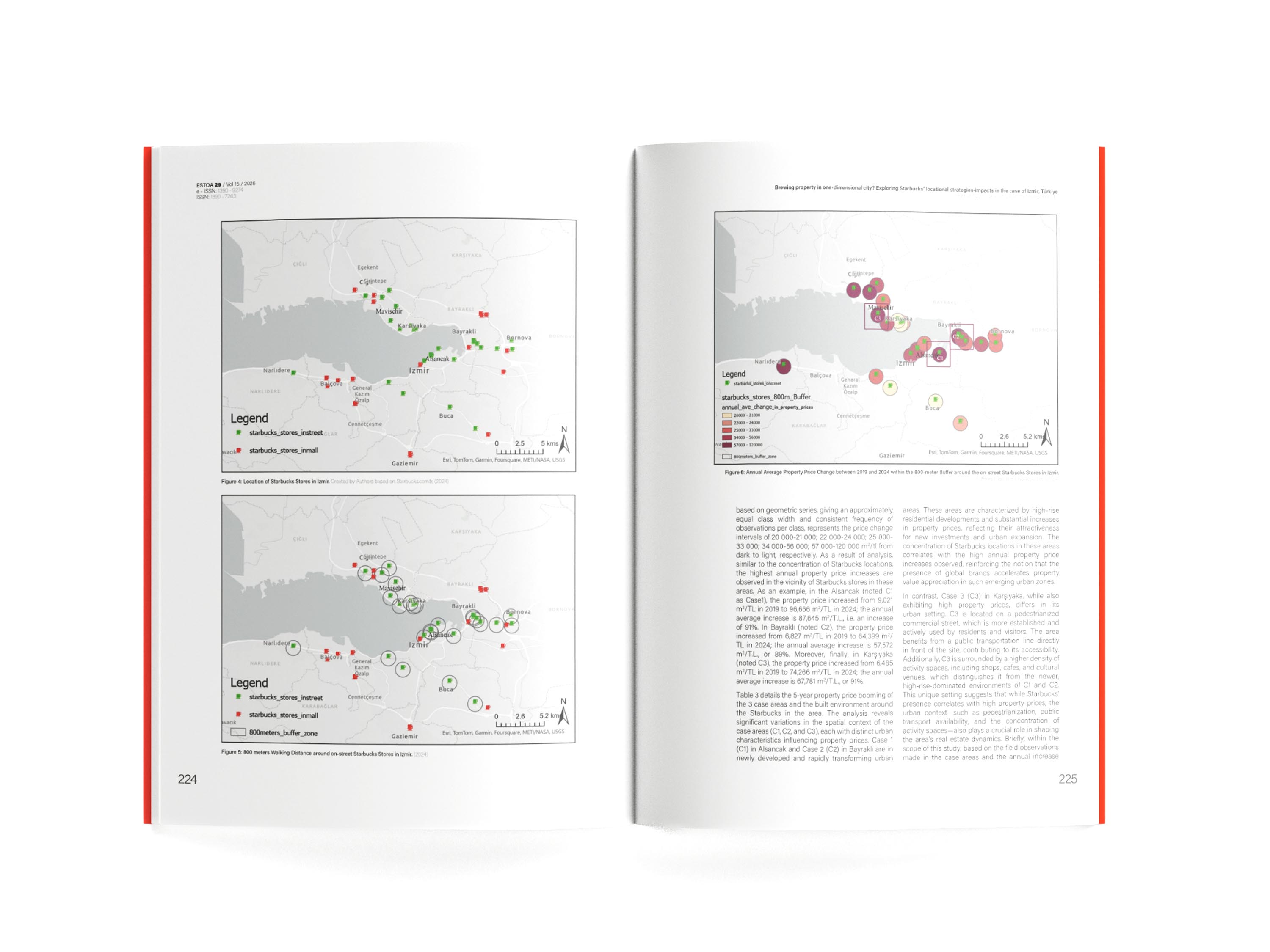
The article examines Starbucks’ locational strategies and their impact on urban spaces, drawing on Rossi’s concept of the “one-dimensional city.” As global brands increasingly shape urban environments, three key effects emerge: rising property prices near stores, the concentration of locations in malls, transit hubs, and walkable areas, and alignment with urban landscapes standardized by major transportation infrastructure decisions. Similar to many cities in the Global South, Starbucks in İzmir functions both as a product and a driver of property-driven, rent-seeking urban development. Empirical evidence reveals that its locational strategies enhance accessibility, increase property values, and reshape the built environment. Through spatial analysis, the article examines Starbucks locations within a walkability and accessibility framework, highlighting their concentration in high-value districts with strong public transit connections. This research underscores how global brands reinforce socio-economic divides, transform urban spaces, and promote consumption-driven urbanization through their integration into global capitalism and real estate dynamics.
Downloads
References
Adorno, T. (2004). Negative Dialectics. Routledge.
Akarçay, E. (2012). Kâh Kahvehane Kâh Café: Küreselleşen Eskişehir’de Kahve Tüketimi Üzerine Kuramsal Bir Giriş. Galatasaray Üniversitesi İletişim Dergisi, Özel Sayı 2, 181-202. https://iletisimdergisi.gsu.edu.tr/tr/download/article-file/82908
Ansenberg, U. (2024). Beyond displacement: The role of real-estate valuations in shaping urban displaceability. Environment and Planning C: Politics and Space.
Añaños, M. C. (2020). Gentrificación e Interrelación Territorial: Efectos de Puerto Norte sobre el barrio refinería (Rosario, Argentina). Estoa. Revista de la Facultad de Arquitectura y Urbanismo de la Universidad de Cuenca, 9(18), 57–66. https://doi.org/10.18537/est.v009.n018.a5
Bayırbağ, M. K. & Penpecioğlu, M. (2017). Urban crisis: ‘Limits to the governance of alienation.’ Urban Studies, 54(9), 2056-2071.
Brenner, N. & Schmid, C. (2015). Towards a new epistemology of the urban? City, 19(2–3), 151–182. https://doi.org/10.1080/13604813.2015.1014712
Brenner, N. (Ed.) (2014). Implosions/Explosions: Towards a Study of Planetary Urbanization. Jovis.
Caro, D. (2018). McPublic Spaces: McDonald’s’ appropriation of the everyday place in Hong Kong. The 18th International Planning History Society Conference.
Chang, H. & Spierings, B. (2023). Places “for the gram”: Millennials, specialty coffee bars and the gentrification of commercial streets in Seoul. Geoforum, 139, 103677.
Choi, J., Guzman, J. & Small, M. L. (2024). Third Places and Neighborhood Entrepreneurship: Evidence from Starbucks Cafés. NBER Working Paper. 32604.
Donner, H. & Loh, T. H. (2019). Does the Starbucks effect exist? searching for a relationship between Starbucks and adjacent rents. Property Management, 37(4), 562–578. https://doi.org/10.1108/pm-01-2019-0004
Falk, R. (1999). Predatory Globalization. Polity.
Ferretti-Ramos, M. A. (2024). Urban system and complexity. socio-spatial fragmentation as a systemic process of inequality. Estoa. Revista de la Facultad de Arquitectura y Urbanismo de la Universidad de Cuenca, 13(26), 203–216. https://doi.org/10.18537/est.v013.n026.a14
Fleisher, C. (2018). There goes the neighborhood. American Economic Association. https://www.aeaweb.org/research/yelp-data-gentrification-starbucks-nowcasting
Hass-Klau, C. (2015). The pedestrian and the city. Taylor & Francis Group.
Gallagher, E. (2022). Does the ‘Starbucks Effect’ Still Apply to Real Estate? Propmodo. https://propmodo.com/does-the-starbucks-effect-still-apply-to-real-estate/
Gehl, J. (1980). The residential street environment. Built Environment 6(1), 51–61. https://www.jstor.org/stable/23286085
Gehl, J. (2010). Cities for People. Island Press.
Gillespie, T. & Mwau, B. (2024). Road corridors as real estate frontiers: The new urban geographies of rentier capitalism in Africa. Antipode, 56(6), 2136–2156. https://doi.org/10.1111/anti.13080
Harvey, D. (2002). Spaces of Global Capitalism: A Theory of Uneven Geographical Development. Verso.
Harvey, D. (2007). Neoliberalism as Creative Destruction. The ANNALS of the American Academy of Political and Social Science, 610(1), 21-44. https://doi.org/10.1177/0002716206296780
Jiang, J. & Manfredini, M. (2021). The Starbuckisation of domesticity in urban China. In Reimagining Public Spaces and Built Environments in the Post-pandemic World Symposium and Book Publication (pp. 1–19). AI4Society, University of Alberta.
Kantar Brandz’s most valuable global brands. (2024). Kantar BrandZ Most Valuable Global Brands 2024. https://www.kantar.com/campaigns/brandz/global
Kasperkevic, J. (2015). In gentrified cities, which came first: Starbucks or higher real estate prices? The Guardian. https://www.theguardian.com/money/us-money-blog/2015/feb/03/starbucks-gentrification-real-estate-prices
Klein, N. (1999). No Logo: Taking Aim at the Brand Bullies. Picador.
Knoema. (2021). Number of Starbucks stores globally, 1992-2021. https://knoema.com/infographics/kchdsge/number-of-starbucks-stores-globally-1992-2021
Lefebvre, H. (1996). Writing on Cities. Blackwell Publishing.
Lefebvre, H. (1991). The Production of Space. Wiley-Blackwell.
Lukács, G. (1999). History and Class Consciousness. MIT Press.
Marasco, L. (2022). Coffee shops transforming neighbourhoods, functioning as co-working spaces and third places (Bachelor’s thesis). LAB University of Applied Sciences.
Marcuse, H. (1991). One-Dimensional Man: Studies in the Ideology of Advanced Industrial Society. Penguin.
Martinez, U., Barbosa, V. & Thoene, U. (2024). Urban transformations in intermediate cities under the logic of neoliberal urbanism: The case of Monteria, Colombia. Regional Science Policy & Practice, 16(8), 100058. https://doi.org/10.1016/j.rspp.2024.100058
Nam, S. & Lee, S. (2023). Urban regeneration in Seoul: Alternative urbanism or the resilience of neoliberal urbanism? International Journal of Urban and Regional Research, 47(4), 601–623. https://doi.org/10.1111/1468-2427.13180
Och, R. & Pfau-Effinger, B. (2022). Marketisation policies in the neoliberal era: How culture and governance structures affect the introduction of market principles in local care policies. Environment and Planning C: Politics and Space, 41(3), 448–465. https://doi.org/10.1177/23996544221137959
Oldenburg, R. (1999). The great good place: Cafés, coffee shops, bookstores, bars, hair salons, and other hangouts at the heart of a community. Marlowe.
Perry, C. A. (1929). The Neighbourhood Unit (Monograph I), Neighborhood and Community Planning, of the Regional Survey of New York and Its Environs, 7. Committee on Regional Plan of New York and Its Environs.
Petrovici, N. & Bejinariu, V. (2023). Café culture and retail gentrification: A nonlinear canonical correlation analysis of intraclass diversity and bivalent class narratives in Cluj, Romania. Urban Research & Practice, 17(3), 307–328. https://doi.org/10.1080/17535069.2023.2202655
Rascoff, S. & Humphries, S. (2015). Zillow Talk: The New Rules of Real Estate. Grand Central Publishing.
Reddan, F. (2017). Irish coffee: The strategy behind Starbucks’ sprawl [Blog post]. https://www.irishtimes.com/business/agribusiness-and-food/irish-coffee-the-strategy-behind-starbucks-sprawl-1.3210602
Ritzer, G. (1983). The ‘McDonaldization’ of society. Journal of American Culture, 6(1), 100–7. https://doi.org/10.1111/j.1542-734X.1983.0601_100.x
Ritzer, G. (1993). The McDonaldization of society. Pine Forge Press.
Rogers, D. & Koh, S. Y. (2017). The globalisation of real estate: The politics and practice of foreign real estate investment. International Journal of Housing Policy, 17(1), 1–14. https://doi.org/10.1080/19491247.2016.1270618
Rosenberg, L., Swilling, M. & Vermeulen, W. J. (2018). Practices of Third Wave Coffee: A Burundian Producer’s Perspective. Business Strategy and the Environment, 27(2), 199-214.https://doi.org/10.1002/bse.2010
Rossi, U. (2016). Diffusions. Cities in Global Capitalism. Polity Press.
Sigler, T. & Wachsmuth, D. (2016). Transnational Gentrification: Globalisation and Neighbourhood Change in Panama’s Casco Antiguo. Urban Studies, 53(4), 705–722. https://doi.org/10.1177/0042098014568070
Simon, B. (2009). Everything but the coffee: Learning about America from Starbucks. University of California Press.
Smiley, K. T. & Emerson, M. O. (2018). A spirit of urban capitalism: Market cities, people cities, and cultural justifications. Urban Research & Practice, 13(3), 330–347. https://doi.org/10.1080/17535069.2018.1559351
Starbucks Corporation. (2023). Starbucks Fiscal 2023 Annual Report. https://s203.q4cdn.com/326826266/files/doc_financials/2024/ar/fy23-annual-report.pdf
Statista Research Department. (2024). Countries with the most Starbucks worldwide 2023. https://www.statista.com/statistics/306915/countries-with-the-largest-number-of-starbucks-stores-worldwide/
Tarmidi, Z., Yap, W. K., Kon, H. X., Azmy, S. & Hassan, N. (2023). Analysing spatial patterns of three major fast-food chain restaurants in Johor Bahru, Malaysia. Journal of Advanced Geospatial Science and Technology, 3(2), 63–76. https://doi.org/10.11113/jagst.v3n2.64
TOBB.(s.f.). Türkiye Ticaret Sicili Gazetesi: Tobb. Türkiye Ticaret Sicili Gazetesi. TOBB. https://ticaretsicil.gov.tr/
Published
How to Cite
Issue
Section
License
Copyright (c) 2025 Estoa. Journal of the Faculty of Architecture and Urbanism

This work is licensed under a Creative Commons Attribution-NonCommercial-ShareAlike 4.0 International License.
The Journal declines any responsibility for possible conflicts derived from the authorship of the works that are published in it.
The University of Cuenca in Ecuador conserves the patrimonial rights (copyright) of the published works and will favor the reuse of the same ones, these can be: copy, use, diffuse, transmit and expose publicly.
Unless otherwise indicated, all contents of the electronic edition are distributed under a Creative Commons Attribution-NonCommercial-ShareAlike 4.0 International License.