Towards a post-naturalist architecture: a systematic review of nature-culture relationship in ecological architecture
DOI:
https://doi.org/10.18537/est.v015.n029.a09Keywords:
nature-culture, systemmatic literature review, thematic analysis, post-naturalism, sustainability, architectural designAbstract
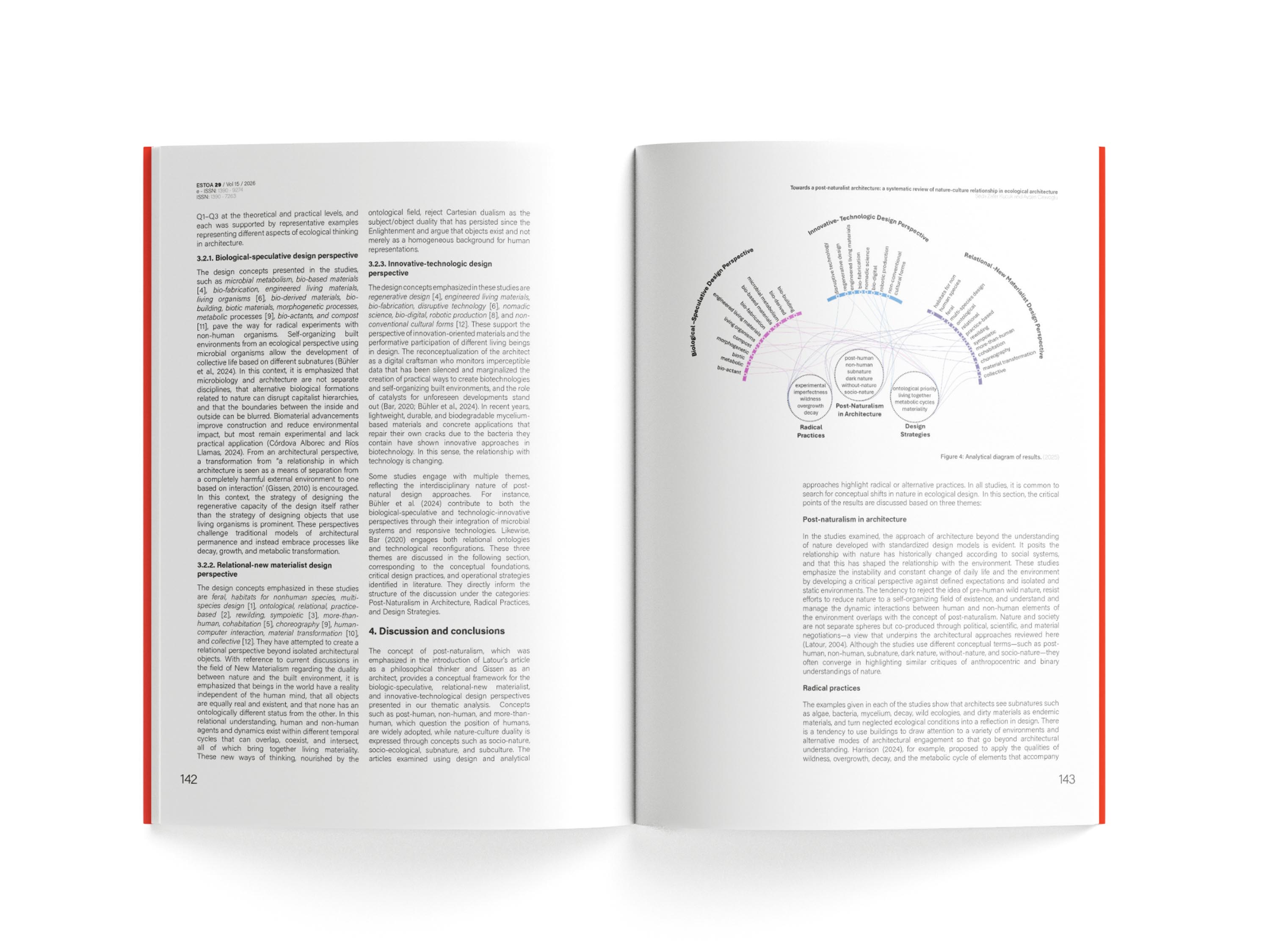
Studies on nature-culture relations emphasize the intertwined cultural relationship between the natural world and human culture. In recent years, there has been an increase in practices that include non-human entities, expanding the scope of architectural design. This review explores current approaches that examine the relationship between nature and culture in the context of ecology in architectural design. The data were collected from the Scopus and Web of Science databases guided by PRISMA The Preferred Reporting Items for Systematic Reviews and Meta-Analyses. Information regarding the post-naturalist perspective in architecture was derived from an analysis of contemporary studies that address the nature-culture discourse and expand the relationship between ecological principles and architectural design. The findings demonstrate that the domain of architectural design can be expanded through the incorporation of alternatives that are frequently perceived as threatening, overlooked, marginalized, or defective, particularly in relation to ecological considerations. This review promotes alternative ecological practices by highlighting innovative architectural design concepts and strategies.
Downloads
References
Akyurek, B. K., Mohammadi, M., Ciravoglu, A. & Yegenoglu, H. (2021). Technological transition in building design at the intersection of living and manufactured. Techne, 2, 71. https://doi.org/10.13128/techne-10685
Armstrong, R. (2020). Soft living architecture: An alternative view of bio-informed practice. Bloomsbury Publishing. https://doi.org/10.5040/9781350011366
Bar, T. (2020). Rethinking the individual–collective divide with biodigital architecture. Architecture and Culture, 8(3-4), 452–467. https://doi.org/10.1080/20507828.2020.1792202
Bennett, J. (2010). Vibrant matter: A political ecology of things. Duke University Press. https://doi.org/10.1515/9780822391623
Braidotti, R. (2013). The posthuman. Polity Press.
Braun, V. & Clarke, V. (2006). Using thematic analysis in psychology. Qualitative Research in Psychology, 3(2), 77–101. https://doi.org/10.1191/1478088706qp063oa
Bühler, M., Hollenbach, P., Köhler, L. & Armstrong, R. (2024). Unlocking resilience and sustainability with earth-based materials: A principled framework for urban transformation. Frontiers in Built Environment, 10, 1385116. https://doi.org/10.3389/fbuil.2024.1385116
Charmaz, K. (2008). Constructionism and the grounded theory method. In J. A. Holstein & J. F. Gubrium (Eds.), Handbook of constructionist research (pp. 397–412). Guilford Press.
Chayaamor-Heil, N., Houette, T., Demirci, Ö. & Badarnah, L. (2024). The potential of co-designing with living organisms: Towards a new ecological paradigm in architecture. Sustainability, 16(2), 673. https://doi.org/10.3390/su16020673
Clement, G. (2013). The emergent alternative. In A. L. Harrison (Ed.), Architectural theories of the environment (pp. 258–277). Routledge. https://doi.org/10.4324/9780203084274-28
Córdova Alborec, L. C. & Ríos Llamas, C. (2024). Repairing and destructive effects of microorganisms in buildings. Estoa. Revista de la Facultad de Arquitectura y Urbanismo de la Universidad de Cuenca, 13(26), 109-122. https://doi.org/10.18537/est.v013.n026.a07
De Landa, M. (1997). A thousand years of nonlinear history. Zone Books.
Dilnot, C. (2011). Sustainability and unsustainability in a world become artificial: Sustainability as a project of history. Design Philosophy Papers, 9(2), 103-155. https://doi.org/10.2752/144871311X13968752924671
Frichot, H. (2018). Creative ecologies: Theorizing the practice of architecture. Bloomsbury Publishing.
Gandy, M. (2008). Above the treetops: Nature, history and the limits to philosophical naturalism. Geoforum, 39(2), 561–569. https://doi.org/10.1016/j.geoforum.2006.08.009
Gannon, T., Harman, G., Ruy, D. & Wiscombe, T. (2015). The object turn: A conversation. Log, 33, 73-94.
Gissen, D. (2009). Subnature: Architecture’s other environments. Princeton Architectural Press.
Gissen, D. (2010). Territory: Architecture beyond environment. Architectural Design, 3(80), 8–13. https://doi.org/10.1002/ad.1068
Gissen, D. (2015). Nature’s historical crises. Journal of Architectural Education, 69(1), 5–7. https://doi.org/10.1080/10464883.2015.987066
Gissen, D. (2019). Digital. AA Files, 76, 126-129.
Groat, L. N. & Wang, D. (2013). Architectural research methods. John Wiley & Sons.
Grosz, E. (2011). Becoming undone: Darwinian reflections on life, politics, and Art. Duke University Press. https://doi.org/10.1215/9780822394518
Haraway, D. J. (2016). Staying with the trouble: Making kin in the Chthulucene. Duke University Press. https://doi.org/10.1215/9780822373780
Harrison, A. L. (2013). Architectural theories of the environment: Posthuman territory. Routledge. https://doi.org/10.4324/9780203084274
Harrison, A. L. (2024). Feral surfaces: Building envelopes as intelligent multi‐species habitats. Architectural Design, 94(1), 38–45. https://doi.org/10.1002/ad.3012
Huang, X., Maalsen, S. & Fredericks, J. (2025). The built environment and social media: A semi-systematic review of interdisciplinary approaches, theoretical frameworks and methods. Archnet-IJAR: International Journal of Architectural Research. Advance online publication. https://doi.org/10.1108/ARCH-07-2024-0288
Hutt, S. (2024). Flying feral: Posthuman architectures, enclosures and open‐loop interface designs. Architectural Design, 94(1), 84–93. https://doi.org/10.1002/ad.3018
Ingold, T. (2011). Being alive: Essays on movement, knowledge and description. Routledge. https://doi.org/10.4324/9780203818336
Joachim, M. (2016). Ten archetypes of nature in design. Technoetic Arts, 14(1-2), 127–130. https://doi.org/10.1386/tear.14.1-2.127_1
Kallipoliti, L. (2018). History of ecological design. In Oxford research encyclopedia of environmental science. Oxford University Press. https://doi.org/10.1093/acrefore/9780199389414.013.144
Latour, B. (2004). Politics of nature: How to bring the sciences into democracy. Harvard University Press. https://doi.org/10.4159/9780674039964
Latour, B. (2011). Waiting for Gaia: Composing the common world through arts and politics. In What is cosmopolitical design? Design, nature and the built environment (pp. 21–32). https://doi.org/10.4324/9781315545721-9
Latour, B. (2012). We have never been modern. Harvard University Press.
Lally, S. (2014). The Air from Other Planets: A Brief History of Architecture to Come. Lars Müller Publishers.
Leveratto, J. (2024). More‐than‐post: A five‐step recipe for decentring design. Architectural Design, 94(1), 14–21. https://re.public.polimi.it/handle/11311/1258838
McGaw, J. (2018). Dark matter. Architectural Theory Review, 22(1), 120–139. https://doi.org/10.1080/13264826.2018.1413406
Mestre, N. (2020). Eco Modernity: Over-designed ecologies. Vesper: Journal of Architecture, Arts & Theory, (3). https://doi.org/10.1400/281807
Moreno, C. D. & Grinda, E. G. (2013). Third natures: Incubators of public space. Architectural Design, 83(4), 46–55. https://doi.org/10.1002/ad.1618
Morton, T. (2010). The ecological thought. Harvard University Press. https://doi.org/10.4159/9780674056732
Morton, T. (2016). Dark ecology: For a logic of future coexistence. Columbia University Press. https://doi.org/10.7312/mort17752
Nassauer, J. I. (1995). Messy ecosystems, orderly frames. Landscape Journal, 14(2), 161-170. https://doi.org/10.3368/lj.14.2.161
Page, M. J., McKenzie, J. E., Bossuyt, P. M., Boutron, I., Hoffmann, T. C., Mulrow, C. D. & Moher, D. (2021). The PRISMA 2020 statement: An updated guideline for reporting systematic reviews. BMJ, 372, n71. https://doi.org/10.1136/bmj.n71
Panagiotopoulou, V., Yang, Z. & Li, X. (2018). Depraved urban scapes: Inhabiting subnature in the hybrid city. In Proceedings of the 4th Media Architecture Biennale Conference (pp. 55–65). https://doi.org/10.1145/3284389.3284488
Puig de la Bellacasa, M. (2017). Matters of care: Speculative ethics in more than human worlds. University of Minnesota Press. https://doi.org/10.5749/minnesota/9781517900631.001.0001
PRISMA Flow Diagram. (2024). https://www.prisma-statement.org/prisma-2020-flow-diagram
Rawes, P. (2013). Relational architectural ecologies: Architecture, nature and subjectivity. Routledge. https://doi.org/10.4324/9780203770283
Ruy, D. (2012). Returning to (strange) objects. TARP Architecture Manual: Not Nature, 38–42.
Saha, T. & Nusem, E. (2024). Ecologies otherwise: Mapping ontological, speculative, and transition design discourses. Design and Culture, 16(2), 191–210. https://doi.org/10.1080/17547075.2024.2335429
Smith, N. (2008). Uneven development: Nature, capital, and the production of space (1st ed.). University of Georgia Press.
Till, J. & Wigglesworth, S. (2001). The future is hairy. In J. Hill (Ed.), Architecture: The Subject is Matter (pp. 11–28). Routledge.
Warner, E., Sutton, E. & Andrews, F. (2020). Cohousing as a model for social health: A scoping review. Cities & Health, 8(2), 107–119. https://doi.org/10.1080/23748834.2020.1838225
Van Wyck, P. C. (1997). Primitives in the wilderness: Deep ecology and the missing human subject. SUNY Press.
Yaneva, A. (2017). Introduction: What is cosmopolitical design? In A. Yaneva & A. Zaera-Polo (Eds.), What is cosmopolitical design? Design, nature and the built environment (pp. 1–21). Routledge. https://doi.org/10.4324/9781315545721-8
Published
How to Cite
Issue
Section
License
Copyright (c) 2025 Estoa. Journal of the Faculty of Architecture and Urbanism

This work is licensed under a Creative Commons Attribution-NonCommercial-ShareAlike 4.0 International License.
The Journal declines any responsibility for possible conflicts derived from the authorship of the works that are published in it.
The University of Cuenca in Ecuador conserves the patrimonial rights (copyright) of the published works and will favor the reuse of the same ones, these can be: copy, use, diffuse, transmit and expose publicly.
Unless otherwise indicated, all contents of the electronic edition are distributed under a Creative Commons Attribution-NonCommercial-ShareAlike 4.0 International License.