Governance assessment in post-earthquake urban regeneration: historic and commercial center of Portoviejo
DOI:
https://doi.org/10.18537/est.v014.n027.a08Keywords:
governance, resilience, sustainable reconstruction, urban regeneration, urban structureAbstract
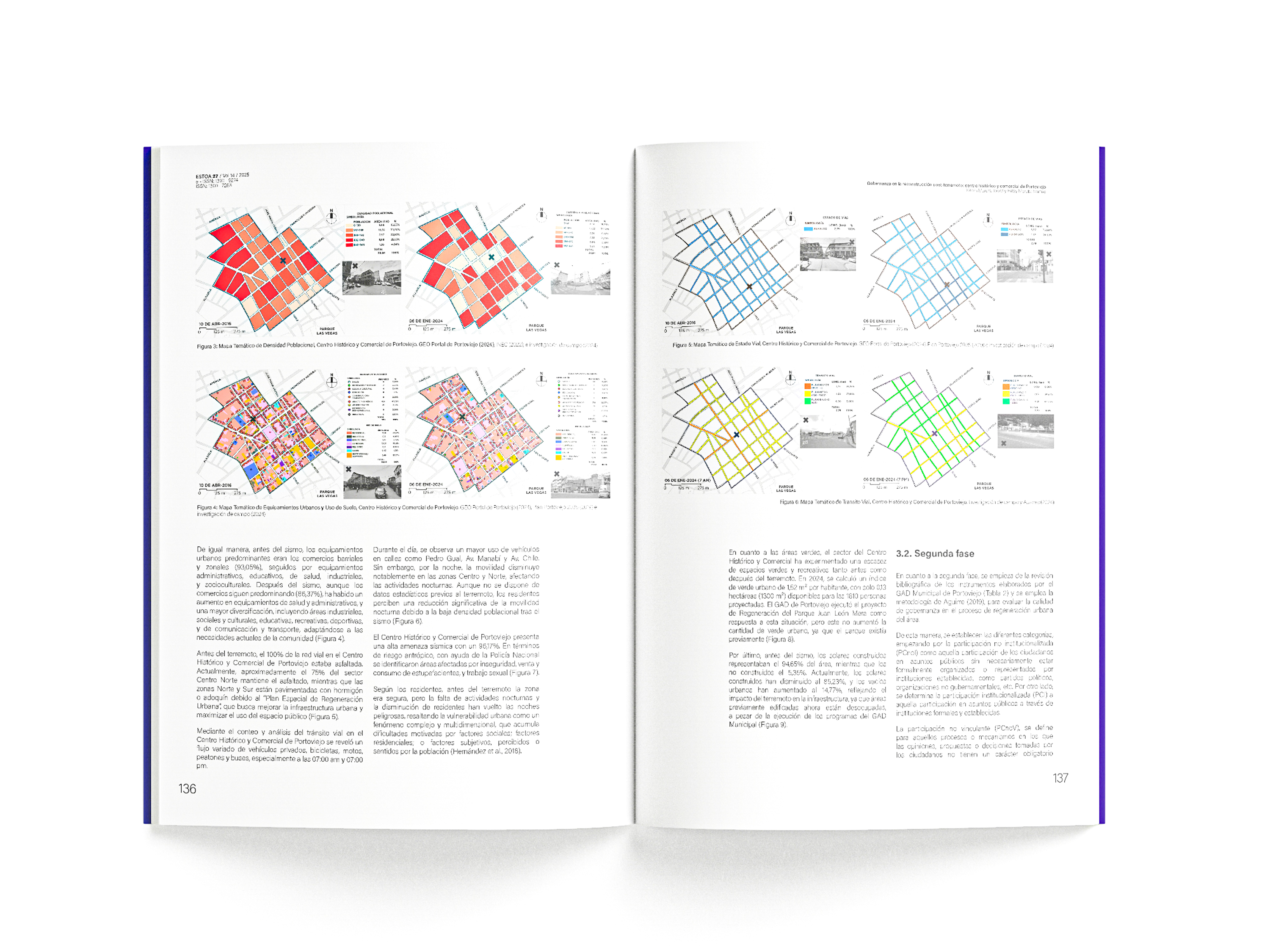
The main objective of this article is to evaluate the quality of territorial governance in the post-earthquake recovery of Portoviejo following the April 16, 2016 earthquake analyzes the articulation between the public and private sectors, as well as citizen participation in all urban regeneration programs, with the purpose of identifying the main urban changes in the sector. For this purpose, an exhaustive documentary review was carried out, and information was collected in situ, including the elaboration of thematic maps and focus groups. It is concluded that, despite addressing social, economic and environmental aspects, urban regeneration in Portoviejo is still exposed to vulnerabilities and threats. Problems in urban structure, infrastructure and governance are highlighted, suggesting comprehensive regeneration to improve the quality of life and promote sustainable development.
Downloads
References
Aguilar, L. (2010). Gobernanza: El nuevo proceso de gobernar. México: Fundación Friedrich Naumann para la libertad. https://bit.ly/3XFGBsE
Aguirre, J. (2019). Propuesta de indicadores para medir y evaluar la gobernanza. Gobernar: The Journal of Latin American Public Policy and Governance, 3 (5), 108-126. https://doi.org/10.22191/gobernar/vol3/iss5/7
Banco Mundial. (02 de Junio, 2023). Mejorar la gobernanza es fundamental para garantizar un crecimiento equitativo en los países en desarrollo. Grupo Banco Mundial. https://bit.ly/3qi3VhI
Behar, D. (2008). Metodología de la investigación. Editorial Shalom. https://bit.ly/3Rfevi7
Castillo-Cubillos, M. (2017). El papel de la participación ciudadana en las políticas públicas, bajo el actual escenario de la gobernanza: reflexiones teóricas. CS, (23), 157-180. https://bit.ly/3zih8vo
Concepto. (05 de Agosto, 2021). Concepto de Observación Científica. Concepto. https://concepto.de/observacion-cientifica/
Coral, D. (2016). Guías Laboratorio de pensamiento y lenguajes. Universidad El Bosque. https://bit.ly/3TU0H00
Crotte, I. (2011). Elementos para el diseño de técnicas de investigación: una propuesta de definiciones y procedimientos en la investigación científica. Tiempo de educar, 12(24), 277-297. https://bit.ly/3YEyRpq
Djordjević, M., Radivojević, A., Dragović, R., y Filipović, I. (2016). Exposure To Earthquakes—Distribution And Change Of The World’s Population With Regard To Disposition Of Seismic Activities. Journal of the Geographical Institute “Jovan Cvijić” SASA, 66(3), 353-370. https://doi.org/10.2298/ijgi1603353d
GAD Municipal de Portoviejo. (16 de Marzo, 2015). Ordenanza que incorpora a la normativa municipal la actualización de los planes de desarrollo y de ordenamiento territorial del Cantón Portoviejo. Plan de Desarrollo y Ordenamiento Territorial del Cantón Portoviejo 2014-2019, 1-153. https://bit.ly/3RIAH6g
Gobierno Autónomo Descentralizado Municipal de Portoviejo. (06 de octubre, 2016). Ordenanza para la Reconstrucción de Portoviejo: Medidas Emergentes. Ordenanzas Municipales (866), 1-21. https://bit.ly/3WRE5Ob
GAD Municipal de Portoviejo. (2017). Modelo de Gestión. IngeniArt. https://bit.ly/3HQmYoS
GAD Municipal de Portoviejo. (2018). Libro 2: Ordenanza que Regula el Desarrollo y el Ordenamiento Territorial del Cantón Portoviejo. Componente Territorial. InegniArt. https://bit.ly/457KqHS
GAD Municipal de Portoviejo. (2019). Plan Portoviejo 2035. La mejor Ciudad para vivir en el Ecuador. GAD Municipal de Portoviejo. https://www.portoviejo.gob.ec/portoviejo2035/
GAD Municipal de Portoviejo. (06 de Enero, 2024). GEO Portal. Portal de servicios al ciudadano del GAD Municipal del cantón Portoviejo. https://bit.ly/4czx2Qj
Giles-Corti, B., Vernez-Moudon, A., Reis, R., Turrell, G., Dannenberg, A., Badland, H., y Owen, N. (2016). City planning and population health: a global challenge. The lancet, 388(10062), 2912-2924. https://doi.org/10.1016/s0140-6736(16)30066-6
Hernández, A., Rodríguez, I., y Córdoba, R. (2018). Vulnerabilidad residencial y social en las grandes ciudades españolas 2001/2011. https://bit.ly/4eHyFxa
Hwang, S., y Lee, S. (2020). Unused, underused, and misused: an examination of theories on urban void spaces. Urban Research y Practice, 13(5), 540-556. https://doi.org/10.1080/17535069.2019.1634140
Instituto Nacional de Estadística y Censos. (2022). Resultados. Censo Ecuador. https://bit.ly/3RPrdGu
Izakovičová, Z., Špulerová, J., y Petrovič, F. (2018). Integrated approach to sustainable land use management. Environments, 5(3), 37. https://doi.org/10.3390/environments5030037
Jha, A., Miner, T. y Stanton-Geddes, Z. (2013). Building urban resilience: principles, tools, and practice. The World Bank Publications. https://bit.ly/47xJxKk
López, J. (2010). Metodologías participativas para la gestión social del hábitat. Habitat y Sociedad, 1, 83-103. https://bit.ly/4cjO6dm
Martínez, M. (2004). Los Grupos Focales de Discusión como Método de Investigación. Objetivos de la Investigación, 10(5), 1-10. https://bit.ly/3R0ZvVf
Martínez, T. (1992). Manual de Investigación Urbana (1ra. Edición). Editorial Trillas. https://bit.ly/3TzOCf8
Mastroianni, P., Monechi, B., Liberto, C., Valenti, G., Servedio, V. D., y Loreto, V. (2015). Local optimization strategies in urban vehicular mobility. PloS one, 10(12), e0143799. https://doi.org/10.1371/journal.pone.0143799
Mayorga, F. y Córdova, E. (2007). Gobernabilidad y gobernanza en América Latina. Ginebra, SZ. 1-18. https://bit.ly/4blzSY3
Medina, M. (2021). Estudio del impacto socio ambiental de la regeneración urbana. Un caso del centro histórico del cantón Portoviejo. Dominio de las ciencias, 7(3), 523-538. https://bit.ly/3M6kENd
Omar, N., y Saeed, E. (2019). Urban Voids As Potentioal Resources For The City Development. JES. Journal of Engineering Sciences, 47(5), 585-600. https://doi.org/10.21608/jesaun.2019.109853
Organización de las Naciones Unidas. (02 de Junio, 2023). Acerca de la buena gobernanza y los derechos humanos: El ACNUDH y la buena gobernanza. Organización de las Naciones Unidas. https://bit.ly/3Ogr8sC
Organización de las Naciones Unidas. (2019). Informe de los Objetivos de Desarrollo Sostenible. https://bit.ly/43OyoSX
Pitarch, M., y Uceda, F. (2015). Analysis of exclusion from juvenile crime in the city of Valencia. The territory as a basis for action. Boletín de la Asociación de Geógrafos Españoles, 69(2015), 505-508. https://bit.ly/3xdxRPh
Ramirez, L., y Grijalba, A. (2020). Sustainability and resilience in smart city planning: A review. Sustainability, 13(1), 181. https://doi.org/10.3390/su13010181
Sarmiento, P., Fritis, A., y Castro Correa, C. P. (2020). Regeneración urbana y gestión del riesgo en Chile: análisis comparativo de casos. Revista INVI, 35(100), 174-198. http://dx.doi.org/10.4067/S0718-83582020000300174
Stefanizzi, S., y Verdolini, V. (2019). Bordered communities: the perception of insecurity in five European cities. Quality y Quantity, 53(3), 1165-1186. https://doi.org/10.1007/s11135-018-0810-x
Tamayo, M. (2001). El proceso de la investigación científica. Editorial Limusa. https://bit.ly/49fy7dO
United Nations Human Settlements Programme. (2018). Leading Change: Delivering the new urban agenda through urban and territorial planning. United Nations Human Settlements Programme. https://bit.ly/47rCZwX
Valdivieso, P. (2019). Análisis institucional de la gobernanza de la reducción de riesgos de desastres en la escala local. Análisis con municipios chilenos. Planificación multiescalar, regional y local, 1 (53), 233-255. https://bit.ly/3MPP99c
Wagemann, E., D’Alençon, R., y Greene, M. (2020). Resiliencia es más que resistencia: dos experiencias del terremoto y tsunami de 2010. ARQ (Santiago), (105), 80-93. http://dx.doi.org/10.4067/S0717-69962020000200080
World Health Organization. (2017). Urban green spaces: a brief for action. World Health Organization: Regional Office for Europe. https://bit.ly/3vtB8cK
Xofi, M., Domingues, J., Santos, P., Pereira, S., Oliveira, S., Reis, E., Zêzere, J., Garcia, R., Lourenço, P., y Ferreira, T. (2022). Exposure and physical vulnerability indicators to assess seismic risk in urban areas: a step towards a multi-hazard risk analysis. Geomatics, Natural Hazards and Risk, 13(1), 1154-1177. https://doi.org/10.1080/19475705.2022.2068457
Downloads
Published
How to Cite
Issue
Section
License
Copyright (c) 2025 Estoa. Journal of the Faculty of Architecture and Urbanism

This work is licensed under a Creative Commons Attribution-NonCommercial-ShareAlike 4.0 International License.
The Journal declines any responsibility for possible conflicts derived from the authorship of the works that are published in it.
The University of Cuenca in Ecuador conserves the patrimonial rights (copyright) of the published works and will favor the reuse of the same ones, these can be: copy, use, diffuse, transmit and expose publicly.
Unless otherwise indicated, all contents of the electronic edition are distributed under a Creative Commons Attribution-NonCommercial-ShareAlike 4.0 International License.