Exploring feminist urban geographies: woman workers in the peanut industry of Osmaniye Turkiye
DOI:
https://doi.org/10.18537/est.v014.n027.a04Keywords:
feminist urban geography, feminization of workplace, peanut production, Türkiye, women workersAbstract
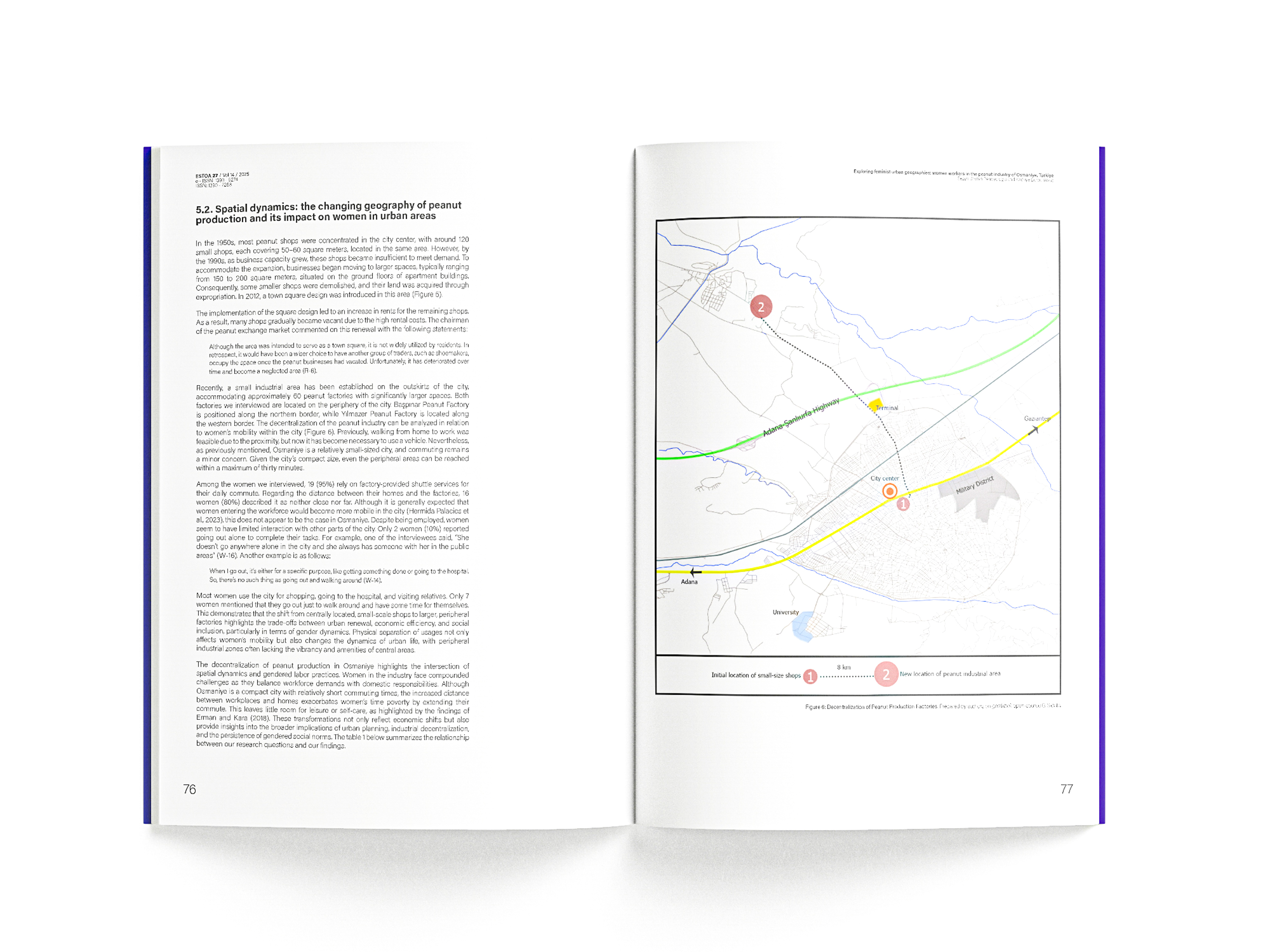
Osmaniye is well-known for its substantial peanut production, and women workers play a crucial role in every aspect of this sector. The article manifests original research findings on the working conditions and the socio-spatial experiences of women workers, who are integral to the peanut industry. The findings rely on semi-structured in-depth interviews and non-participant observations conducted in 2022, involving women workers and other key actors at two major factories. Among the common issues confronted by women workers are low wages, precarious working conditions, and unsuitable work environments and worsening mobility patterns which exacerbate their urban daily life experience. Their work does not lead to empowerment or an increased usage of space but instead results in a “double shift”; and a negative perception of their work. Ultimately, the working environment and the daily urban geographies of women workers dramatically reproduces patriarchal dynamics.
Downloads
References
Aksit, E. E. (2009). Osmanlı İmparatorluğu ve Türkiye’de Kamusallık Kavramının Dönüşümü ve Dışladıkları. Ankara Üniversitesi SBF Dergisi, 64(01), 1-21.
Aksit, E. E. (2011). The women’s quarters in the historical hammam. Gender, Place and Culture, 18(02), 277-293.
Alkan, A. (2000). Özel Alan-Kamusal Alan” Ayrımının Feminist Eleştirisi Çerçevesinde Kentsel Mekan. Kültür ve İletişim, 3(5), 71-95.
Alkan, A. (2012). Şehircilik çalışmalarının zayıf halkası: Cinsiyet. Nermin Abadan Unat’a Armağan içinde, Koç Üniversitesi Yayınları.
Álvarez, A., & Buigues-Nollens, A. F. (2023). Indicators of environmental Assessment and gender. Pilot proposal for social housing in arid zone: San Juan as a case study. Estoa, Revista de la Facultad de Arquitectura y Urbanismo de la Universidad de Cuenca, 12(24), 109-122.
Baines, D. (2006). Staying with people who slap us around: Gender, juggling responsibilities and violence in paid (and unpaid) care work. Gender, Work & Organization, 13(2), 129-151.
Baliyan, K. (2018). Use of Female Family and Hired Labour in Agriculture: An Empirical Study in Western Uttar Pradesh, India. Gender and Women’s Studies.
Barman, N., & Sarkar, B. (2022). Women Beedi Workers of Cooch Behar, West Bengal: Accessibility of Welfare Programmes. Social Change, 52(4), 505-519.
Beckwith, J. (1992). Stereotypes and reality in the division of household labor. Social Behavior and Personality, 20, 283-288.
Beebeejaun, Y. (2017). Gender, urban space, and the right to everyday life. Journal of Urban Affairs, 39(3), 323–334.
Benería, L., Berik, G., & Floro, M. (2015). Gender, development and globalization: Economics as if all people mattered. Routledge.
Bergmann, B. (1989). Does the Market for Women’s Labor Need Fixing? Journal of Economic Perspectives, 3, 43-60.
Bondi, L. (1992). Gender and dichotomy. Progress in Human geography, 16(1), 98-104.
Bondi, L., & Domosh, M. (1992). Other figures in other places: on feminism, postmodernism and geography. Environment and Planning D: Society and Space, 10(2), 199-213.
Bondi, L., & Rose, D. (2003). Constructing gender, constructing the urban: A review of Anglo-American feminist urban geography. Gender, Place and Culture: A Journal of Feminist Geography, 10(3), 229-245.
Bowles, H. R., & Babcock, L. (2013). How Can Women Escape the Compensation Negotiation Dilemma? Relational Accounts Are One Answer. Psychology of Women Quarterly, 37(1), 80-96.
Bueno Carvajal, J. M. (2021). Public space and identity. Three scenarios of interpretation in the contemporary city. Estoa, Revista de la Facultad de Arquitectura y Urbanismo de la Universidad de Cuenca, 10(19), 161–169.
Cain, M., Khanam, S. R., & Nahar, S. (1979). Class, Patriarchy, and Women’s Work in Bangladesh. Population and Development Review, 5(3), 405–438.
Caraway, T. L. (2005). The Political Economy of Feminization: From “Cheap Labor” to Gendered Discourses of Work. Politics & Gender, 1(3), 399-429.
Cesur, F. (2018). The Place of Women in Employment: Turkish Case. Sustainability and Social Responsibility of Accountability Reporting Systems: A Global Approach, 81-93.
Choudhry, S. (1997). Women Workers in the Global Factory: Impact of Gender Power Asymmetries. In: Gupta, S.D. (eds) The Political Economy of Globalization. Recent Economic Thought Series, 55. Springer.
Coddington, K. (2015). Feminist geographies “beyond” gender: De‐coupling feminist research and the gendered subject. Geography Compass, 9(4), 214-224.
Çağatay, N., & Berik, G. (1990). Transition to export-led growth in Türkiye: is there a feminization of employment? Review of Radical Political Economics, 22(1), 115-134.
Çetin, R., & Türkün, A. (2022). The effects of women’s joining in paid employment on public place usage: Sakarya Geyve case. Megaron, 17(1), 107-116.
De, I. (2022). Women’s empowerment, work environment, and income: evidence from India. Development in Practice, 32, 468 - 480.
Dedeoğlu, S. (2004). Working for Family: The Role of Women’s Informal Labor in the Survival of Family-owned Garment Ateliers in Istanbul, Türkiye (Vol. 281). Women and International Development, Michigan State University.
Dedeoğlu, S. (2010). Visible hands–invisible women: Garment production in Türkiye. Feminist Economics, 16(4), 1-32.
Deniz, A. & Şenol, F. (2024). Feminist Coğrafya. Feminist Tahayyül, 5(1), 1-5.
Dixon, R. (1982). Women in agriculture: counting the labor force in developing countries. Population and Development Review, 8, 539.
Doğaka. (2015). TR 63 Bölgesi yer fıstığı sektör raporu. Doğu Akdeniz Kalkınma Ajansı.
Erdoğan, E. (2020). Domatesler ve Aileleri: Bağımlı Bir İlişkinin Hikâyesi. Praksis, 53, 67-92.
Erman, T., & Kara, H. (2018). Female domestic workers strategizing via commuting long distance: new challenges and negotiations in neoliberalizing Türkiye. Womens Studies International Forum, 67, 45-52.
Fenster, T. (1999). Space for gender: cultural roles of the forbidden and the permitted. Environment and Planning D: Society and Space, 17(2), 227-246.
Fincher, R. (1990). Women in the city: feminist analyses of urban geography. Australian Geographical Studies, 28(1), 29-37.
Flores, L. Y., Settles, I., McGillen, G. G., & Davis, T. M. (2021). Critical contributions to scholarship on women and work: Celebrating 50 years of progress and looking ahead to a new decade.Journal of Vocational Behavior, 126, 103490.
Fuentes, L., & Cookson, T. P. (2020). Counting gender (in) equality? a feminist geographical critique of the ‘gender data revolution’. Gender, Place & Culture, 27(6), 881-902.
Fussell, E. (2000). Making labor flexible: The recomposition of Tijuana’s maquiladora female labor force. Feminist Economics, 6(3), 59-79.
Garcia-Ramon, M. D., Ortiz, A., & Prats, M. (2004). Urban planning, gender and the use of public space in a peripherial neighbourhood of Barcelona. Cities, 21(3), 215-223.
Gilbert, M. R. (1997). Feminism and difference in urban geography. Urban Geography, 18(2), 166-179.
Gomes, D., Jesus, M., Rosa, R., Bandeira, C., & da Costa, A. C. (2022). Women in family farming: Evidence from a qualitative study in two Portuguese inner regions. Frontiers in Sociology, 7, 939590.
Hartmann, H. (2006). Capitalism, patriarchy, and the subordination of women. Social class and stratification: Classic statements and theoretical debates, 183-192.
Heath, R., & Mobarak, A. M. (2015). Manufacturing growth and the lives of Bangladeshi women. Journal of development Economics, 115, 1-15.
Hermida Palacios, C. M., Cordero-Salcedo, M., Eljuri, G., Fajardo, G., & Serrano-Fernández de Córdova, E. (2023). Gender and daily mobility in a university community. Estoa, Revista de la Facultad de Arquitectura y Urbanismo de la Universidad de Cuenca, 12(23), 19–30.
Hossain, M. I., Mathbor, G. M., & Semenza, R. (2013). Feminization and labor vulnerability in global manufacturing industries: Does gendered discourse matter? Asian Social Work and Policy Review, 7(3), 197-212.
İlkkaracan, İ. (2012). Why so Few Women in the Labor Market in Türkiye? Feminist Economics, 18(1), 1–37.
Jones, K., & Clifton, J. (2018). Rendering sexism invisible in workplace narratives. A narrative analysis of female entrepreneurs’ stories of not being talked to by men. Gender, Work & Organization, 25(5), 557-574.
Kandiyoti, D. (1998). Gender, power and contestation: Rethinking bargaining with patriarchy. In C. Jackson & R. Pearson (Eds.), Feminist visions of development (pp. 123–145). Routledge.
Kern, L. (2020). Feminist city: Claiming space in a man-made world. Verso Books.
King, K. E. (1994). Method and methodology in feminist research: what is the difference? Journal of advanced nursing, 20(1), 19-22.
Kucera, D., & Tejani, S. (2014). Feminization, defeminization, and structural change in manufacturing. World Development, 64, 569-582.
Law, R. (1999). Beyond ‘women and transport’: towards new geographies of gender and daily mobility. Progress in Human Geography, 23(4), 567-588.
Lee, C. K. (1998). Gender and the South China miracle: Two worlds of factory women. University of California Press.
Luxton, M. (1997). The UN, women, and household labour: Measuring and valuing unpaid work, Women’s Studies International Forum, 20(3), 431-439.
MacDonald, M., Phipps, S., & Lethbridge, L. (2005). Taking Its Toll: The Influence of Paid and Unpaid Work on Women’s Well-Being. Feminist Economics, 11(1), 63–94.
Madanipour, A. (2014). Urban design, space and society. Palgrave Macmillan.
Maheshwari, G., Nayak, R., & Ngyyen, T. (2021). Review of research for two decades for women leadership in higher education around the world and in Vietnam: a comparative analysis. Gender in Management: An International Journal, 36(5), 640-658.
Manolache, E. (2013). Transforming the Gendered Social Relations of Urban Space. Journal of Research in Gender Studies, 3(1), 125–130.
McDowell, L. (1992). Doing Gender: Feminism, Feminists and Research Methods in Human Geography, Transactions of the Institute of British Geographers, New Series, 17(4), 399-416.
McDowell, L. (1993). Space, place and gender relations: Identity, difference, feminist geometries and geographies, Progress in Human Geography, 17(3), 305-318.
Ministry of Development. (2013). İllerin ve bölgelerin sosyo-ekonomik gelişmişlik sıralaması araştırması. [Report]. https://www.sanayi.gov.tr/merkez-birimi/b94224510b7b/sege
Mirioğlu, G. (2018). Kentlere feminist coğrafya perspektifinden bakmak. Ege Coğrafya Dergisi, 27(2), 183-194.
Montoya-Robledo, V., Calero, L., Carvajal, V., Molina, D., Pipicano, W., Peña, A., Pipicano, C., Valderrama, J., Fernández, M., Porras, I., Arias, N., & Miranda, L. (2020). Gender stereotypes affecting active mobility of care in Bogotá. Transportation Research Part D-transport and Environment, 86, 102470.
Morvaridi, B. (1992). Gender Relations in Agriculture: Women in Türkiye. Economic Development and Cultural Change, 40, 567 - 586.
Navarrete-Hernandez, P., Vetro, A., & Concha, P. (2021). Building safer public spaces: Exploring gender difference in the perception of safety in public space through urban design interventions. Landscape and Urban Planning, 214, 104-180.
Newman, A. (2008). Inclusive planning of urban nature. Ecological Restoration, 229-234.
Nguyen, T. P. (2022). Addressing gender discrimination in Vietnam’s light manufacturing industry: What role for labor law? Asian Journal of Social Science, 50(1), 44-52.
Núñez-González, M., & Moya-Olmedo, P. (2023). Women in the Sevillian House (16th century): Real Estate Market Analysis and Architectural Study. Estoa, Revista de la Facultad de Arquitectura y Urbanismo de la Universidad de Cuenca, 12(24), 80-91.
Oaxaca, R. (1973). Male-Female Wage Differentials in Urban Labor Markets. International Economic Review, 14, 693-709.
Özbay, F. (1999). Gendered space: A new look at Turkish modernisation. Gender & history, 11(3), 555-568.
OTB. (2020). 2020 yılı faaliyet raporu. Osmaniye Ticaret Borsası.
Kobayashi, A., & Peake, L. (1994). Unnatural discourse: ‘Race’ and gender in geography. Gender, Place and Culture: A journal of feminist geography, 1(2), 225-243.
Peake, L. J. (1995). Toward an Understanding of the Interconnectedness of Women’s Lives: The “Racial” Reproduction of Labor in Low-Income Urban Areas. Urban Geography, 16(5), 414–439.
Pepper, A. (2012). Sexual divisions of labor in export-oriented manufacturing sectors: the reconstruction of gender and the urbanization of production in the Global South. Consilience, 8, 142-152.
Peterson, V. S. (2004). A critical rewriting of global political economy: Integrating reproductive, productive and virtual economies. Routledge.
Praharaj, S. (2021). Area-based urban renewal approach for smart cities development in India: Challenges of inclusion and sustainability. Urban Planning, 6(4), 202-215.
Quinones, L. M. (2020). Sexual harassment in public transport in Bogotá. Transportation Research Part A: Policy and Practice, 139, 54-69.
Park, Y., & Garcia, M. (2020). Pedestrian safety perception and urban street settings. International Journal of Sustainable Transportation, 14(11), 860-871.
Rios, P. N. (1990). Export-oriented industrialization and the demand for female labor: Puerto Rican women in the manufacturing sector, 1952-1980. Gender & Society, 4(3), 321-337.
Rose, G. (1992) Feminist Voices and Geographical Knowledge, Antipode 24, 230-33.
Rose, D. (2010). Refractions and recombinations of the ‘economic’and the ‘social’: A personalized reflection on challenges by and to feminist urban geographies. The Canadian Geographer, 54(4), 391-409.
Sadiqi, F., & Ennaji, M. (2006). The feminization of public space: Women’s activism, the family law, and social change in Morocco. Journal of Middle East Women’s Studies, 2(2), 86-114.
Sanders, R. (1990). Integrating race and ethnicity into geographic gender studies, The Professional Geographer, 42(2), 228–231.
Savran Penbecioğlu, S. Büyücek, G. (2024). Kadın ve Kentsel Mobilite İlişkisini Güzergâh Haritaları Üzerinden Okumak, Cumhuriyetin 100. Yılında Kentleşme ve Kentsel Toplum içinde (Eds: Şerife Geniş, Neslihan Demirtaş Milz), İdealkent Yayınları, 496-515.
Scheiner, J. & Holz-Rau, C. (2017) Women’s complex daily lives: a gendered look at trip chaining and activity pattern entropy in Germany. Transportation 44, 117–138.
Shaw, R. (2022). Geographies of night work. Progress in Human Geography, 46(5), 1149-1164.
Shelton, B. A., & John, D. (1996). The division of household labor. Annual Review of Sociology, 22(1), 299-322.
Sirman, A. N. (1988). Peasants and family farms: the position of households in cotton production in a village of western Türkiye (Doctoral dissertation), University of London.
Spierings, N. (2014). The Influence of Patriarchal Norms, Institutions, and Household Composition on Women’s Employment in Twenty-Eight Muslim-Majority Countries. Feminist Economics, 20, 112 - 87.
Surdu, S., Mertz, E., Langelier, M., & Moore, J. (2021). Dental workforce trends: a national study of gender diversity and practice patterns. Medical Care Research and Review, 78, 30-39.
Tejani, S., & Milberg, W. (2016). Global defeminization? Industrial upgrading and manufacturing employment in developing countries. Feminist Economics, 22(2), 24-54.
Tuncer, S. (2012). Beşeri coğrafyaya feminist itirazlar. Fe Dergi, 4(1), 78-90.
Tuncer, S. (2018). Women and public space in Türkiye: Gender, modernity and the urban experience. Bloomsbury Publishing.
Tuncer, S. (2015). Dışarı çıkmak: Özelden kamusala feminist bir saha hikâyesi. Moment dergi, 2(2), 30-58.
Vaiou, D., & Lykogianni, R. (2006). Women, Neighbourhoods and Everyday Life. Urban Studies, 43, 731 - 743.
Vera-Gray, F. (2020). The whole place self: reflecting on the original working practices of rape crisis. Journal of Gender-Based Violence, 4(1), 59-72.
Walby, S. (1989). Theorising patriarchy. Sociology, 23(2), 213-234.
Wharton, A. (1986). Gender Segregation and the Dual Economy: A Study of Blue‐Collar Occupations in U.S. Manufacturing Industries. International Journal of Sociology and Social Policy, 6, 30-44.
Wilson, E. (2001). The contradictions of culture: Cities, culture, women. SAGE Publications.
Yavuz, N., & Welch, E. W. (2010). Addressing fear of crime in public space: Gender differences in reaction to safety measures in train transit. Urban Studies, 47(12), 2491-2515.
Yüceşahin, M. M. & Yazgan, P. (2017). Kentler toplumsal cinsiyetsiz değildir: Türkiye’de kentsel mekânın üretiminin feminist bir eleştirisi. Kadın / Women 2000: Kadın Araştırmaları Dergisi. 18(1), 85-106.
Published
How to Cite
Issue
Section
License
Copyright (c) 2025 Estoa. Journal of the Faculty of Architecture and Urbanism

This work is licensed under a Creative Commons Attribution-NonCommercial-ShareAlike 4.0 International License.
The Journal declines any responsibility for possible conflicts derived from the authorship of the works that are published in it.
The University of Cuenca in Ecuador conserves the patrimonial rights (copyright) of the published works and will favor the reuse of the same ones, these can be: copy, use, diffuse, transmit and expose publicly.
Unless otherwise indicated, all contents of the electronic edition are distributed under a Creative Commons Attribution-NonCommercial-ShareAlike 4.0 International License.