The local and the universal in Ecuadorian art applied to architectural education
DOI:
https://doi.org/10.18537/est.v015.n029.a19Keywords:
abstraction, composition, local, mimesis, universalAbstract
The relationship between the local and the universal in creative processes is examined, using the methodology of Architectural and Urban Design I Workshop from the Architecture program at Pontificia Universidad Católica del Ecuador (PUCE) during 2022. The study analyzes how students can integrate local traditions with universal principles through mimesis and abstraction, referencing two comparative cases: one Ecuadorian and one international. The methodology aims to ¨ not only theoretically, but also through a practical process that transforms real objects into abstract forms. This approach facilitates the understanding of universal patterns present in various cultural and artistic expressions, allowing their adaptation to the architectural context.
Downloads
References
Aparicio, J. (2004). Giuseppe Terragni: El Danteum 1938-1940. Editorial Rueda.
Aureli, P. V. (2021). Articular opuestos. El Croquis, (208).
Aureli, P. V. (2024). Arquitectura y abstracción. Puente Editores.
Benavides, J. (2022). La lección de la historia: razón, crítica y revolución. En Comisión BAQ (Ed.), Catálogo académico BAQ 2022 (pp. 49–52). Colegio de Arquitectos del Ecuador.
Benavides, J. y Revelo, N. (2023). El problema de la forma como propuesta metodológica: El caso de los Talleres de Diseño Arquitectónico y Urbano de la PUCE FADA de 2019 a 2022. Revista Eidos, 16(22), 61–71. https://doi.org/10.29019/eidos.v16i22.1224
Bonfanti, E., Bonicalzi, R., Rossi, A. y Scolari, M. (1979). Arquitectura Racional. Alianza Forma.
Buchholz, E., Zeidler, B. y Zimmermann, B. (2005). Pablo Picasso, vida y obra. Könemann.
Branzi, A. (2006). No Stop City: Archizoom Associati. HYX.
Campo Baeza, A. (2013). Principia Architectonica. Mairea.
Curran, A. (2019). Aristóteles y la Poética. Cátedra.
de Prada, M. (2012). Arte, arquitectura y mímesis. Nobuko.
Frampton, K. (2020). Teoría. Gustavo Gili.
Gozak, A. & Leonidov, A. (1988). Ivan Leonidov: The Complete Works. Rizzoli.
Han, B., (2022). Infocracy: Digitalization and the Crisis of Democracy, Polity Press.
Kahn, L. (2003). Escritos, conferencias y entrevistas. El Croquis.
Koolhaas, R. & Mau, B. (2010). S, M, L, XL. The Monacelli Press.
Krier, L. (2013). La arquitectura de la comunidad. Editorial Reverté.
Le Corbusier. (1998). Hacia una arquitectura. Apóstrofe.
Lucas, G. (Director). (1971). THX-1138 [Película]. America Zoetrope.
Malevich, K. (2023). El mundo no objetivo. Buchwald Editorial.
Miranda, A. (2013). Arquitectura y verdad. Cátedra.
Miranda, A. (2008). Columnas para la resistencia. Mairea.
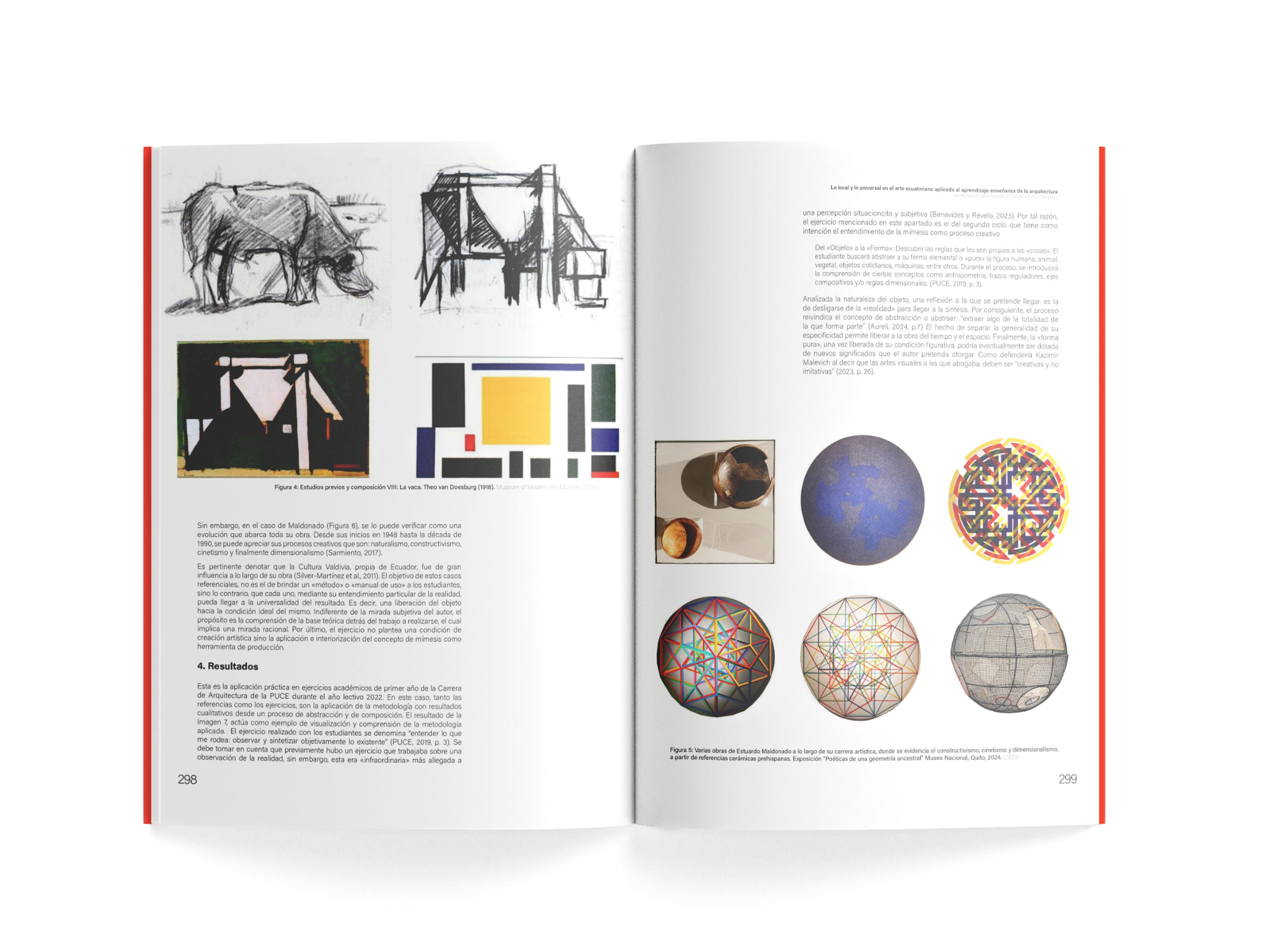
Museum of Modern Art (MoMA). (2025). Composition VIII (The Cow), de Theo van Doesburg (1918) [Página web]. https://www.moma.org/artists/6076-theo-van-doesburg
Pancorbo, A. (2014). La guía del Prado. Museo Nacional del Prado.
PUCE, (2022). Guía metodológica de Taller DAU I. Manuscrito.
RAE, (2001). Diccionario de la lengua española, 21.ª ed., Tomo I. Editorial Espasa.
Rossi, A. (2017). La arquitectura de la ciudad. Gustavo Gili.
Roth, L. (2010). Entender la arquitectura sus elementos, historia y significado. Editorial Gustavo Gili.
Sarmiento, M. (2017). Estuardo Maldonado, Hacia el dimensionalismo pictórico [Video]. YouTube. https://www.youtube.com/watch?v=U7fz5NFiS7Q
Silver-Martínez, R., Martínez, J. y Martínez, R. (2011). Estuardo Maldonado: “En otro tiempo en el mismo espacio” [Video]. YouTube. https://www.youtube.com/watch?v=GUoeWzp50Ho&t=4s
Stepanova, V. (2022). Constructivismo y creación. Ediciones Asimétricas.
Stravinsky, I. (2006). Poética Musical. Acantilado.
Wittkower, R. (1958). La arquitectura en la edad del Humanismo. Editorial Nueva Visión.
Downloads
Published
How to Cite
Issue
Section
License
Copyright (c) 2025 Estoa. Journal of the Faculty of Architecture and Urbanism

This work is licensed under a Creative Commons Attribution-NonCommercial-ShareAlike 4.0 International License.
The Journal declines any responsibility for possible conflicts derived from the authorship of the works that are published in it.
The University of Cuenca in Ecuador conserves the patrimonial rights (copyright) of the published works and will favor the reuse of the same ones, these can be: copy, use, diffuse, transmit and expose publicly.
Unless otherwise indicated, all contents of the electronic edition are distributed under a Creative Commons Attribution-NonCommercial-ShareAlike 4.0 International License.